More than 100,000 advertisers had placed ChatGPT campaigns by 21 October 2026, when OpenAI announced that its ad platform had reached 89 countries. That shows advertisers are adopting the channel, though it doesn’t tell you whether ChatGPT ads will deliver meaningful results for your business.
Before committing budget, consider four questions:
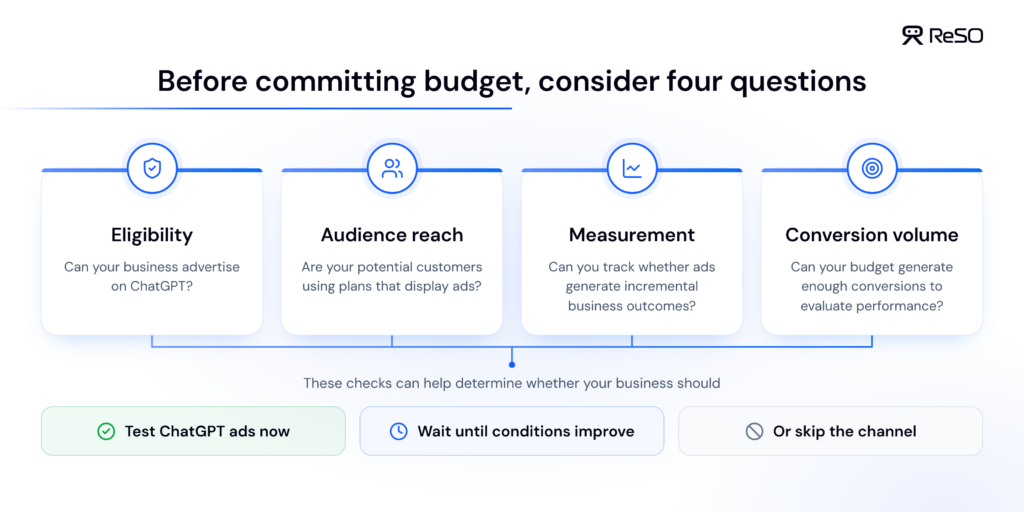
- Eligibility: Can your business advertise on ChatGPT?
- Audience reach: Are your potential customers using plans that display ads?
- Measurement: Can you track whether ads generate incremental business outcomes?
- Conversion volume: Can your budget generate enough conversions to evaluate performance?
These checks can help determine whether your business should test ChatGPT ads now, wait until conditions improve, or skip the channel.
Can your business buy ChatGPT ads yet?
Businesses in supported markets and categories can, but eligibility depends on where the advertiser is billed, what it sells and who it needs to reach. Check these before anyone briefs creative.
Where you are billed: OpenAI’s availability page, as retrieved on 26 October 2026, lists self-service markets across the Americas, Europe, Asia-Pacific and the Middle East and North Africa. The advertising and billed legal entity must be based in an eligible country. The 21 October announcement also named markets, including Argentina, Nigeria, South Africa and Pakistan, that did not yet appear in the self-service table, so confirm access at account level rather than reading the announcement as a guarantee. Some new self-service accounts also start with home-country-only targeting.
What you sell: OpenAI’s ad policy, updated 10 September 2026, separates allowed, restricted and prohibited categories.
| Category | Position under the September 2026 policy |
|---|---|
| Consumer goods, local services, travel, entertainment, digital products, education | Initial emphasis under the policy |
| Financial services | Restricted; case-by-case approval in the US, generally prohibited elsewhere |
| Medical and health services | Case-by-case approval for specified US advertisers; generally prohibited elsewhere |
| Legal services | Allowed in the US where licensed in the jurisdiction of delivery; prohibited outside the US |
| Housing and jobs | Platform-level advertising possible; individual listings prohibited |
| Political advocacy, gambling, alcohol and tobacco promotion, adult and dating, recreational drugs | Prohibited |
Even if OpenAI approves your business to advertise, your ads cannot appear in sensitive conversations. OpenAI evaluates advertiser eligibility, ad content compliance, and placement suitability separately.
Who can see the ads: Ads may appear on the Free and Go plans. Plus, Pro, Business, Enterprise and Edu stay ad-free, Temporary Chats show no ads, and OpenAI does not show ads to accounts it identifies as under 18. If most of your buyers use paid business plans, a large share of them will never see your ad.
What does buying ChatGPT ads involve?
Advertisers can buy ChatGPT ads through several channels:
- Ads Manager: Set up and manage campaigns directly.
- OpenAI’s sales team: Work with OpenAI on advertising campaigns.
- Agency and technology partners: Manage campaigns through supported partners and integrations.
On 16 September 2026, OpenAI also introduced HubSpot campaign management and a ChatGPT Ads app for eligible US Shopify merchants.
The standard unit is a sponsored placement below the answer, separate from the organic response. A multi-image format during image generation is still in testing, and Sponsored Agents, a labeled conversation with a business-sponsored agent, remain a limited alpha for selected US advertisers.
| Buying element | What the documentation says (26 October 2026) |
|---|---|
| Minimum daily budget | USD 25, EUR 15, GBP 15, INR 725, AUD 25, CAD 25, JPY 2,500 |
| Pricing models | CPM for views, CPC for clicks, oCPC or oCPM when optimizing to a conversion event |
| Daily budget behavior | An average across a seven-day week; a single day can reach twice the daily budget |
| Context hints | Descriptions of relevant needs, not exact-match keywords |
| Customer lists | 25,000 matched users needed for inclusion or bid adjustment; 100,000 recommended |
| EEA and Switzerland | Personalized ads not initially available; OpenAI advises avoiding custom audiences there |
Two important details affect how you plan your budget and targeting:
- Conversion optimisation: Optimising for conversions doesn’t mean paying only when someone converts. You still pay for traffic that may not generate a conversion.
- Context hints: These help OpenAI identify relevant conversations, though they don’t give advertisers the same precise keyword control available in traditional search advertising.
Check OpenAI’s campaign documentation for the latest pricing and targeting details.
What should you weigh before committing budget?
Before investing in ChatGPT ads, prioritise measurement readiness and conversion volume. Without reliable tracking or enough conversions, you won’t have the evidence needed to evaluate campaign performance.
Eligibility comes first. If your business doesn’t meet OpenAI’s advertising requirements, the remaining criteria won’t matter.
| Criterion | Weight | What a strong position looks like |
|---|---|---|
| Measurement readiness | 30% | Conversion events validated, the oppref click identifier preserved through redirects, outcomes tied to orders or CRM |
| Conversion volume within budget | 25% | Enough purchases or qualified leads at a realistic CPC to read a result inside the test window |
| Offer-to-situation fit | 20% | A clear planning, comparison or buying moment where your offer answers the question being asked |
| Reach of the right users | 15% | Buyers likely to be on Free or Go plans, in supported geographies |
| Tolerance for loose targeting | 10% | No dependence on job-title, firmographic or exact-keyword precision |
Score each criterion from 1 to 5, multiply the score by its percentage weight (e.g., 4 × 30% = 1.2), and add the weighted scores to get a final result out of 5. A score above 3.5 suggests testing now, 2.5–3.5 suggests redesigning or deferring the test, and below 2.5 suggests waiting.
Use this checklist to score the first two rows honestly:
The billed entity is based in an eligible country and the account can target your market
Your category is allowed, or written approval is in hand
Pixel or Conversions API events fire and deduplicate with a shared event ID
Revenue or pipeline, not form fills alone, can be traced back to the click
You know how many conversions per week the planned budget should produce
You have a holdout region or another way to estimate incremental lift
What do early ChatGPT ad results look like?
Early results show what delivery costs, not what profitable acquisition looks like across advertisers. Search Engine Journal reported in September 2026 that OpenAI had not published cross-advertiser performance benchmarks, and OpenAI’s suggested $3 to $5 starting maximum CPC is a bid recommendation, not an average.
Early ChatGPT advertising tests have produced different results.
Synter’s June 2026 test across five markets reported:
- Total spend: $4,428.84
- Clicks: 448
- Click-through rate (CTR): 0.35%
- Cost per click (CPC): $9.89
- Cost per thousand impressions (CPM): $34.16
Synter recorded too few conversions to publish a cost per acquisition (CPA). Since Synter sells advertising software, its results should be interpreted in that context.
Dose’s October 2026 case study, published by WorkMagic, reported:
- A geographic holdout test that paused ads in selected US markets while other markets continued.
- 2.3 times as many incremental orders as click attribution showed.
- 67% of incremental orders coming from new customers.
These are results from individual advertisers, not industry benchmarks. The public Dose case study also omits figures needed to independently reproduce its incremental-lift estimate.
LocaliQ and WordStream’s 2026 dataset of 13,474 US Google and Microsoft search campaigns reported a 6.64% CTR and a $5.42 CPC, useful only as background for a mature channel. The cleaner comparison is the marginal return on your own non-brand search or prospecting spend.
Which advertisers should test now, wait or skip?
Businesses selling considered-purchase ecommerce products or self-serve software are among the stronger candidates for early ChatGPT ad tests. Narrow enterprise campaigns and regulated services outside the US may be better off waiting or skipping the channel.
These recommendations reflect current eligibility and targeting requirements, rather than proven advertising performance across industries.
Your existing organic visibility in ChatGPT should also influence your advertising decision.
ReSO’s audits found that:
- The five most-mentioned brands in a category accounted for a median 16.5% of ChatGPT’s organic mentions.
- In roughly one-third of audits, ChatGPT never mentioned the audited brand in its own category-related prompts.
These findings have practical implications for advertisers:
- Already getting mentioned: ChatGPT ads could reinforce your brand’s presence when users are considering a purchase.
- Rarely or never mentioned: Improving organic AI visibility may deserve attention before investing heavily in paid placements.
If ChatGPT regularly recommends competing brands, your ad could appear alongside those recommendations. Understanding your existing AI visibility can help you decide where to invest first.
| Advertiser type | Verdict | What has to be true first |
|---|---|---|
| Considered ecommerce, household goods, travel, experiences | Test now | An offer tied to a planning or comparison moment, and reliable revenue tracking |
| Self-serve software, prosumer tools, education | Test now | Clear use-case positioning and enough activations to judge downstream quality |
| Broad B2B SaaS and business services | Conditional test | Judge results on qualified accounts and pipeline, not form fills |
| Local services | Conditional test | Supported subnational targeting for the campaign type and measurable qualified inquiries |
| Regulated services in the US | Eligibility first | Written approval, licensing, and compliant creative and landing pages |
| Narrow enterprise account-based programs | Wait | Customer lists below 25,000 matched users cannot be used for inclusion targeting |
| Regulated services outside the US | Generally skip under current policy | Financial, health and legal service rules can block the campaign entirely |
| Prohibited categories | Skip | No route under the current policy |
The enterprise row catches B2B teams that are otherwise ready: a program aimed at a few hundred named accounts cannot use customer-list inclusion below 25,000 matched users, so channels that reach named buyers directly serve it better.
Will buying ads make ChatGPT recommend you?
No. OpenAI states that advertisers cannot shape, rank or alter ChatGPT’s organic responses, and its October 2026 engineering explanation describes separate services, models and code for answers and for ad selection. That is OpenAI’s own account rather than an independent audit, but it rules out treating ad spend as a way to buy organic mentions.
Observational data points the same way. Seer Interactive’s tracking, updated in July 2026, found the advertiser named in the organic answer 5.4% of the time and cited as a source 3.3% of the time. It also observed competitors advertising beneath branded prompts, which means a rival’s ad can appear directly under an answer about you.
ChatGPT ads and organic AI visibility serve different purposes:
- Paid advertising: Helps your brand appear in sponsored placements alongside relevant ChatGPT responses.
- Organic AI visibility: Depends on whether ChatGPT identifies, mentions, or recommends your brand within its answers, based on the information and sources available to it.
A ReSO Visibility Audit helps you understand whether ChatGPT already mentions your brand organically, giving you a clearer starting point before investing in ads.
What do buyers get wrong in a first ChatGPT test?
Three planning errors undermine first tests more than anything about the channel itself.
- Treating the minimum budget as a test budget: USD 25 a day can check that delivery and tracking work, but it is a platform floor, not a test budget. Size the budget from the number of business outcomes you need and the time they take to convert.
- Reading attributed conversions as incremental: Reports can include modeled conversions and one-day view-through, using last-touch credit across 7-, 14- or 30-day click windows. Keep a click-only view beside any view-through view, and use a holdout where you can. The Dose case suggests attribution can also understate effect, so neither direction is safe to assume.
- Planning around keyword control: Context hints are guidance, and advertisers receive aggregate performance data rather than the chats that triggered an ad. September 2026 reporting also found no auction-insights or impression-share reports, so plan without the diagnostics search teams rely on.
How should you set up a first ChatGPT ad test?
Treat the test as a bounded experiment with a stop rule decided in advance.
- Confirm eligibility, account access and category approval before producing any creative.
- Write a one-sentence hypothesis naming the buying situation and the offer that should create new demand.
- Install and validate conversion tracking, keep UTMs, and connect outcomes to orders or CRM records, the same discipline used for AI traffic in GA4.
- Set the attribution windows you will report on before launch, and wait for conversion cohorts to mature.
- Hold out a region or audience where feasible, then compare the result against your next-best use of the same budget.
Before investing in ChatGPT ads, understand how visible your brand already is in AI-generated answers. ReSO’s AI Visibility Audit identifies where ChatGPT mentions, cites, and recommends your brand, along with gaps where competitors are gaining visibility. Request your AI Visibility Audit to identify opportunities to strengthen your organic AI presence before committing to paid advertising.
Frequently Asked Questions
Are ChatGPT ads worth testing for a small business?
ChatGPT ads can suit a small business with an eligible offer, working conversion tracking and enough daily volume to read results. The USD 25 minimum makes entry cheap, but a test that produces only a handful of conversions cannot separate a good result from luck. Small local services should confirm that subnational targeting is available for their campaign type before launch.
Can I target ChatGPT ads by job title or company?
The targeting controls OpenAI documents are country and some subnational geography, platform, context hints and customer lists. B2B teams wanting company-level reach can upload customer lists, which need at least 25,000 matched users for inclusion targeting and bid adjustments. Smaller lists work only as exclusions, which limits account-based programs.
Do ChatGPT ads run in Europe?
Yes. ChatGPT ads launched in 31 European markets in August 2026, with self-service access confirmed on 31 August. Personalized ads are not initially available in the EEA or Switzerland, so campaigns rely on contextual targeting rather than custom audiences.
What happens to my ads if users upgrade to a paid plan?
Users who upgrade to Plus, Pro, Business, Enterprise or Edu stop seeing ads. Eligible users can also choose an ad-free Free option with reduced functionality. Advertisers should focus on conversions and qualified leads from reachable Free and Go users rather than impressions alone.