
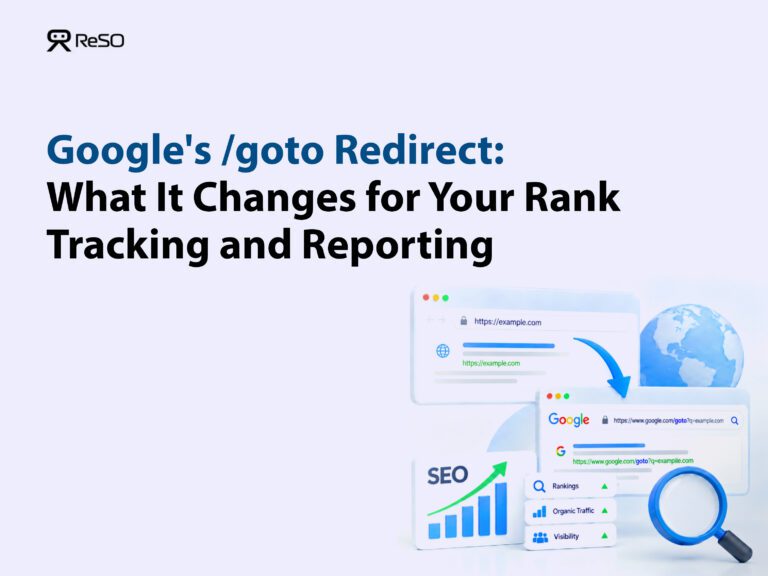
Since late August 2026, Google has been routing search-result clicks through its own /goto redirect before sending users to the destination site. Users still land on the correct page; for rank trackers, SERP APIs, and AI-visibility platforms, however, the change can affect how reliably a result is attributed to the right URL or domain.
This does not mean Google rankings themselves have changed. The redirect is applied after results are ranked. The disruption is primarily in how third-party tools read and report those results. As a result, unexpected ranking, visibility, or citation shifts during the rollout period should be validated against first-party data such as Google Search Console before being treated as real performance changes.
Why Did Google Wrap Search Result Links in a Redirect?
Before the change, an organic listing exposed the destination address directly in the HTML. That made the process straightforward for tracking tools:
- Before: Rank trackers, share-of-voice dashboards, and in-house scripts could pull the destination URL directly from the results page without contacting the destination site.
- After: The link points to google.com/goto?url= followed by an encoded token. Google’s server then responds with a 302 temporary redirect to the actual page.
- What changed for tools: The destination can no longer be read directly from the results-page HTML. Tools now have to resolve Google’s redirect to identify the actual URL.
The redirect happens on Google’s side rather than in the browser, which is what creates the additional work for tools that previously relied on reading the destination directly.
Google’s confirmation came after practitioners had already documented the change. The pattern had been observed since 23 June 2026, and Brodie Clark’s SERP Alert newsletter recorded it across organic and paid listings by 2 July. Google did not comment publicly until 26 August, when a spokesperson told two trade outlets: “We have a long history of deploying technical measures against evolving forms of abuse, and we regularly take steps to protect our services and users.”
Google’s statement refers to abuse generally; it does not identify scrapers, AI companies, or rank trackers as the specific target. Google has also published no detailed technical documentation about the mechanism. The view that the change is intended to make scraping harder is therefore an industry interpretation supported by how the redirect behaves, rather than something Google has stated.
What Does the Redirect Actually Break, and What Doesn’t It Touch?
Rankings are decided before Google writes the result link, so the /goto redirect does not change crawling, indexing, or ranking order. Googlebot does not encounter google.com/goto on a publisher’s own pages; the wrapper appears only in links Google renders outward, at the final stage. The 302 temporary redirect reinforces that distinction: the wrapper is not intended to replace the destination URL in Google’s index.
A few things therefore remain unaffected:
- Rankings: The redirect is added after results have already been ordered.
- Search Console: Clicks are counted inside Google’s own systems when a result is clicked, rather than by parsing the rendered destination link. Search Engine Land has therefore said that “you have to assume that Google Search Console data is not impacted by this change,” although that remains a reporter’s inference rather than a direct Google confirmation.
- On-site SEO: Canonical tags, robots rules, sitemaps, and internal links sit outside the redirect entirely, so there is nothing to fix on the publisher’s site.
What does break is anything that used to read the destination URL directly from the results page. An independent analysis of 380 /goto links found that the token could not be decoded locally and appeared consistent with Google’s Tink encryption library, although that was not confirmed. In practice, this means a tool has to follow the redirect with a live request to find the actual destination. That creates much more work for tracking tools. Nozzle’s founder estimated that resolving every link across a five-page ranking could require 500 to 1,000 requests.
The impact also varies by search surface. DataForSEO’s measurement, taken on 27 August after some fixes were already in place, showed that some SERP elements took longer to resolve than others:
| SERP element | Share of SERPs with an unresolved goto link |
|---|---|
| AI Overview | 52.26% |
| Local pack | 25.1% |
| Featured snippet | 0.39% |
| Organic | 0.01% |
DataForSEO clarified that these figures showed its own ability to resolve the links, not how often Google was using the /goto redirect overall. Its AI Overview gap was resolved the next day once the same fix was extended there. Even so, the broader pattern was clear: AI Overview citations and local results took longer to resolve than standard organic listings, so reports that rely heavily on those surfaces may have been more affected.
How Do You Check Whether Your Own Reports Are Affected?
You’ll need a recent keyword-rank export from your tracker and Search Console access for the same account and date range; nothing else is required to run through this.
- Check the URL column for google.com/goto or a ?url= token
If either appears, the tool may have stored Google’s redirect instead of the actual destination URL, so that row may be unreliable.
- Compare the URL and domain fields
If the URL shows google.com/goto but the domain still shows the expected website, the tool identified the domain without fully resolving the redirect.
- Compare the tracker with Search Console for the same period
If the third-party tool shows a change but Search Console does not, the issue may be with the tracking tool rather than your actual rankings.
- Check whether your vendor published an update about the /goto change
The timing matters because some providers adapted earlier than others, which affected how much disruption appeared in their reports.
- Be more cautious with AI Overview and Local Pack data
Based on DataForSEO’s breakdown, these surfaces took longer to resolve than standard organic results.
AI visibility reporting depends on the same process. If a platform is reporting which sources were cited inside an AI Overview, it first needs to resolve the link before it can attribute that citation to the correct domain. ReSO’s Visibility Audit includes this resolution step for that reason: visibility across the journey is only meaningful when the cited sources are correctly identified, rather than left as unresolved redirect links.
How Do You Confirm a Number Is Real?
A report is trustworthy when three things are true:
- No google.com/goto links remain in the export.
- The tracker’s figures broadly match Search Console for the same period, rather than showing a gap that appeared only after late August.
- The vendor has published a dated statement covering the period you’re reviewing, rather than a general note about industry changes.
Moz’s guidance explains what the problem can look like when a tool has not fully adapted. A google.com/goto link can temporarily distort ranking and Search Visibility data because the ranking site may be identified as Google.com. In some cases, the Ranking URL field may also show only the root domain.
The key point is that this is a measurement issue, not evidence that the page actually lost its ranking.
How Do You Keep This From Distorting Future Reports?
None of this requires a permanent fix because nothing on your site has broken. The better approach is to build a few checks into reporting so the rollout does not get mistaken for a real trend.
- Baseline your GA4 organic-versus-direct ratio and the ratio of Search Console clicks to GA4 organic sessions. Google has not published a specific referrer policy for the /goto redirect. One dated vendor test across ten device and browser combinations found that the referrer remained intact and GA4 still classified the sessions as Organic Search. So far, there is no clear evidence that the redirect is pushing traffic into (direct) / (none), but it is worth monitoring.
- Request a change log from your tracking vendor: A one-time confirmation is not enough. Changes in retrieval depth, extraction logic, service tiers, or other methodology can affect reported numbers even when the SERP itself has not changed.
- Treat comparisons from roughly June through early September 2026 with extra caution. Providers adapted at different times and used different infrastructure, so some volatility during the rollout may reflect changes in tool visibility rather than real movement in search results.
- Treat this as a higher measurement cost, not just a temporary disruption. Google’s removal of the num=100 parameter in September 2025 already increased the number of pages providers needed to fetch. The /goto change adds another layer by increasing the number of requests needed to identify where links actually lead. Tracking systems that already validate results against first-party data, as ReSO’s audit pipeline does, are better placed to handle changes like this.
A reporting change should not be mistaken for a real loss in search or AI visibility. ReSO helps brands track where they appear across LLMs, identify the sources being cited, compare visibility against competitors, and find the gaps that matter across the buyer journey.
Book a call to see where your brand is actually visible and where it needs to improve.
Frequently Asked Questions
Does the /goto redirect affect my actual Google rankings?
No, the redirect is added after Google has already ranked the results, so it does not change crawling, indexing, or ranking order. The main impact is on third-party tools that need to identify the destination URL behind a search result.
Do I need to make any changes to my website because of the /goto redirect?
No site-level fix is required. Canonical tags, robots rules, sitemaps, and internal links are not affected because the redirect exists on Google’s search results page, not on your website.
How can I tell whether a ranking drop is real or a tracking issue?
Compare your rank tracker with Google Search Console for the same period. If the tracker shows a sharp change while Search Console remains stable, check whether the tool stored google.com/goto links or whether the vendor reported issues during the rollout.
Can the /goto redirect affect AI visibility reporting?
Yes, AI visibility platforms also need to resolve links correctly when identifying which domains are cited in AI Overviews or other search surfaces. If the redirect is not resolved, citations can be attributed incorrectly or missed.