When someone asks ChatGPT or Google AI for the best business “near me,” a smaller nearby business with a clearer category match and stronger branch-level evidence can appear ahead of a nationally recognized brand, because local AI search considers more than brand reputation. It looks at the user’s location, nearby businesses, relevant services, and local credibility to decide which ones to recommend.
For businesses targeting specific cities or neighborhoods, improving AI visibility starts with accurate business listings, dedicated location pages, consistent information across platforms, and reliable local signals. Each location also needs to be tested separately to understand how often the business appears in AI-generated recommendations.
What do you need before you start?
Improving hyper-local AI search visibility starts with accurate business information and access to the platforms where your locations appear. Before optimising your website or creating location-specific content, make sure you have:
- Complete location details: A master list of all genuine branches or operating locations, including addresses, phone numbers, business hours, categories and service areas.
- Access to business listings: Owner or manager access to Google Business Profile and other platforms where your business is listed.
- Website editing access: The ability to update individual location pages and their structured data.
- Local search questions: A consistent set of location-specific queries to test across AI search engines and track which businesses they recommend.
Accurate location information is essential for AI search visibility. Even well-optimised content and structured data cannot compensate for an ineligible business profile, incorrect branch details or distance from the customer. Start by verifying your business information before investing in location-specific content and technical optimisation.
How do AI engines decide where the user is?
AI search engines draw on several signals to determine where a user is searching from. A city, neighborhood, or postal code mentioned directly in the question provides the clearest location context. Each AI platform uses these signals differently, as shown below.
| Location signal | How the products use it | What it means for you |
|---|---|---|
| A city, neighborhood or postal code in the question | Google tells users to add a place name for results in a specific location; ChatGPT recommends adding one when local results are wrong | The cleanest way to define a market, and the right control for repeatable tests |
| Precise device location | Used by Google and Gemini when permission is granted; optional and off by default in ChatGPT; opt-in in Perplexity | Matters most for “closest”, “near me” and route-dependent questions |
| IP or network location | ChatGPT may use approximate IP location; Gemini defaults partly to an IP-derived area; Perplexity falls back to network location without a profile location | A city- or region-level fallback that can be wrong or point to an ISP exit |
| Account or profile settings | Gemini can use Google Account home or work addresses; Perplexity offers an optional profile location | Can persist across sessions and skew repeated tests |
| Earlier activity and conversation | Google Search can use previous activity; chat products can keep context from earlier prompts | Makes repeated tests less independent than they look |
Google Search, Maps, and Gemini may estimate a user’s location using device location, saved addresses, previous activity, and IP address. OpenAI says ChatGPT may also share general location information, based on your IP address, with third-party search providers to improve the accuracy of results.
For businesses testing their visibility in AI search, two factors matter:
- Search query wording: “Near me” searches depend on how accurately AI identifies the user’s location, while “in [city]” searches test whether a business appears when the target location is specified.
- Location accuracy: IP addresses provide an approximate location and may not reflect where the customer is physically located. This can affect which businesses appear in local recommendations.
A September 2026 study by CompleteSEO analyzed 44,988 ChatGPT answers across 35 US home-service trades and 24 metropolitan areas. It found that changing the wording of a question materially changed how many businesses ChatGPT recommended. Every prompt in the study named the city, so it tested wording rather than device location.
For accurate local AI visibility tracking, use consistent search queries and location settings across repeated tests.
Which sources does each engine use for local answers?
Each product draws on a different mix, and only some of those sources are documented by the platforms themselves.
| Surface | Local sources | How businesses appear to be chosen |
|---|---|---|
| Google Maps | Business Profile and Maps records, categories, hours, photos, ratings, reviews and wider-web prominence | Relevance, distance and prominence, as Google states |
| Gemini | Public Google Maps information, including addresses, websites, ratings, hours, reviews and AI place summaries | Maps retrieval plus Gemini’s reasoning and summaries |
| Google AI Overviews and AI Mode | The Search index, Maps place data and review summaries where the local experience calls on them | Search retrieval plus generative selection |
| ChatGPT Search | Third-party search providers, web pages, local listing providers, Yelp content, and OpenTable, Resy or Yelp for restaurant availability | A structured place route for map cards and a web route for prose |
| Perplexity | Live web retrieval, with business websites, directories and articles observed in industry studies; Tripadvisor hotel data under a January 2025 partnership | Retrieved-source relevance and intent matching |
AI search engines use customer reviews and business listings to understand and recommend local businesses. Recent updates to ChatGPT and Google have made this information more relevant to local AI visibility.
- ChatGPT and Yelp: In July 2026, Yelp and OpenAI introduced a content integration that allows ChatGPT to display Yelp reviews, ratings, photos, and business details. In August 2026, the integration expanded to include reservations and waitlists for participating restaurants in the US and Canada. Businesses should keep their Yelp profiles accurate and updated to support their visibility in ChatGPT’s local recommendations.
- Google and Gemini: Google’s AI-generated review summaries use customer reviews to describe businesses. According to Google’s Places documentation, these summaries are based solely on user reviews, are not available for every business, and must be shown with the attribution “Summarized with Gemini wherever apps display them.” Customer feedback can therefore influence how Google AI describes a business and its individual locations.
For local businesses, accurate listings and genuine customer reviews help AI engines identify their services, understand their local relevance, and present reliable information to potential customers.
How is hyper-local visibility different from national visibility?
National visibility asks whether an engine trusts your brand on a topic. Hyper-local visibility adds an earlier question: is this branch eligible for this user, this place and this constraint?
| Dimension | National answer | Hyper-local answer |
|---|---|---|
| Geography | Often secondary or absent | Decides the candidate pool |
| Entity | Brand or domain | Individual branch, practitioner or service-area business |
| Authority | Links, citations and broad reputation | Local prominence, reviews, directories, news and community evidence |
| Proximity | Usually weak | Often decisive, especially in Maps and “near me” questions |
| Freshness | Content freshness | Also hours, closures, moved addresses and availability |
| Typical failure | Brand omitted | Wrong branch, stale phone number, closed location or a distant provider |
AI-generated local answers work differently from Google’s traditional map pack. The map pack displays a ranked list of nearby businesses, while AI search engines can use additional information, including customer reviews, website content, business availability, and the wording of a search query, to decide which businesses to recommend.
Google said in October 2024 that its AI-generated local results in Maps would appear above or below the standard place listings rather than replace them. This means:
- Maps visibility matters: Appearing in Google Maps can improve a business’s chances of being considered for AI-generated local answers, although it does not guarantee a recommendation.
- Other sources may influence recommendations: Businesses that do not appear among the top Maps results may still be recommended through relevant website content, authoritative articles, or directory listings.
- Search intent affects selection: AI may recommend different businesses based on the user’s specific needs, such as service availability, location, or customer reviews.
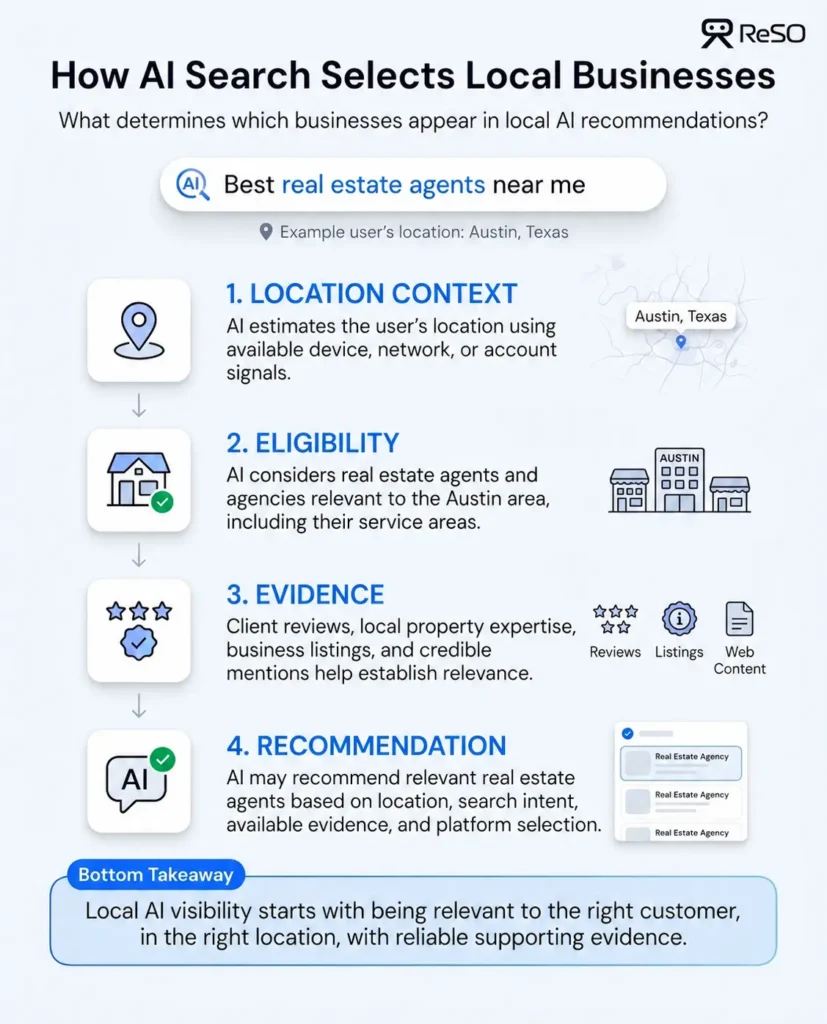
Local AI visibility depends on both Google Maps presence and the relevance of business information across other online sources.
How do you win local AI answers, step by step?
Work through these seven steps in order. The order reflects priority, so fix the earlier steps before investing in the later ones.
1. Make every location eligible and identifiable
Give each staffed branch its own Business Profile and its own page, and keep one canonical record per branch. Service-area businesses follow different rules. For a business without a customer-facing storefront, Google:
- Requires the address to be hidden, so the profile shows only the service area
- Allows up to 20 service areas
- Recommends keeping the overall boundary within about two hours’ driving time
- Asks for only one profile for the metropolitan area the business serves
Caution: Do not create neighborhood profiles for a single mobile business because separate landing pages exist. Google also states that age-restricted categories such as alcohol, cannabis and weapons cannot list as service-area businesses without a storefront.
2. Resolve cross-platform discrepancies
Check that your business information is accurate and consistent across Google Business Profile, your website, and other local listing platforms. Focus on the following details:
- Business name and address: Verify business names, street addresses, suite numbers, and local-language variations.
- Contact details and hours: Check phone numbers, call routing, operating hours, and business categories.
- Website links: Ensure each listing points to the correct location page and uses the appropriate canonical URL.
- Duplicate or outdated listings: Identify duplicate profiles, closed or relocated branches, and reviews linked to the wrong location.
Not every difference requires correction. Some platforms format addresses differently, and service-area businesses may legitimately keep their verification addresses private.
The goal is to ensure AI search engines can identify the same business and its locations across different sources. Conflicting information can lead to entity drift, where AI systems incorrectly identify or describe a business.
3. Publish a useful page for every genuine location
Each branch needs an indexable URL that states these facts in ordinary HTML:
- Exact branch name
- A visitable address, or a clear statement that you serve customers at their premises
- Local phone number and hours
- The services that branch delivers, and the neighborhoods or postal areas it legitimately serves
- Staff, licenses and facilities specific to the location
- Local proof such as completed work, plus directions or parking where relevant
Link the page from your location finder and from the matching Business Profile.
Multi-location brands should generate pages, structured data and listing feeds from one master dataset, with an internal location ID, coordinates, categories, holiday hours, service areas, regulatory identifiers and platform profile URLs for each branch.
4. Strengthen local prominence
AI search engines need reliable information to understand why a local business is relevant to a user’s specific needs. Build local credibility through sources that verify your services, expertise, and presence in the area.
- Local news coverage: Earn mentions in regional publications that highlight your business, services, or community involvement.
- Industry associations and directories: Maintain accurate listings with relevant trade associations, chambers of commerce, and industry-specific directories.
- Licensing and registrations: Keep business information updated in applicable licensing registers and official records.
- Local projects and customer reviews: Showcase completed projects in the area and encourage genuine customer reviews that describe the services received and where they were provided.
Avoid paid “best business” listings and self-created directory networks. These can introduce inconsistent information and provide little credible evidence of your business’s local relevance.
5. Cover the sources each engine uses
Start with Google Maps and Business Profile for Google surfaces, add Yelp now that it feeds ChatGPT directly, add Tripadvisor where travel results matter on Perplexity, and keep authoritative regional and sector directories accurate everywhere else.
6. Add location-specific structured data
Add location-specific structured data to help AI search engines identify each business branch, its services, and the areas it serves. Google recommends using LocalBusiness schema with the most specific LocalBusiness subtype available for each physical location.
Include the following details for every branch:
- Business identity: Use name, url, and a unique @id based on the location page’s canonical URL.
- Location details: Add address using PostalAddress and include geographic coordinates through geo.
- Contact information and hours: Specify telephone and openingHoursSpecification to identify branch contact details and operating hours.
- Business relationships: Connect each branch to its parent organization.
- Service coverage: Use Service and areaServed to define the services offered and the areas covered.
Make sure the structured data matches the information visible on the location page. Validate the markup using Google’s Rich Results Test to identify potential errors.
Accurate schema markup for AI search helps search engines understand business details and distinguish individual branches. However, structured data should only describe verified information already available on the website.
7. Measure each market and surface separately
Track AI search visibility separately for each neighborhood, city, and AI platform to understand where your business appears in local recommendations. Use consistent search queries and testing conditions to compare results accurately, following the approach outlined in the next section.
How do you measure visibility for one neighborhood?
Use a fixed test matrix rather than a single screenshot, because answers change with location mode, session state and repetition.
| Dimension | What to hold constant or record |
|---|---|
| Surface | ChatGPT Search, Perplexity, Gemini, Google AI surfaces and Google Maps, separately |
| Market | Each city, with priority neighborhoods as separate cells |
| Prompt | Exact wording, language and constraints |
| Location mode | Explicit place; “near me” on a local device; IP only; account or profile location where testable |
| Session | New conversation, signed-in state, memory and personalization settings |
| Repetition | Several independent attempts on several days |
Keep prompt families separate: category (“electricians in [district]”), neighborhood (“emergency electrician near [neighborhood]”), service constraint, suitability (“child-friendly dentist in [area] with Saturday appointments”), comparison, proximity (“closest open locksmith to me”) and branded verification (“does [business] serve [neighborhood]?”). Leave your business name out of discovery prompts, since branded prompts test accuracy, not competitive visibility.
Measure how consistently your business appears in local AI search results across different locations and platforms. Track the following metrics:
- Business mentions: How often AI recommends or mentions your business.
- Map appearances: How frequently your business appears in AI-generated map cards.
- Written recommendations: How often AI includes your business in its written answers.
- Citations: How frequently AI cites your website or other sources mentioning your business.
- Branch accuracy: Whether AI recommends the correct business location.
- Source diversity: Which websites, directories, and listings AI uses to find your business.
- Google Maps overlap: Whether businesses appearing in AI answers also appear in Google Maps results.
- Location accuracy: Whether recommendations match the neighborhood or city being searched.
- Result consistency: How often your business appears when the same question is tested multiple times.
Tracking consistency is especially important because AI search engines can provide different answers to identical questions. A single result may not accurately represent your overall local AI visibility.
Use the following methods. The order is our recommended priority, not the result of a published comparison:
- Physical location testing: Have testers physically present in the target neighborhood, with device location permissions documented.
- Location-specific prompts: Include city or neighborhood names directly in search questions to test visibility in a defined area.
- Account location settings: Adjust account or profile location preferences where the AI platform supports them.
- Local IP addresses or residential proxies: Use location-specific network connections to approximate searches from different areas.
- Third-party tracking tools: Use tools that clearly disclose which AI platforms, models, and location simulation methods they use.
A proxy only changes the network location. It cannot fully replicate a customer’s actual device location, saved addresses, previous activity, or app behavior. This can affect the accuracy of local AI visibility tests.
Which mistakes cost local businesses AI visibility?
The costliest mistakes are the ones that make an engine doubt which branch is which.
- Thin or duplicate location pages: Pages for every suburb with only the place name swapped, multiple URLs for one location with conflicting hours, old branch URLs left live after a move, or several branches on one page with only the head office marked up.
- Profile and entity errors: Keyword-stuffed business names, duplicate profiles for departments, a call-center number where a branch number exists, profile links pointing to the homepage instead of the location page, and closed branches that still appear in directories.
- Service-area misuse: Publishing a residential address that customers never visit, using a mailbox as a storefront, creating one profile per suburb for a single mobile operation, or claiming implausibly broad coverage.
- Ignoring regulated-category rules: Healthcare, legal, financial, childcare and home-security businesses should match branch pages and profiles to licensing registers, separate the organization from individual practitioners, state where they are authorized to serve, and avoid unsupported superlatives such as “best” or “most trusted”.
An AI mention is not platform approval or regulatory verification, and it does not establish that a business may legally serve the user’s location. Accurate entity data is what lets an engine name the right branch, which is why a ReSO Technical Audit checks site-level eligibility before any new local content is written. Book a call to identify and address issues affecting your local AI visibility.
Frequently Asked Questions
Do I need a separate Google Business Profile for every city I serve?
No, you need one Google Business Profile per staffed branch, not per city. Businesses without a storefront should generally maintain one profile for their metropolitan service area, list up to 20 service areas, and use website pages to explain their coverage. Creating separate neighborhood profiles for one mobile business violates Google’s guidance.
Does LocalBusiness schema improve my ranking in Maps or AI answers?
LocalBusiness schema helps search engines identify your business locations and supports rich-result eligibility, but it does not guarantee higher rankings. Distance and profile eligibility still influence visibility. Add structured data only after verifying that your business profiles and location pages contain accurate information.
Can a business far from the customer still appear in a local AI answer?
It can, though the evidence is still limited. AI search engines may recommend businesses beyond the top Google Maps results using authoritative articles, directories, or relevant location pages. Distance remains important for “near me” searches, while specialized services or availability may influence other recommendations.
Why do local AI results change between tests?
AI results can vary based on device location, account settings, conversation history, and search wording. Even identical queries may produce different recommendations. Test consistently across multiple days and track how frequently your business appears rather than relying on a single result.
Should a single-location business bother with hyper-local AI visibility?
Yes, a nearby business with accurate information, relevant services, and strong local credibility can appear ahead of larger national brands. Focus on maintaining an accurate Google Business Profile, a dedicated location page, consistent directory listings, and genuine customer reviews.