Third-party reviews influence AI visibility most when buyers compare brands or products. In our AI Search Audits, review platforms appeared among the citations for 38.6% of comparison prompts, compared with just 3.9% of informational prompts. AI engines access reviews in three ways: by retrieving review and listing pages, using review text to generate summaries, and accessing content through platform integrations, such as Yelp’s integration with ChatGPT.
Still, a strong review profile doesn’t guarantee an AI recommendation. Repeated tests found that even established brands were left out, with recommendation lists changing between attempts. For marketing teams, the priority is to identify which review platforms AI engines cite for their target prompts, what those reviews say, and where review efforts can actually improve visibility.
Key takeaways
- Review platforms appeared in 38.6% of comparison prompts but only 3.9% of informational prompts in our AISO audits.
- Which platforms AI engines cite: G2, Yelp, Google Maps, and niche directories have different levels of visibility across AI engines.
- How reviews reach AI answers: AI engines retrieve review pages, summarise customer feedback, and access reviews through platform integrations.
- High ratings and review volume don’t guarantee AI recommendations, which can vary across engines and searches.
- Where to invest: Focus on review platforms that AI engines consistently cite for your target queries rather than collecting more reviews everywhere.
How often do AI engines cite review platforms?
Review platforms appear in AI answers, but their visibility varies by engine, industry, and search intent.
A Minuttia and Convex study analysed 24,067 brand, alternatives, category, and comparison prompts across Google AI Overviews, ChatGPT, Gemini, Claude, and Perplexity.
Among Google AI Overviews that displayed citations, the most frequently cited platforms included:
- G2: 39.2%
- Reddit: 38.4%
- YouTube: 35.5%
These figures represent citation-bearing AI Overviews, not all prompts or individual citations. The study used US English desktop prompts, each tested once.
A separate analysis of 30 million US citations ranked G2 sixth and Yelp seventh among all cited domains.
Which AI engines cite review platforms most?
The 30-million-citation analysis showed different citation patterns across engines.
| AI engine | Review platform visibility |
| Google AI Overviews | G2 appeared in 39.2% of citation-bearing answers in the separate Minuttia study. |
| Google AI Mode | Yelp was among the five most-cited domains. |
| Perplexity | G2 was among the five most-cited domains. |
| ChatGPT | Neither G2 nor Yelp ranked among the top five. |
| Gemini | No dedicated review platform ranked among the top five. |
Local searches show a different pattern: SOCi’s 2026 benchmark of 2,751 multi-location brands across ChatGPT, Gemini, and Perplexity found:
| Citation source | Share |
| Google Maps | 32.5% |
| Niche directories | 26.3% |
| Brand websites | 23.1% |
| Yelp | 10.5% |
| 7.6% |
For local businesses, Google Maps and industry-specific directories are the first sources worth checking.
Review platforms don’t dominate every recommendation query either. Conductor’s analysis from September 2025 to March 2026 found YouTube was the most-cited domain for recommendation queries in all seven months.
What do ReSO’s AISO audits show?
Our audits found that review platforms appeared in category-prompt citations at different rates across engines:
| AI engine | Answers citing review platforms |
| Perplexity | 16.7% |
| ChatGPT | 10.0% |
| Google AI Overviews | 6.2% |
The 6.2% Google AI Overviews figure covers all category prompts and any review platform. It isn’t directly comparable to Minuttia’s 39.2% G2 figure, which covers only citation-bearing answers from software-heavy prompts.
For brands, the priority is to identify which review platforms AI engines actually cite for their target queries before investing further in review programmes.
How do reviews reach an AI answer?
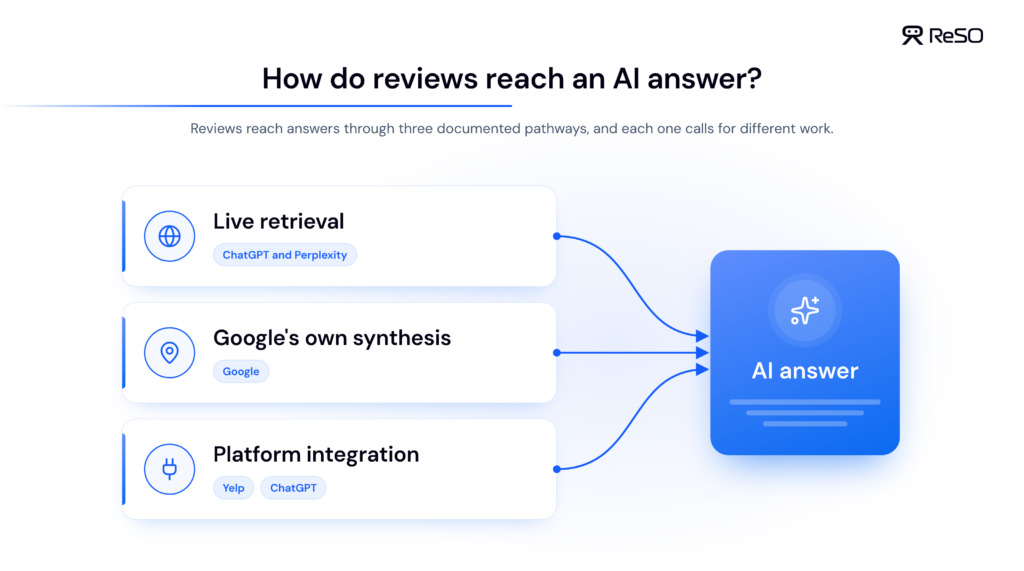
Live retrieval
ChatGPT and Perplexity retrieve current web pages, including review profiles and category pages, and cite some of them. Google’s AI Overviews cite such pages too, as the G2 figures above show. The profile page an engine retrieves is what counts, so keep categories accurate, reviews current, and product names clear.
Google’s own synthesis
Google analyses recent place reviews to summarise common sentiment and tips in local listings. Review text can shape how Google describes a location even when no review page is cited.
Platform integration
Yelp reviews, ratings, photos, and business details began appearing directly in ChatGPT through a July to August 2026 integration with OpenAI. For local businesses, Yelp reviews now feed ChatGPT through a documented partnership, so their quality matters there directly.
Google’s documentation states that its AI summaries use reviews from the past year, are updated regularly, and may be withheld where reviews are limited or themes are inconsistent. A business with few recent reviews, or reviews that contradict each other, may get no summary at all.
Which review signals matter, and how much?
Review text has the strongest documented link to how a brand is described. Ratings, volume and recency change the review platform’s own scores and rankings, which can alter the page an engine retrieves.
| Signal | What the platforms document | What it means for AI answers |
|---|---|---|
| Review text and themes | Google summarises sentiment and tips from the past year; Capterra extracts themes on features, pricing and support | The strongest route to influencing description: detailed text supplies the reasons and caveats an answer repeats |
| Recency | G2 applies daily decay, with stronger weight during the first 18 months and about 3% residual weight after roughly three years | An indirect route to selection through G2’s own rankings, and a direct one for Google’s local summaries |
| Volume | G2 treats volume as highly important for statistical significance; Capterra normalises ratings for volume and recency | Volume can affect platform prominence, which can change what gets retrieved |
| Star rating | Ratings feed G2, Capterra, and Trustpilot scores; Trustpilot adds a Bayesian adjustment equal to seven 3.5-star reviews | Associated with visibility, not proven to cause it |
| Review quality | G2 weights review quality and unique word count, and gives verified, non-incentivised reviews more weight | Detailed reviews strengthen both the source page and the description |
G2’s scoring methodology explains why a burst of reviews three years ago does little today: older reviews retain only a small fraction of their weight. A steady flow of detailed, recent reviews is worth more than a one-off campaign aimed at a star threshold.
Owner responses are worth funding for customer care, factual correction and conversion. Treat any AI-visibility lift from them as something to test rather than assume.
Do reviews work differently for B2B software and local businesses?
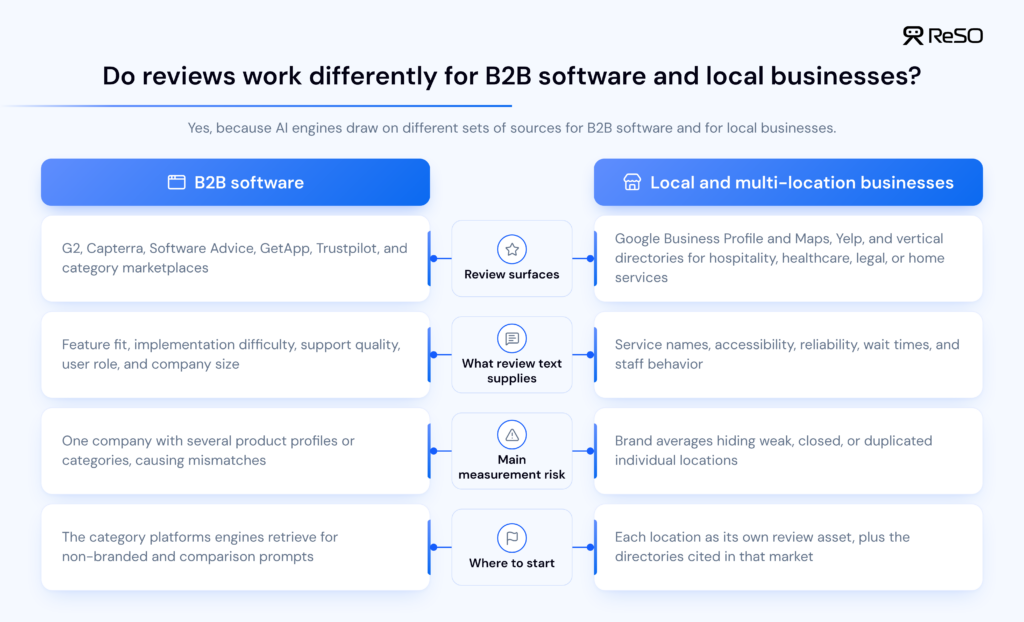
Ownership of the major software review sites has also consolidated. Gartner completed the sale of its Digital Markets business, which G2 identifies as Capterra, Software Advice, and GetApp, on 5 February 2026 for approximately $110 million before customary adjustments, and G2 now calls the group G2 Digital Markets. The four sites keep separate domains, so their citation rates do not immediately become interchangeable.
For local businesses, more review content now reaches buyers inside the AI answer itself. Google writes its own summary from Maps reviews, and Yelp’s content now appears inside ChatGPT, so a customer can read the engine’s summary without opening the review site. It is one way AI is replacing review sites as a reading surface.
Why do strong reviews sometimes fail to win mentions?
Strong reviews can improve AI visibility, but they don’t guarantee a mention. AI engines consider more than review ratings, and their recommendations can change across searches and between engines.
Research points to three reasons:
1. AI engines don’t always recommend established brands
A 2026 study tested category-based recommendation prompts 40 times across six AI models and five product categories, generating 1,200 recommendation lists.
The results showed that:
- Established brands were frequently left out of recommendations.
- Search interest and online brand discussions were more closely associated with AI prominence than conventional popularity measures.
- Recommendation lists varied across repeated attempts.
2. Being cited doesn’t mean influencing the answer
A separate study analysing 602 prompts and 21,143 search-layer citations found that citing more sources didn’t necessarily mean AI engines used more information from each page.
A review platform may appear in an AI answer’s citations without its content influencing the final recommendation.
3. AI engines can misinterpret customer reviews
A study of 28,900 reviews found that GPT-4’s inferred ratings were strongly correlated with actual customer ratings, yet it still misclassified 37% of reviews.
This shows why review sentiment alone may not accurately reflect how AI engines interpret customer feedback.
For marketing teams, the priority is to identify which sources influence AI recommendations. If engines consistently rely on editorial content or community sources rather than review platforms, investing in those sources may be more effective than collecting additional reviews.
What can get a review profile removed or penalised?
Manipulated review activity can cost you the very source an engine would otherwise retrieve. Google, Trustpilot, and Yelp all enforce at scale.
- Google removed fake or misleading reviews equal to 15.4% of reviews contributed in 2025 and restricted 782,000 accounts. It prohibits reviews posted for payment, discounts, or free goods, and treats unusual review volumes as possible rating manipulation.
- Trustpilot removed 4.5 million fake reviews in 2024, 7.4% of submissions, with 90% detected automatically.
- Yelp received about 22 million reviews in 2025 and recommended 70% of them. It prohibits reviews drafted or revised with third-party AI tools and filtered nearly half a million suspected AI-generated reviews in 2025.
Consumer protection laws also regulate how businesses collect and manage reviews. In the US, the FTC’s Consumer Review Rule, fully effective since 21 October 2024, prohibits creating, buying, or selling materially false reviews when its knowledge requirements are met. It also prohibits payments or incentives tied to positive or negative reviews.
In the EU, the Unfair Commercial Practices Directive prohibits fake reviews and requires businesses displaying customer reviews to explain whether and how they verify their authenticity. Google and Yelp may have stricter rules, meaning an incentive permitted under consumer protection law could still violate a platform’s policies.
How should you fund review work for AI visibility?
Fund review work where the engines already retrieve review sources for your high-value prompts, and measure before you spend.
| What you observe | Where to put budget |
|---|---|
| A review platform appears repeatedly in citations for non-branded prompts | Profile accuracy, authentic review collection, recent coverage, and fixing duplicated products or categories |
| Google’s place summary affects how your locations are described | Steady, policy-compliant collection of specific first-hand feedback, monitored per location |
| A platform ranks you well but the engines rarely retrieve it | Baseline coverage only |
| Engines cite editorial, community or directory sources instead | Factual consistency and earned coverage on those source types |
| Results rest on a single answer to a prompt | Measurement first: repeated attempts with fixed prompts, dates, locations and source capture |
Measurement decides where the rest of the budget goes:
- Set up separate prompt sets for category recommendations, alternatives, direct comparisons, brand checks, and near-me questions.
- Repeat each prompt in independent sessions, keeping prompts, dates, and locations fixed.
- Classify every cited source as a review marketplace, listing, directory, editorial, community, or brand-owned page.
An AI Search Audit from ReSO records which cited sources each engine uses for your category prompts. That shows whether review platforms are part of your answer set at all before you scale a review programme.
ReSO helps you see where your brand is being mentioned, cited, or missed across LLMs, and which review and third-party sources shape those answers. Book a call or get your free AI Search Audit to see where your visibility gaps are.
Frequently Asked Questions
Do more reviews always improve AI visibility?
No, volume and recency raise a brand’s standing on platforms such as G2 and Capterra, which can change the page an engine retrieves, but recommendations also depend on category fit, editorial coverage, and how often a brand is discussed elsewhere.
Does a 4.5-star rating guarantee AI recommendations?
No, engines treat a rating as one piece of evidence and may repeat it, ignore it, or prefer a better-matched candidate with a lower score. Review text that explains why customers chose a business does more to shape how an engine describes it.
Can a business offer customers an incentive to leave a review?
Only with care, because it is risky even where the law allows it. The FTC bars compensation conditioned on sentiment, Google prohibits reviews posted for payment, discounts, or free goods, and Yelp says businesses should not ask customers for Yelp reviews at all.
How long do old reviews keep counting?
They count for less over time. G2 weights reviews most heavily for about 18 months, with roughly 3% residual weight after about three years, and Google’s AI place summaries use reviews from the past year.
Which review platforms do AI engines cite most?
It depends on the engine and the query. G2 appears often in Google AI Overviews for software prompts, while Google Maps and niche directories lead citations for local queries.