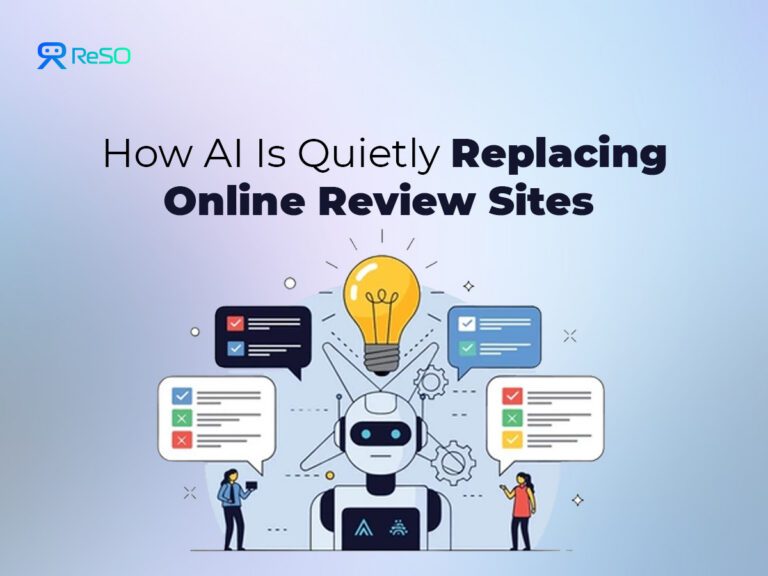


Ask Google “what’s the best toaster?” and you get a list of review sites offering comparisons, rankings, and affiliate-linked recommendations. Ask ChatGPT the same question, and you just get an answer. Users often move directly from an AI recommendation to a brand site or marketplace, reducing the need for multi-site comparison that review platforms depend on.
This is happening now, at scale, with devastating consequences for traditional online review sites and profound implications for how brands capture consumer attention. The data reveals exactly how dramatic this shift has become and what marketers must do to adapt.
Key Findings:
- AI is compressing the buying journey. Instead of visiting multiple review sites and comparison pages, users move directly from a question to a small set of recommendations, reducing the role traditional review platforms once played.
- Discovery is shifting from traffic to selection. When AI surfaces only one to three options, visibility inside those answers matters more than being one of many ranked links.
- The impact on review sites reflects a structural change, not a temporary traffic drop. As AI answers questions before users click, the comparison-driven affiliate model faces long-term pressure.
- AI recommendations are driven by understanding, not rankings. Brands that provide clear product information, structured specifications, FAQs, and consistent signals across the web are more likely to be cited.
- Traffic volume matters less than decision influence. Even with fewer visits, AI-driven discovery brings higher-intent users who arrive closer to purchase.
The Traffic Crisis Hitting Review Sites
NerdWallet’s credit card revenue fell 24% year over year in Q1 2025, which the company attributed to ongoing organic search headwinds. This points to a deeper shift: when AI answers the question directly, the comparison step that once drove high-value clicks begins to disappear.
The pattern extends across major publishers. Following the rollout of Google AI Overviews in mid-2024, Forbes and HuffPost each lost roughly 40% of their traffic, while CNN declined nearly 30%. Business Insider’s organic search traffic dropped 55% between April 2022 and April 2025, forcing a 21% workforce reduction. This isn’t traffic shifting between publishers. Demand is increasingly being answered before the click.
The inference is clear. AI is not just redistributing traffic across publishers. It is compressing the discovery journey itself. When users move from question to recommendation without visiting multiple sources, the click volume that affiliate models depend on simply does not exist.
For review sites built entirely on comparison traffic and affiliate commissions, the risk is structural, not cyclical. The business model assumes browsing behavior that AI is steadily removing.
How AI Provides Insights Into Search Behavior Changes
| Aspect | Traditional Review Sites | AI-Driven Discovery |
| Traffic Model | Search sends users to compare multiple articles | AI aggregates/summarizes; no clicks needed |
| Revenue Impact | Losing affiliate earnings (core business) | 800% Black Friday direct referrals to retailers |
| AI Traffic Share | Conductor: 13,770 domains: AI chatbots currently send just 1% of all website visits vs. traditional Google searchers 50%+ share. | ChatGPT dominates 87.4% of AI referrals: Of that small 1% AI traffic pie, ChatGPT delivers nearly 9/10 visits while Perplexity/Gemini fight for scraps. |
| Category Variation | IT/Tech (2.8%) and Consumer Staples (1.9%) get the highest AI referral traffic because users ask complex research queries needing their expertise. | Communication/Utilities (0.25-0.35%) get lowest as consumers rarely research telco services via AI; they already know their providers or use apps directly. |
| Conversion Reality | Traffic volume shrinking | 1% = AI traffic remains small in volume but disproportionately high in purchase intent and conversion. |
How AI decides which brands to recommend
AI recommendations feel trustworthy because they skip biased affiliate links and give direct answers. But here’s the catch:
Conductor’s 17 million AI answers show AI picks different winners than Google:
- Retail: Amazon and Walmart dominate product queries
- Health/Finance: Mayo Clinic, NerdWallet for YMYL topics
- Tech/B2B: Google, McKinsey for expert queries
- Old search: 10 blue links = comparison shopping
- New AI: 1-3 recommendations = winner-takes-most
Online Review Sites Scramble to Adapt
| Strategy | Execution | Why It Beats AI Summaries |
| Licensing Deals | Sell testing data/comparisons to OpenAI/Google | Revenue from data vs traffic dependency |
| User-Generated Pivot | Reddit-style authentic discussions | AI can’t replicate community credibility |
| Proprietary Tools | Build calculators, scoring systems | Interactive value AI summaries can’t match |
| Hyper-Niche Focus | Bottom-funnel specific queries only | Target bottom-funnel, ultra-specific queries instead of broad terms to lose only 10-20% traffic vs 40-50% collapse suffered by general sites when AI Overviews answer broadly. |
Rewriting AI Marketing Strategy: From Traffic to Education
The old model focused on maximizing distribution and converting traffic referred to a brand’s website. The new model is about education: making sure AI systems understand a brand and can recommend it credibly.
This requires a fundamental shift in mindset: less about luring eyeballs, more about providing structured signals that help AI systems understand and recommend your brand. Marketers can no longer rely solely on SEO. Visibility now depends on how well AI systems understand and reference your brand, not just where your pages rank.
Now two metrics are rising (rankings and conversions) while traffic falls; a pattern explained by AI Overviews answering questions directly without requiring clicks.
Visibility and traffic no longer correlate the way they did for two decades.
What This Means for Brands: The Visibly Even Playing Field
| Aspect | Challenge | Opportunity |
| Visibility | Google ranking ≠ AI citation (Conductor 2026) | Smaller brands win with authentic expertise |
| Traffic Patterns | B2B AI traffic -9.8% seasonal drops | B2C organic +1.7% growth (Siege Media) |
| Competition | Established players lose their authority edge | Expertise > budget levels playing field |
| Trusted Guidance | Shifts from aggregators to AI recommendations | Brands become AI’s data sources |
The Future of Consumer Discovery
Review sites made their money by inserting themselves into consumers’ browsing behavior. But browsing itself is what AI has eliminated. If the future of search is about skipping the middleman and going straight to the answer, then the very function review sites were built to serve is quietly disappearing.
For consumers, this shift makes things easier. No more sifting through affiliate-heavy listicles wondering which recommendations are genuine versus commission-optimized. But it also centralizes trust in AI platforms whose recommendation logic remains opaque.
According to Cloudflare’s Radar Year in Review report tracking AI crawler behavior, Googlebot originated 4.5% of HTML content requests in 2025, a share slightly larger than AI bots in aggregate. Meanwhile, AI “user action” crawling, which tracks website visits in response to user queries in AI chatbots, increased over 15x in 2025.
This explosion in AI-driven web crawling reveals the infrastructure being built for AI-mediated commerce. The platforms aren’t just summarizing existing review content; they’re building comprehensive product knowledge graphs that will eventually make traditional review sites redundant.
Strategic Imperatives for Brands
Optimize for AI Understanding:
Structure your product information, specifications, and differentiators so AI can extract and cite them accurately. This means clear headers, FAQ schema, and machine-readable data.
Build Authentic Authority:
- AI prioritizes authoritative sources over promotional content.
- Invest in genuine expertise, original research, and credible third-party validation rather than SEO-optimized marketing copy.
Diversify Beyond Affiliate Channels:
If review sites drove 30% of your customer acquisition, that channel is rapidly declining. Build direct relationships, invest in brand search, and ensure AI platforms understand your core value proposition.
Monitor AI Citation Patterns:
- Track where and how AI platforms mention your brand.
- Tools analyzing AI citation frequency, sentiment, and competitive share of voice reveal whether you’re gaining or losing ground in the new discovery landscape.
Keep product and brand information consistent across your website, marketplaces, and third-party listings to avoid conflicting signals.
By offering a faster, simpler, and more trusted path from question to purchase, ChatGPT makes the old review site model feel obsolete.
The brands that win in this new landscape won’t be those clinging to affiliate traffic models or traditional SEO tactics alone. They’ll be those who recognize AI as the new front door to consumer decision-making and adapt their entire go-to-market strategy accordingly, focusing on education over promotion, credibility over clicks, and AI understanding over search rankings.
Review sites served a valuable function when search was the primary discovery mechanism. But when AI answers the question directly, that function and their role in the discovery journey is shrinking as AI becomes the primary decision interface.
If you want your brand to get cited by LLMs, book a call with ReSo here.