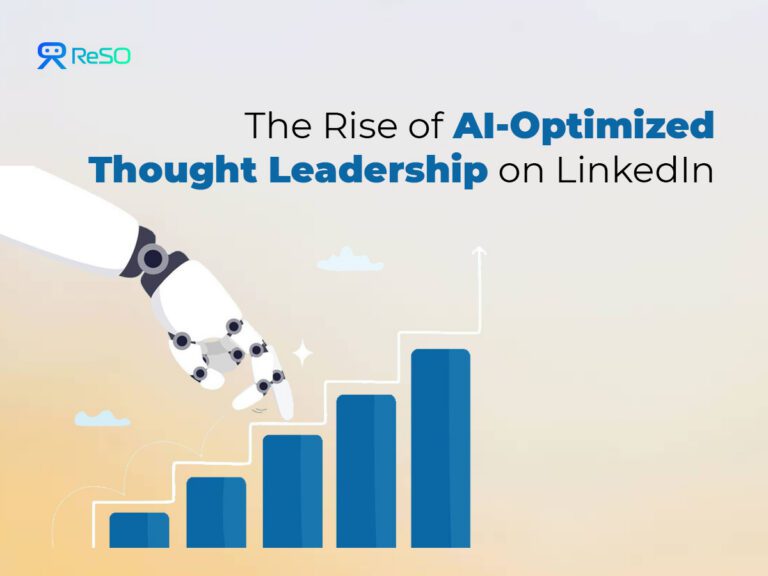
LinkedIn has evolved beyond being a professional networking platform.
In 2025, with over 1 billion members globally, LinkedIn has become the primary battleground where B2B professionals compete for human attention & for AI recognition.
The transformation is stark. According to Originality.AI’s comprehensive 82-month study analyzing posts from January 2018 to October 2024, there was a 189% surge in AI-generated content on LinkedIn immediately after ChatGPT’s launch.
Yet here’s the paradox: AI systems like ChatGPT, Perplexity, and Google’s AI Overviews are simultaneously becoming the primary way professionals discover expertise. When someone asks, “Who are the leading voices on AI strategy?” or “What do experts say about B2B marketing in 2025?” They’re asking an AI that synthesizes information from across the web, including LinkedIn posts.
This creates a new imperative: AI-optimized thought leadership.
Key Findings:
- LinkedIn is evolving into a main platform for AI-optimized professional thought leadership, with AI-generated content surging 189% post-ChatGPT launch.
- AI-optimized thought leadership blends authentic storytelling for humans with structured, data-rich content that AI systems can parse and cite.
- Strong AI signals include signature frameworks, topical consistency, cross-platform validation, and clear data hooks in posts.
- Consistent posting of 3-4 high-quality, insightful posts weekly builds lasting AI visibility and authority on LinkedIn.
- With 54% of long-form posts AI-generated and thought leadership content driving more shares, mastering AI-optimized content is critical for influence and discoverability in 2026.
Defining “AI-Optimized Thought Leadership”
Beyond Traditional Thought Leadership
Traditional thought leadership focused on demonstrating expertise through:
- Insights
- Building credibility within your professional community
- Establishing a distinctive point of view
- Creating content that resonates with your target audience
The success metrics were engagement within your network, speaking invitations, and inbound business opportunities driven by human readers.
AI-optimized thought leadership maintains these foundations but adds critical new dimensions. It requires structuring content so AI systems can easily parse and extract key insights. Also, using language and terminology that matches how people query AI about your domain, creating clear authority signals that help AI confidently identify you as a credible source.
And building a cross-platform presence that reinforces your expertise across multiple data sources, AI systems access.
The Technical Foundation
AI-optimized thought leadership understands how AI systems evaluate content differently from humans. When ChatGPT or Perplexity crawls LinkedIn, it’s looking for concepts and relationships clearly articulated, structural coherence (frameworks, numbered points, explicit definitions), credibility indicators (data citations, specific examples, professional credentials), and contextual markers.
A traditionally well-written LinkedIn post might say: “I’ve been thinking about marketing strategy lately. Here are some observations from my experience.”
An AI-optimized version would say: “3 B2B SaaS marketing strategies that drove 40% pipeline growth in 2025:”
The difference is making expertise machine-readable while remaining valuable for human readers.
The Dual Audience Challenge
- Human readers want authenticity, storytelling, emotion, personal voice, and content that resonates emotionally and intellectually.
- AI systems need clear structure, explicit expertise signals, quantifiable data points, semantic clarity, and contextual markers.
The most effective AI-optimized thought leaders blend these requirements seamlessly. They tell compelling stories that include specific frameworks AI can extract.
Writing authentically while ensuring key insights are structured in ways AI systems recognize as credible information worth citing.
What AI-Optimized Thought Leadership Is Not
It’s critical to understand these elements:
- It’s not keyword stuffing or writing for algorithms over humans
- It’s not abandoning personal voice to sound like a machine.
- It’s not generating all content with AI tools.
- It’s not optimizing for viral reach at the expense of substance.
- It’s not sacrificing authenticity for discoverability.
AI-optimized thought leadership is about making your best insights as visible to AI systems as they are compelling to human readers.
How B2B Leaders’ Posts Get Surfaced in ChatGPT Answers
| STAGE | WHAT HAPPENS | WHY IT MATTERS |
| Crawl | AI scrapers collect public LinkedIn profiles, posts,and engagement | Data forms training sets/knowledge banks for AI |
| Data Captured | Headline, summary, experience, posts, published articles, engagement | Used to assess and reference expertise |
| Querying by AI | System matches queries to stored data (not real-time search) | Finds entities using credentials, content depth, and signals |
| Authority Ranking | Assessed by relevance, topical depth, engagement, and recency | Strong profiles, posts, and engagement rise to the top |
| Authority Cluster | Some users cited more due to topic focus, quality, and recognition | Consistency multiplies citation probability |
| Engagement Signals | Early, substantive engagement is valued more by AI | Comments > likes; deeper discourse = higher authority |
| Leadership Patterns | 3-4 topic posts/week, rich discussions, long-term consistency | Sustained patterns make users “default citations.” |
Using Timestamping, Credibility Signals, and Data Hooks
Strategic Timestamping for Relevance
AI systems favor recent, timely information when responding to current queries. Timestamping your insights signals that your content addresses the present landscape, not outdated conditions.
Effective timestamping includes explicit year references (“In 2025, B2B buyers expect…” rather than vague “nowadays”), quarterly markers for business insights (“Q1 2025 showed 40% increase in…”), trend positioning (“Post-AI adoption, we’re seeing…”), and temporal comparisons (“Unlike 2022-2023 when X was true, 2025 data shows Y”).
Credibility Signals That AI Recognizes
AI systems evaluating thought leadership look for specific credibility indicators that separate genuine expertise from superficial takes. The most powerful signals include:
- Data citations (“According to Gartner research…” or “Our analysis of 10,000 campaigns showed…”)
- Specific examples (“When working with a Fortune 500 client, we implemented…”)
- Quantifiable results (“This framework drove 40% pipeline increase…”)
- Acknowledging complexity (“While X is common advice, Y context changes that…”).
Professional credentials strategically mentioned also signal expertise, but they work best when woven naturally into insights rather than stated abstractly.
External validation provides particularly strong credibility signals. References to being quoted in publications, speaking at recognized conferences, client case studies or industry certifications help AI systems confidently identify you as authoritative.
Data Hooks for Extractability
Effective data hooks include original research findings, specific statistics with sources, quantified outcomes, and benchmark data.
When you present “The 5-Stage B2B Content Funnel” or “3-Tier Pricing Strategy Framework,” you’re creating structured information that AI can extract and cite.
“This worked well” is not a data hook. “This drove a 40% increase in qualified leads over six months” is citable information. The more specific and quantifiable your insights, the more likely AI systems are to extract and reference them.
5 Best Practices for Consistent AI + LinkedIn Visibility
1. Develop Signature Frameworks and Methodologies
Consistently cited thought leaders create and repeatedly use unique frameworks that simplify complex ideas, making their expertise memorable and easily recognized by AI. These signature frameworks, applied across multiple posts, strengthen AI’s association of the leader with specific methodologies, increasing their chance of being cited.
2. Maintain Topical Consistency With Depth
- AI systems spot expertise by seeing repeated, focused posts over time.
- Posting randomly on many topics signals general interest, not authority.
- Pick 2-3 core topics in your field and make 80% of your posts about them.
- For example, a B2B SaaS marketer might focus on demand generation, product-led growth, and sales-marketing alignment.
- Posting consistently on these topics, with growing depth, helps AI link your name to your expertise area.
3. Build Cross-Platform Validation Loops
AI values consistent presence across platforms like LinkedIn, personal websites, industry articles, podcasts, and speaking events.
Each platform reinforces the others, LinkedIn links to your website, your website features LinkedIn, and podcasts drive traffic to both. This network of linked content helps AI build a strong, credible profile of your expertise.
Strategically interlink these platforms by including your website in LinkedIn, referencing LinkedIn in your articles, and mentioning podcasts in posts to boost AI recognition and authority citation.
4. Optimize Post Architecture for Dual Audiences
The architecture you need includes a compelling hook that:
- Creates curiosity
- Explicit context setting about who this is for
- What problem it addresses
- Structured body with numbered frameworks or clear sections
- Specific data points and examples
- Explicit takeaways or implications.
E.G: “If you’re a B2B SaaS CMO struggling with lead quality, here’s the 3-tier qualification framework we used to increase SQL-to-close rate by 40% in 2025:.”
This structure gives human readers a reason to engage while providing AI systems with clear expertise signals, context markers, extractable frameworks, and quantifiable results.
5. Implement Consistent Publishing Cadence With Quality
Frequency drives AI visibility only with quality. Only 310 million of 1.2 billion users of LinkedIn are active users, opening huge chances for consistent publishers. The ideal 2025 frequency is 3-4 high-quality posts weekly, avoiding multiple posts within 24 hours.
Quality is key: posts must show expertise, offer real value, include data or frameworks, and spark meaningful engagement. This consistent, valuable posting signals both active presence (recency) and deep expertise (topical authority) to AI.
Track visibility by monthly querying AI tools (ChatGPT, Perplexity) on your expertise topics. Look for your name and context shifts over time to refine your approach.
AI is reshaping professional discoverability: 54% of long-form LinkedIn posts are AI-generated, yet LinkedIn’s algorithm penalizes low-quality AI content. Thought leadership content is driving more shares, highlighting the value of genuine, educational posts. With AI content flooding the platform, true expertise must be clear and authentic to stand out.
Success belongs to those mastering AI-optimized thought leadership by using signature frameworks, topical consistency, cross-platform validation, dual-audience posts, and consistent quality publishing. Professionals who grasp that every post doubles as training data for AI will dominate visibility in the AI-driven discovery landscape.
Your LinkedIn posts now compete to be AI’s answer for expertise in your domain. Optimizing for this competition is critical for lasting authority and influence.
For deeper reads on AI visibility, AISO, and modern discovery, check out our other blogs.