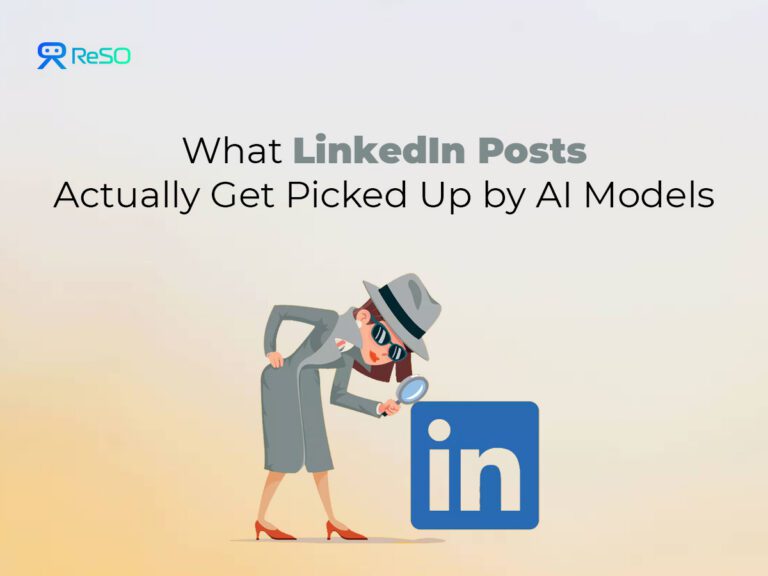
LinkedIn content is not just competing for visibility in the feed anymore. It is also competing to be discovered and cited by AI systems like ChatGPT, Perplexity, Google AI Overviews, which are quickly becoming the primary tools professionals use to find experts and shortlist vendors.
Recent research shows this growth is already happening. In Semrush’s 2026 analysis of 325,000 prompts and 89,000 cited LinkedIn URLs, LinkedIn ranked as the #2 most cited domain across major AI search tools, appearing in 11% of AI responses on average.
LinkedIn now has about 1.3B members. What gets picked up most often isn’t viral content, but original, educational, and structured posts. LinkedIn articles account for 50-66% of cited LinkedIn content, feed posts for 15-28%, and about 95% of cited content is original rather than reshared.
The feed is crowded. AI systems are now the gatekeepers deciding which posts surface for professional queries.
Key takeaways
- LinkedIn posts now compete for AI citation, not just feed visibility.
- Early engagement still matters, but long-term relevance and topic authority decide whether posts keep resurfacing.
- Carousels, native documents, and structured posts perform well because they are easier to read, save, and extract.
- AI systems favor content with semantic density, clear context, structured language, and authority signals.
- Educational frameworks, original data, expert stories, and problem-solution posts are more likely to earn AI pickup.
- Promptable content helps creators answer the exact questions their audience is asking AI tools.
- Consistent publishing, ideally 3-4 times per week, compounds visibility across both LinkedIn and AI discovery.
How AI Models Interpret Social Signals and Engagement
Engagement as authority
AI models use social signals like likes, comments, and shares to gauge content value. The “golden hour” (first 60–90 minutes) still matters for initial distribution, but it is no longer make-or-break. Posts can flop in the first hour, then explode within 24 hours. LinkedIn now surfaces posts from weeks ago if they are relevant.
Substantive comments matter far more than passive likes. When you reply to comments within 30 minutes of posting, it shows active participation and helps your content reach more people.
Dwell time over vanity metrics
LinkedIn prioritizes posts that hold reader attention. AI mirrors that priority, favouring content that demonstrates expertise through thorough coverage rather than quick takes.
What matters now is dwell time, which is how long users spend reading. Thorough in-depth coverage over quick takes is key. Consistent posting in one niche builds topic authority. Original insights, such as industry trends and actionable advice, drive engagement.
The LinkedIn algorithm has evolved
Older posts can surface if they are relevant. Native content, such as text, carousels, and video, gets priority over links. Video and Live content tend to get significantly more engagement than standard posts. The algorithm is also better at detecting clickbait and engagement bait.
Instead of timing posts perfectly, focus on posting when it suits your schedule. Stay on the app after posting to reply to comments. Create evergreen, value-driven content that remains useful over time. Track performance over weeks rather than just 24 hours.
Format influences discoverability
- Carousels still outperform most formats; the carousel advantage is ~3.7× vs text, down from earlier 11.2× peak levels. Multi-image posts and native documents also perform strongly with 5.85% and 5.60% engagement rates, respectively, while polls generate the highest number of impressions.
- Long-form posts with external links perform well when they provide genuine value. AI models value content tied to broader knowledge networks, so posts linking to authoritative sources or your own research get cited more often. However, LinkedIn’s algorithm gives posts with external links less initial reach, so consider putting links in the first comment if raw impressions are your goal.
- Educational frameworks and data visualisations simplify AI extraction and lift citation likelihood. Clear frameworks, numbered steps, or visual data help AI models understand and reference your content. This makes educational posts more likely to appear in AI-generated answers from ChatGPT and Google AI Overviews.
The AI-Content Paradox
LinkedIn penalises AI-generated posts (30% less reach, 55% less engagement) even as AI-generated posts flood the platform. AI models distinguish real human engagement from algorithmically-manufactured noise. Only authentic engagement signals survive AI pickup.
How language and context influence AI visibility
The words you use influence whether AI systems can understand, retrieve, and cite your content. The following language patterns make that process easier.
| Concept | Description | Example |
|---|---|---|
| Semantic density | AI understands rich, interconnected concepts beyond keywords. Precise domain language signals expertise. | “B2B demand gen via ABM and predictive analytics” beats vague “marketing” |
| Structured language | Clear main points, numbered lists, definitions, and cause-and-effect aid AI parsing and citation. | “5 mistakes in content strategy: 1)… 2)…” is extractable |
| Contextual anchors | Industry, role, problem, and time-specific phrases help AI match content to user queries. | “in B2B SaaS” or “for remote teams in 2026”, link content to precise intents |
| Authority language | Data citations, acknowledged nuance, and practical application signal real expertise. | “According to Gartner…” or “while X is common, context Y changes that” |
Patterns of top-performing posts
Framework-led posts
Posts built around clear structures like 5-step processes, 7-part breakdowns, or 3-pillar frameworks tend to perform better. They make the idea easier for readers to follow and easier for AI systems to extract.
Data-driven content
Original stats, first-party research, and analysis give AI systems concrete reference points. These posts are more likely to be treated as useful sources because they add evidence, not just opinion.
Personal stories with professional value
Stories that open with a personal challenge and transition to actionable insight generate high dwell time and AI resonance.
Problem-solution structure
Outline a problem, explain common failures, and propose a clear solution. This format works well for both human readers and AI retrieval.
Consistency matters
Only 7.1% of LinkedIn users post regularly. Those who publish 3-4 posts per week consistently build stronger topic authority over time, and that consistency becomes a visibility signal.
Promptable content library: 15 AI questions your audience asks
The question that unlocks real AI citation share is not “what should I post?” It is “which specific AI queries do I want my LinkedIn presence to answer?” Below is a working library for B2B founders, operators, and marketing leaders. The pattern works across categories once you translate the themes.
| AI query your audience may ask | LinkedIn post angle |
|---|---|
| What is the best LinkedIn strategy for a B2B founder with no personal brand? | A zero-to-500-follower sequence with content cadence, topic mix, weekly sub-themes, and one metric to track each week. |
| How do B2B founders build thought leadership without burning out? | A personal story plus framework post covering false starts, a sustainable rhythm, and signals that the system is working. |
| Which LinkedIn post formats work best for B2B in 2026? | A data-led comparison of carousels, text posts, videos, and polls, with a rule for when to use each format. |
| How do I convert LinkedIn engagement into pipeline? | A process post showing the comment-to-DM-to-call flow, including scripts, timing, and follow-up logic. |
| Does the golden hour on LinkedIn still matter? | A myth-breaking post using engagement curves and practical posting guidance. |
| How do AI tools decide which LinkedIn posts to cite? | An explainer post that demonstrates the same structure it recommends. |
| What is the best LinkedIn posting cadence for founders without a marketing team? | A realistic constraints post with cadence options based on available hours per week. |
| How do I write a LinkedIn hook that does not feel like clickbait? | A technique post with hook patterns and a simple rule for each. |
| What is changing about LinkedIn’s algorithm in 2026? | A trend-synthesis post covering key changes, what the data shows, and what to adjust. |
| How do I get cited as an expert by AI without being a recognised thought leader? | A tactical post on building entity signals through consistent LinkedIn content. |
| Which LinkedIn topics earn the highest engagement for B2B SaaS? | A data post mapping engagement patterns by topic. |
| How do I turn a customer case study into a LinkedIn post series? | A structure post showing a 5-post sequence from one case study. |
| What is the difference between personal branding and thought leadership on LinkedIn? | A definitional post that clarifies a commonly confused distinction. |
| Should B2B founders post every day on LinkedIn? | A contrarian data post explaining when daily posting works, when it fails, and what cadence to use instead. |
| How do I measure whether my LinkedIn strategy is working? | A metrics post covering useful signals, vanity metrics to ignore, and a simple dashboard structure. |
Work the list as a one-post-per-week programme for a quarter. Fifteen questions can become fifteen authoritative posts, each targeting a specific prompt pattern an AI model is likely to encounter.
LinkedIn algorithm and AI visibility feedback loop
LinkedIn’s algorithm and AI visibility are not separate games. They reinforce each other, and understanding the feedback loop is what separates consistent AI-cited creators from one-off viral hits. The loop, step by step:
- LinkedIn rewards engagement:
Posts that earn high early engagement in the golden hour get broader feed distribution. Not a new mechanic, but the knock-on effect now extends beyond LinkedIn’s own feed.
- Engaged posts collect more views and more comments:
More distribution leads to more comments, saves, profile visits, and repeat interaction. These signals make the post more useful, searchable, and easier to connect to a topic.
- AI systems pick up stronger content signals:
When ChatGPT or Perplexity surfaces a LinkedIn-sourced citation, they are drawing from content that earned engagement. Low-engagement posts are effectively invisible to the AI layer.
- AI visibility sends attention back to the creator:
The creator sees an increase in LinkedIn profile visits, follow requests, and direct message inbound, which the LinkedIn algorithm then interprets as further authority.
- The loop compounds:
Consistent creators build topic authority with every relevant post. This leads to LinkedIn reach and AI visibility reinforcing each other month after month.
What this means in practice:
The first 60-90 minutes of post life are not just for feed reach, they are also the window in which the post earns eligibility for AI pickup. The same discipline of publishing when your audience is active, prompting early comments, and responding to the first wave of replies within the first hour, now serves two masters. It is cheaper to optimise for the feedback loop than to treat LinkedIn and AI visibility as separate projects.
How to create LinkedIn content that AI can cite
Promptable content is content designed to answer the real questions your ICP is already asking AI tools. Instead of asking, “What do I want to say?”, start with “What is my ICP likely asking ChatGPT, Perplexity, or Google AI Overviews right now?”
- Build a prompt library:
Gather common audience questions from sales calls, LinkedIn comments, customer conversations, Reddit threads, Quora discussions, support tickets, and community forums. These sources reveal the problems, comparisons, objections, and use cases your audience cares about most.
- Turn questions into content:
Create posts that directly answer those questions. The closer a post aligns with a real user query, the more likely it is to be useful to both readers and AI systems.
- Structure for extractability:
Use clear headlines, numbered lists, definitions, formatted statistics, and practical examples. Structured content is easier for AI models to understand, retrieve, and cite.
- Connect authority signals:
Link LinkedIn posts to supporting assets such as website content, case studies, research, media appearances, webinars, and founder interviews. The goal is to create a connected authority graph around your expertise rather than a collection of isolated posts.
Optimize for humans and AI at the same time
AI visibility does not mean writing robotic content. The strongest LinkedIn posts balance personal voice with structured information. Personal stories, opinions, and lived experience make the post worth reading. Frameworks, data, examples, and clear takeaways make it easier for AI systems to understand and cite. The split is not 50/50. It is the same post doing both jobs. A well-structured story with data woven through it can work for the LinkedIn feed and the AI retrieval layer simultaneously.
How to measure your AI visibility
Tools for tracking AI citations
- Otterly.ai: automated citation tracking across ChatGPT, Perplexity, Claude, and Gemini. It is useful for brand-level monitoring, though less precise for individual creators.
- Profound: enterprise-grade AI visibility platform with competitor benchmarking.
- BrightEdge AI citation tracker: particularly strong for Google AI Overviews coverage.
Run your own AI visibility audit (20 minutes, bi-weekly)
Ask ChatGPT and Perplexity five category queries where your name, brand, or content should ideally appear. For example:
- Who are the top voices on [your topic]?
- What is the best content on [your niche]?
- Which experts should I follow in [your area]?
Log whether you appear, where you appear, who appears alongside you, and how the answer frames your expertise.
Metrics to track
- Citation rate: The percentage of category queries where you are named.
- Citation position: Whether you appear first, in the middle, or near the end.
- Sentiment and framing: Whether the mention is neutral, favorable, or too narrowly scoped.
- Co-citation patterns: Which other creators, brands, or competitors appear alongside you?
These probes take less time than writing one post, but they can give you some of the clearest signals for shaping your LinkedIn content and AI visibility strategy.
The end game
LinkedIn posts now do more than create feed visibility. They can also become signals for AI-driven professional discovery. The posts most likely to be picked up combine educational frameworks, original data, clear structure, useful storytelling, and consistent publishing.
AI systems reward content that is easy to understand, extract, and connect to a specific topic. That means depth matters. Structure matters. Authenticity matters. For B2B founders and brands, promptable content is the edge: content built around the questions your audience is already asking AI tools.
Only 7.1% of LinkedIn users post consistently, which means regular, well-structured publishing can quickly separate you from most of the market. As AI-generated content floods LinkedIn, real expertise with clear structure becomes even more valuable.
If you want help turning LinkedIn into an AI-discoverable authority signal, ReSO works with B2B brands and founders on exactly this motion. Book a call.
Frequently Asked Questions
What types of engagement influence AI pickup?
Early engagement in the first 60-90 minutes helps with initial reach, but meaningful interaction matters more than raw likes. Substantive comments, shares, saves, and profile visits signal that the post is useful enough to keep circulating.
Does AI prefer human or AI-generated content?
AI systems favor content with specific examples, lived experience, and clear expertise. Use AI for research, outlining, or editing support, but keep the final draft human, specific, and grounded in real insight.
How often should I post to rank well with AI?
Consistency matters more than volume. Posting 3-4 times per week over several months helps build topic authority. Irregular bursts of content rarely create the same long-term visibility signal.
Can smaller creators get cited by AI tools?
Yes, AI visibility is not only about follower count. Smaller creators can get picked up when they publish structured, useful, and topic-specific content consistently. Clear frameworks, original data, and promptable posts can help them become visible for niche queries.