Executive Summary:
- Perplexity AI integrates generative AI with real-time web search to deliver direct, cited answers rather than mere links, supporting stronger AI citation practices.
- Valued at $14 billion, it processes hundreds of millions of queries monthly, demonstrating significant user adoption among professionals, students, and researchers.
- Co-founded by Aravind Srinivas, Denis Yarats, Johnny Ho, and Andy Konwinski, Perplexity aims to provide a reliable platform for information by combining LLMs with rigorous, transparent search and enhancing overall AI discoverability.
- Unlike traditional search engines or chatbots, Perplexity offers a unique blend of conversational AI with live, sourced web results, emphasizing accuracy and transparency through citations and alignment with conversational search prompts.
- It serves a broad spectrum of users, from market analysts and engineers to students and government agencies, all seeking credible and actionable knowledge quickly.
- Includes Deep Research Mode for comprehensive reports, Perplexity Labs for creating rich deliverables, Memory for personalized context, and multimodal search capabilities for image, video, and text queries.
- Offers Perplexity Pro ($20/month), Enterprise Pro ($40/seat/month), and Enterprise Max ($325/seat/month), with Enterprise Max providing unlimited Labs access, Comet Max assistant, enhanced video generation, and premium AI models.
- Applied in B2B for knowledge management, sales, engineering, and R&D, and in B2C for personal assistance, content creation, shopping, and technical support. It also supports the government, NGOs, and educational institutions.
- Perplexity’s commitment to providing direct sources for its answers distinguishes it from rivals like ChatGPT, Gemini, and Claude, which may lack real-time web access or comprehensive citations.
- Recent launches include the Comet browser (now available on desktop and Android), Memory for personalization, AI patent search, flight status tracking, and video generation with Sora 2 Pro.
Introduction:
You are a product manager trying to beat the clock, to condense the current market data, synthesize 12 analyst reports, and put a summary together to share with your leadership team, all before lunch. Not long ago, this meant hours and hours fumbling through skills and experience, endless and tedious “Google”ing, picking through SEO choked articles, and piecing together a few facts from the fractured sources available. Today, she types her question into yet another type of search box, and just seconds later, she receives a short, sourced answer, along with links to explore further. That is the potential, and reality, of Perplexity AI.
Perplexity AI is a conversational answer engine that combines the best of generative AI and real-time search. It works to provide not just lists of links, but answers, synthesized and cited to support complex questions. Since its launch in 2022, it has surged from an uncut diamond startup to a $14 billion AI company, answering hundreds of millions of queries every month, and changing the way both professionals, students, and other users access knowledge.
Against rivals like ChatGPT, Gemini, and Claude, Perplexity’s edge is its hybrid approach, melding conversational AI with live, cited web results, and a relentless focus on transparency and accuracy.
Let’s be clear: Perplexity isn’t your typical search engine, nor is it just another chatbot. It’s a conversational answer engine, a direct line to the world’s knowledge, compressed, cited, and made clear. Unlike Google, which serves up a buffet of blue links, Perplexity delivers synthesized, source-cited answers in natural language, with the option to drill deeper or ask follow-ups. For anyone who’s ever lost hours to rabbit holes or doubted the veracity of an AI-generated fact, this represents a fundamental shift in how we access information.
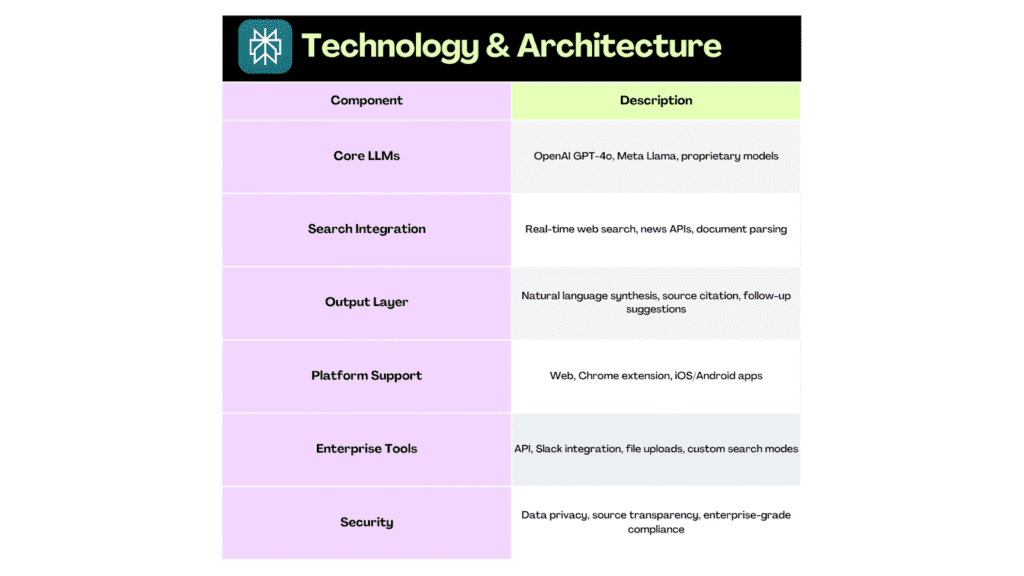
Founding & Mission
Perplexity was founded in 2022 by Aravind Srinivas, Denis Yarats, Johnny Ho, and Andy Konwinski, engineers and researchers with deep expertise in AI, backend systems, and machine learning. Srinivas, whose journey took him from IIT to UC Berkeley and stints at DeepMind and OpenAI, teamed up with Yarats after a serendipitous connection over similar research papers. Their mission is to serve the world’s curiosity by building the best platform for answers and information, one that marries the power of LLMs with the rigor and transparency of search.
User Profile
Who uses Perplexity? The answer is as varied as the questions it fields. Professionals such as analysts, marketers, and engineers, seeking to collapse research cycles. Students and academics are looking for reliable, cited information. Journalists and writers in need of fast, fact-checked summaries. Even government agencies and NGOs, which rely on Perplexity for policy research and public communication. The common thread: a need for credible, actionable knowledge, delivered at the speed of thought.
Key Features, Tools, and Pricing:
Search Modes & Customization:
Perplexity offers several search modes: Default (web search with LLM synthesis), Pro (access to advanced models), and specialized modes for shopping, travel, code, academic research, SEC filings, and finance. Users can customize the depth of research through three search context levels (Low, Medium, High), choose which LLM to use, and set preferences for output format and citation style. The Academic filter prioritizes peer-reviewed sources, while the SEC filings filter enables targeted financial research.Perplexity offers several search modes: Default (web search with LLM synthesis), Pro (access to advanced models), and specialized modes for shopping, travel, and code. Users can customize the depth of research, choose which LLM to use, and set preferences for output format and citation style.
Organization & Output:
Features like Collections allow users to organize research into folders, share findings with teams, and revisit past queries. The platform’s output is always cited, with links to original sources, and can include images, tables, videos, and code snippets.
Content Generation & Assistants:
Writers and marketers use Perplexity’s content generation tools to draft articles, emails, SEO copy, and more. The system learns from user preferences, offering a personalized writing assistant that evolves over time. For developers, Perplexity can generate code, explain programming concepts, and assist with debugging. New additions include an Email Assistant (in trial) and Quizzes and Flashcards on iOS for learning.
Memory:
Launched in December 2025, Memory enables Perplexity to retain context across sessions. The platform remembers your preferences, past research, and interaction patterns to deliver increasingly personalized responses over time.
Perplexity Pro & Enterprise Tiers
Perplexity Pro – $20/month ($200/year) For personal, non-commercial use. Includes unlimited Pro searches, 10x citations in answers, extended access to Research and Labs, image generation, and access to the latest AI models.
Enterprise Pro – $40/month per seat ($400/year). For teams and organizations. Adds private Spaces collaboration, answers from file and productivity apps, up to 15,000 file uploads, SSO/SCIM provisioning, user management, data retention controls, audit logs, team insights (50-seat minimum), no training on data, and SOC 2 Type II compliance.
Enterprise Max– $325/month per seat ($3,250/year). For complex challenges with unlimited queries. Adds unlimited Labs queries, access to advanced AI models, greater file upload limits, enhanced video generation, Comet Max assistant, and team insights with no seat minimum.
Perplexity Labs:
Unveiled in May 2025, Labs is a powerful workspace for creating rich deliverables. Users can generate reports, spreadsheets, dashboards, data visualizations, and interactive web apps. Labs orchestrates multi-step workflows, conducting research, running code, structuring data, and generating charts or images. Available to Pro and Max subscribers on web, mobile, and desktop.
Deep Research Mode:
Deep Research lets users request comprehensive, expert-level reports on any topic. Perplexity autonomously performs dozens of searches, reviews hundreds of sources, and synthesizes findings into a detailed, source-cited report. Now enhanced with an asynchronous API for complex queries, reasoning effort control (low/medium/high) for cost management, and detailed cost tracking in responses.
Image Upload and Multimodal Search:
The platform supports image uploads, allowing users to analyze visuals, extract contextual information, and blend text and image queries. The Media Classifier (December 2025) automatically detects when queries would benefit from visual content and includes relevant images or videos in responses.
File Attachments:
Launched September 2025, users can upload and analyze documents in PDF, DOC, DOCX, TXT, and RTF formats. Ask questions, extract information, and get summaries from uploaded documents with multi-language support.
Enhanced Sonar Models & Search Modes:
The Sonar model family includes Sonar (lightweight, cost-effective), Sonar Pro (advanced understanding), Sonar Reasoning Pro (multi-step reasoning), and Sonar Deep Research (exhaustive research). Note: The sonar-reasoning model was deprecated in December 2025; users should migrate to sonar-reasoning-pro.
Comet Browser (Early Access for Max Subscribers):
Comet, Perplexity’s browser, is now fully launched on desktop and Android. It integrates answer engine capabilities directly into browsing, research, and workflow automation. Enterprise Max subscribers access the Comet Max assistant with enhanced capabilities, privacy controls via Snapshot widget, and task scheduling in Spaces.
Pricing Models:
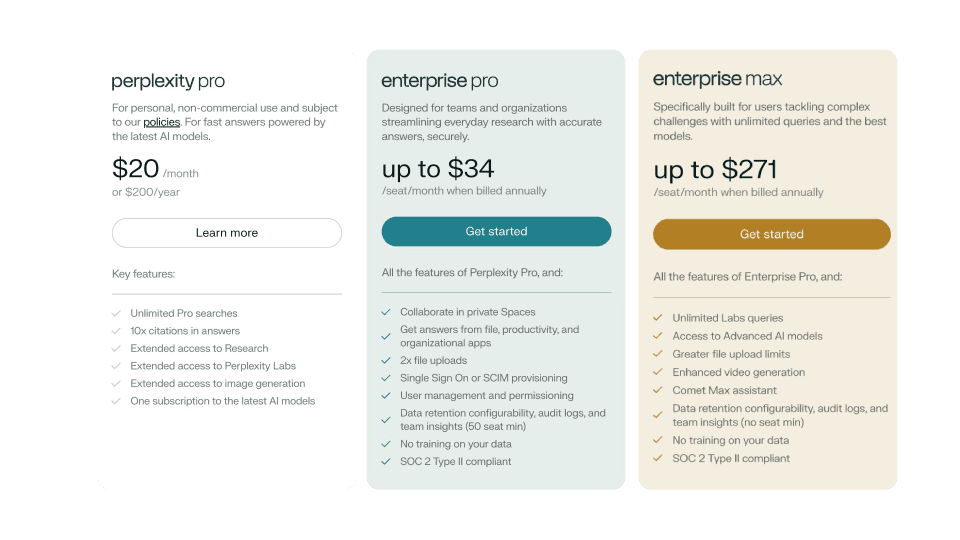
Source: Which Perplexity Subscription Plan is right for you?
Competitor Analysis:
| Feature / Criteria | Perplexity AI | ChatGPT | Gemini | Claude |
|---|---|---|---|---|
| Purpose & Core Design | Specialized AI answer engine focused on real-time, cited, fact-checked research and Q&A | General-purpose conversational AI for creative writing, coding, brainstorming, and dialogue | Search engine (Google) + conversational AI for web info, summaries, and some creative tasks | General-purpose AI assistant focused on safe, nuanced, context-aware conversation |
| Information Source | Real-time web search; pulls from 10–20 sources per query with citations and links | Pre-trained data (cutoff Oct 2023); web browsing available; citations only when browsing enabled | Google web index, News, Knowledge Graph; Gemini can cite sources but not always available | Trained on large datasets; no real-time web search (as of 2025); no default live citations |
| Accuracy & Factuality | High for factual, up-to-date queries; strong transparency and verifiability | Strong general knowledge and reasoning; may hallucinate or be outdated without browsing | High for web facts; influenced by SEO and ad-driven content; citations inconsistent | Strong reasoning and nuance; less reliable for real-time facts |
| Citation & Source Transparency | Always provides clickable citations for claims and summaries | Citations only when browsing enabled; otherwise implicit or missing | Google Search links sources; Gemini sometimes cites, sometimes not | Rarely provides explicit citations; focuses more on conversational context |
| Use Cases / Best For | Research, fact-checking, academic work, business intelligence, technical queries | Creative writing, brainstorming, coding, tutoring, multi-turn conversation | Quick web lookups, news, local info, summaries, some creative tasks | In-depth conversations, safety-sensitive topics, nuanced reasoning |
| Conversational Abilities | Functional, structured, less chatty; focused on information delivery | Strong, human-like multi-turn conversation; remembers context and adapts tone | Gemini conversational but less nuanced than ChatGPT; Google Search not conversational | Very strong context awareness and safe conversation; less focused on factual Q&A |
| Generative AI Strengths | Moderate; strong in structured and factual writing; weaker in creative/ambiguous tasks | High; excels in creative, narrative, ambiguous tasks and code generation | Moderate creative ability; Google Search has none | High for creative and nuanced writing; less focused on structured factual output |
| Customization & Modes | Search depth, LLM model, output format; more control in Pro/Enterprise | Custom instructions, plugins, browsing (Pro); less direct factual control | Search filters; Gemini offers some answer style control | Prompt customization available; less control over factuality or structure |
| File / Media Support | Text, images, PDFs, audio; strong document analysis in Pro | Text, images, code, voice, and some file uploads (Pro) | Google: text, images, video search; Gemini supports text/image input | Text and some image input (varies by version); less robust overall |
| API & Integration | Robust API, Slack, browser extensions, enterprise connectors | API, plugins, integrations via OpenAI | Google APIs for search; limited Gemini integration | API and some enterprise integrations |
| Speed & Latency | 5–10 seconds for detailed answers; slower for deep research | 2–6 seconds for most queries | Instant for search; ~2–5 seconds for Gemini/Bard | 3–8 seconds depending on model/load |
| Overall Strengths | Real-time, cited research; transparency; accuracy; enterprise-ready | Flexible, creative, conversational; strong memory and language capabilities | Massive web index; strong for real-time info and summaries | Safe, nuanced, context-aware reasoning and conversation |
Use Cases & Applications:
B2B (Enterprise & Professional) Use Cases
Knowledge Management & Research:
Corporate teams use Perplexity to synthesize information across documents, reports, and the web. Product managers accelerate discovery, analysts summarize market data in minutes, and consultants prepare client briefings without wading through endless PDFs. The ability to cite sources builds trust and streamlines decision-making.
Scenario: A product manager needs to synthesize market trends from disparate sources for a leadership briefing.
Step-by-Step Process:
- Initiate a Deep Research Query: The manager opens Perplexity, selects the “Deep Research” mode, and enters a prompt such as, “Summarize the latest trends in the electric vehicle market with citations.”
- AI-Driven Exploration: Perplexity automatically conducts multiple searches, reads recent articles, analyst reports, and regulatory filings, and extracts key points. It checks for factuality using its high-accuracy models.
- Synthesis & Citation: Within minutes, the platform generates a concise, multi-paragraph summary, embedding clickable citations for each claim.
- Follow-Up & Drill-Down: The manager can ask follow-up questions (e.g., “What are the top three risks for EV manufacturers in 2025?”), and Perplexity refines its answer, again citing sources.
- Organization: The manager saves this thread in a dedicated project folder, shares it with colleagues, and can revisit or update the research as new data emerges.
Sales & Marketing:
Sales teams research prospects and draft pitch decks; marketers surface industry trends and generate brand-compliant content. Perplexity’s aggregation of knowledge and citation of sources enhances campaign planning and prospect engagement, reducing research cycles from hours to minutes.
Scenario: A sales rep is preparing for a pitch to a prospective client in the healthcare sector.
Step-by-Step Process:
- Prospect Research: The rep enters, “Provide a profile of [Company], including recent news and executive changes.”
- Real-Time Search: Perplexity scans news sources, press releases, and business databases, then summarizes findings with direct citations.
- Content Generation: The rep asks, “Draft a personalized outreach email referencing [Company]’s latest initiatives.”
- Customization: The AI tailors the email, ensuring tone and content are suitable for the healthcare industry.
- Campaign Planning: For broader marketing, the team requests, “Identify emerging trends in healthcare marketing for 2025,” receiving a cited market overview for campaign strategy.
Engineering & Development:
Engineers use Perplexity for code research, bug triage, and documentation. By automating parts of code review and summarizing technical docs, teams reclaim hours each week. Integration with tools like GitHub Copilot extends its utility into the developer workflow.
Scenario: A software engineer needs to debug a Python script and document the process.
Step-by-Step Process:
- Code Input: The engineer uploads the problematic script or pastes the code into Perplexity.
- Query: “Identify and fix bugs in this script. Explain the changes.”
- Analysis & Output: Perplexity analyzes the code, suggests corrections, and provides an annotated, corrected version with explanations.
- Documentation: The engineer asks, “Summarize this debugging process for the project wiki,” and receives a concise write-up.
- Integration: For ongoing projects, the engineer links Perplexity with GitHub, enabling code review and documentation automation.
Product & R&D:
R&D teams leverage Perplexity to investigate technical topics, compare tools, and scout emerging technologies. One tech company reported saving thousands of engineer hours monthly by using Perplexity to kickstart research and development tasks.
Scenario: An R&D team is evaluating new AI frameworks.
Step-by-Step Process:
- Comparative Query: “Compare TensorFlow, PyTorch, and JAX for large-scale NLP projects.”
- Deep Analysis: Perplexity pulls technical documentation, benchmarks, and user reviews, synthesizing a side-by-side comparison with citations.
- Best Practices: The team follows up, “What are best practices for scaling NLP models in production?”
- Knowledge Capture: All findings are saved in a shared collection for ongoing reference and onboarding.
Customer Support & Documentation:
Support agents and documentation writers use Perplexity to answer questions and summarize policies, logs, and manuals. Government and nonprofit teams report daily use for research and document creation, citing the value of transparent, source-linked answers.
Scenario: An internal support agent needs to answer a policy question and update documentation.
Step-by-Step Process:
- Query: “What is our policy on remote work allowances for international employees?”
- Document Search: Perplexity scans internal policy documents (uploaded or linked) and external regulatory sources.
- Answer with Citations: It generates a clear, cited answer, referencing both company policy and relevant labor laws.
- Summarization: The agent asks, “Summarize this policy for the employee handbook.”
- Validation: The cited answer allows for quick fact-checking and compliance verification.
Industry & Sector-Specific Applications:
Finance & Banking:
Financial professionals use Perplexity for real-time market analysis, summarizing earnings reports, and compliance checks. Asset managers assess risk by reviewing transaction data and news, while banks use Perplexity to support fraud detection and regulatory research.
- Scenario: A risk analyst is monitoring for potential fraud.
- Step-by-Step Process:
- Data Upload: The analyst uploads transaction logs.
- Query: “Identify irregularities or potential fraud in this dataset.”
- Pattern Analysis: Perplexity scans for anomalies, flags suspicious entries, and explains the reasoning.
- Market Research: The analyst follows up, “Summarize market risks for [investment] in Q3 2025.”
- Regulatory Check: “What new compliance requirements affect this asset class?” Perplexity returns a cited summary from regulatory bulletins.
Healthcare & Life Sciences:
Doctors and researchers use Perplexity to summarize medical literature, analyze patient data, and support diagnosis and treatment planning. Hospitals employ it for predictive analytics (identifying at-risk patients) and administrative efficiencies (scheduling, billing). Pharmaceutical researchers use it to review clinical trial data and literature.
Scenario: A clinician wants to personalize a treatment plan based on the latest research.
Step-by-Step Process:
- Patient Context: The clinician enters anonymized patient data and a prompt: “What are the latest recommended treatments for [condition] in [demographic]?”
- Literature Review: Perplexity searches medical journals, clinical trial databases, and guidelines, synthesizing a summary with direct citations.
- Predictive Analytics: The clinician asks, “What complications should I anticipate based on this patient’s profile?”
- Personalization: Perplexity highlights risk factors and suggests monitoring protocols, citing the relevant studies.
Manufacturing & Supply Chain:
Manufacturers optimize production and maintenance by analyzing historical data with Perplexity. Predictive analytics enable proactive maintenance and quality control, while supply chain teams respond more efficiently to demand shifts.
Scenario: A plant manager needs to predict equipment failures.
Step-by-Step Process:
- Historical Data Upload: Maintenance logs and sensor data are uploaded.
- Query: “Predict which machines are at risk of failure in the next quarter.”
- Predictive Output: Perplexity analyzes patterns, flags at-risk equipment, and suggests preventive maintenance schedules.
- Supply Chain Optimization: “Recommend adjustments to supply orders based on forecasted demand shifts.”
- Continuous Monitoring: The manager sets up periodic queries to automate ongoing analysis.
Retail, E-Commerce & D2C:
Retailers use Perplexity to analyze customer behavior, optimize pricing, and personalize shopping experiences. The system supports recommendation engines and virtual shopping assistants, helping brands stay agile in a shifting market.
Scenario: A retail manager wants to optimize inventory and personalize marketing.
Step-by-Step Process:
- Customer Data Input: The manager uploads sales and customer data.
- Query: “Analyze customer purchase patterns and recommend inventory adjustments.”
- Behavioral Insights: Perplexity identifies trends, forecasts demand, and suggests stock changes.
- Personalization: “Generate personalized email campaigns for high-value customers based on recent behavior.”
- Dynamic Pricing: “What price adjustments would maximize revenue this week?” The AI analyzes competitor data and demand.
Automotive & Transportation:
Auto manufacturers leverage Perplexity for R&D, maintenance planning, and regulatory research. As vehicles become more connected and autonomous, Perplexity supports innovation by analyzing driving data and enhancing supply chain efficiency.
Scenario: An automotive R&D team is enhancing vehicle safety systems.
Step-by-Step Process:
- Data Input: The team uploads driving performance data and incident reports.
- Query: “Analyze recent safety incidents and recommend system improvements.”
- Insight Generation: Perplexity synthesizes findings, benchmarks against industry standards, and proposes actionable changes.
- Regulatory Research: “Summarize new safety regulations for autonomous vehicles in the EU.”
- Integration: Findings are exported for engineering and compliance teams.
Energy & Utilities:
Energy firms use Perplexity to predict demand, oversee grids, and integrate renewables. Smart grids leverage its analytics for maintenance forecasting and resource allocation, supporting sustainability initiatives.
Scenario: An energy analyst is forecasting grid demand and planning maintenance.
Step-by-Step Process:
- Data Input: Uploads grid usage and weather data.
- Query: “Forecast peak demand periods for the next month.”
- Resource Allocation: Perplexity suggests optimal resource allocation and identifies potential stress points.
- Renewables Integration: “Analyze wind and solar generation patterns to improve grid efficiency.”
- Maintenance Planning: “Which infrastructure elements are most likely to require maintenance soon?”
B2C & D2C (Consumer-Focused) Use Cases:
Personal Knowledge & Assistance:
Consumers use Perplexity as an AI search assistant for everyday questions—news, hobbies, travel, recipes—receiving conversational, cited answers. The platform excels at summarizing factual topics, brainstorming ideas, and providing current, trustworthy information.
Scenario: A user wants to learn about a new topic quickly.
Step-by-Step Process:
- Query: “Explain quantum computing in simple terms.”
- Conversational Output: Perplexity generates a clear, concise explanation, citing reputable sources.
- Follow-Up: The user asks, “What are the real-world applications of quantum computing?”
- Drill-Down: Perplexity provides examples, again with citations.
- Organization: The user saves this thread for future review.
Creative Content & Knowledge:
Writers, students, and hobbyists use Perplexity for creative writing, study help, and project ideation. The tool generates text in various formats, supports academic research, and encourages exploration with source-backed answers.
Scenario: A writer needs help brainstorming a blog post.
Step-by-Step Process:
- Prompt: “Generate five blog post ideas about sustainable travel.”
- Content Generation: Perplexity returns ideas, each with a brief outline and references.
- Drafting: “Write an introduction for the post on eco-friendly hotels.”
- Revision: The writer requests, “Make it more conversational and add a recent statistic.”
- Fact-Checking: All claims are cited, allowing the writer to verify before publishing
Shopping Help & Lifestyle:
Perplexity assists with product research, travel planning, and direct hotel booking. Its shopping mode curates product results, while travel queries yield hotel recommendations and reviews, streamlining the online trip-planning experience.
Scenario: A consumer is comparing smartphones.
Step-by-Step Process:
- Query: “Compare the latest iPhone and Samsung Galaxy models for camera quality.”
- Comparison Table: Perplexity generates a side-by-side comparison, citing reviews and specs.
- Price Check: “Where can I find the best price for iPhone 15 Pro?”
- Deal Aggregation: The AI lists top deals from reputable retailers, with links.
- Purchase Planning: The user saves the results and sets a price alert.
Technical & Coding Help:
Tech enthusiasts and marketers use Perplexity for coding help, troubleshooting, and planning. While not a full coding assistant, it provides code snippets, explanations, and support for common programming tasks.
Scenario: A hobbyist is troubleshooting a JavaScript error.
Step-by-Step Process:
- Paste Error: The user pastes the error message and code snippet.
- Query: “Fix this error and explain what went wrong.”
- Debugging: Perplexity identifies the bug, provides a corrected snippet, and explains the fix.
- Learning: The user asks, “How can I avoid this type of error in future projects?”
- Tips: Perplexity offers best practices and references documentation.
Government, NGOs & Public Sector:
Policy Research & Public Information
Government agencies and NGOs use Perplexity for policy research, legislative analysis, and real-time news updates. Nonprofit leaders rely on it for drafting documents and validating information.
Scenario: A government analyst is preparing a policy brief on renewable energy incentives.
Step-by-Step Process:
- Query: “Summarize recent federal incentives for solar energy adoption in the US.”
- Document Review: Perplexity scans legislation, agency reports, and news.
- Cited Summary: It provides a concise brief with direct links to source documents.
- Follow-Up: “How do these incentives compare to those in Germany?”
- Comparative Analysis: Perplexity delivers a side-by-side summary, again with citations.
Communications & Outreach:
Public servants and nonprofit staff use Perplexity to draft press releases, grant proposals, and social media posts. The tool supports translation and summarization, freeing up time for higher-value work.
Scenario: A nonprofit needs to draft a press release about a new grant.
Step-by-Step Process:
- Prompt: “Draft a press release announcing a $500,000 grant for community health initiatives.”
- Draft Output: Perplexity generates a draft, referencing similar releases and best practices.
- Customization: The team requests, “Add a quote from the executive director and recent health statistics.”
- Finalization: Edits are made, and all facts are cited for validation.
Education & Research:
K-12 Teaching & Curriculum Design:
Teachers and administrators use Perplexity to plan lessons, create materials, and support classroom learning. The tool reduces planning time and encourages student creativity through safe, source-cited AI research.
Scenario: A teacher is creating a lesson plan on climate change.
Step-by-Step Process:
- Prompt: “Create a lesson outline on climate change for 8th graders.”
- Draft Outline: Perplexity generates a structured plan with learning objectives and activities.
- Resource Gathering: “List three recent articles or videos suitable for students.”
- Cited Resources: The AI provides links to age-appropriate, credible sources.
- Assessment: “Write five quiz questions based on this lesson.”
Higher Education & Academic Research:
University students and professors use Perplexity for literature reviews, study help, and drafting academic materials. The platform supports evidence-based answers and assists with teaching and scholarly work.
Scenario: A graduate student is conducting a literature review.
Step-by-Step Process:
- Query: “Summarize recent research on CRISPR gene editing in agriculture.”
- Deep Research: Perplexity reviews academic journals, synthesizes findings, and cites each source.
- Gap Identification: “What are the current research gaps in this field?”
- Summary Output: The student receives a list of open questions and suggested readings.
- Organization: All threads are saved for easy reference and sharing
Distance Education:
EdTech platforms integrate Perplexity for Q&A, tutoring, and content generation. The tool supports quiz creation, study guides, and translation of complex topics, promoting self-directed learning.
Scenario: An EdTech platform integrates Perplexity for on-demand tutoring.
Step-by-Step Process:
- Student Query: “Explain the difference between mitosis and meiosis.”
- Conversational Answer: Perplexity provides a clear, cited explanation with diagrams if needed.
- Follow-Up: “Generate quiz questions for practice.”
- Assessment Generation: The AI creates questions and answers for self-testing.
- Feedback: Students receive instant, source-backed feedback.
Conclusion:
Is it perfect? Of course not. No AI is. But with every query, every AI citation, every saved hour, we’re inching closer to a future where knowledge is not just accessible, but actionable. Will we trust AI to be our research partner, optimizing for AI discoverability and semantic relevance, or will we cling to the old ways, sifting through noise for the signal? That’s a question only time and perhaps your next deadline will answer.
Looking for information on more AI tools? Check out our blog category “AI Tools” here
Frequently Asked Questions
How does Perplexity AI differ from traditional search engines like Google?
Perplexity AI synthesizes information from multiple sources and delivers direct, conversational answers with citations. Its real-time web search and large language models enable it to provide up-to-date, context-rich responses in a direct answer format, making research and fact-finding faster and more efficient than traditional search engines.
What makes Perplexity’s answers trustworthy?
Every answer from Perplexity AI includes AI citation and links to original sources, allowing users to fact-check and dig deeper. This transparency is a core part of its design, helping users verify information and trust the results they receive.
Can Perplexity AI handle follow-up questions and maintain context?
Yes, Perplexity supports conversational search and adapts to conversational search prompts. It remembers the context of your previous questions within a session (called Threads), and with Memory (December 2025), it retains context across sessions for personalized experiences.
What is the difference between Quick Search and Pro Search?
Quick Search provides fast, basic answers using optimized models, while Pro Search (generally available November 2025) engages in deeper research with multi-step reasoning and automated tool usage, performing multiple web searches to answer complex queries.
Does Perplexity ever hallucinate, and how can I reduce errors?
Yes, like any LLM, it can be wrong. Open cited sources, use Pro/Deep Research with focus modes (Academic, SEC filings, site: domain), switch models, and verify critical facts before using them.