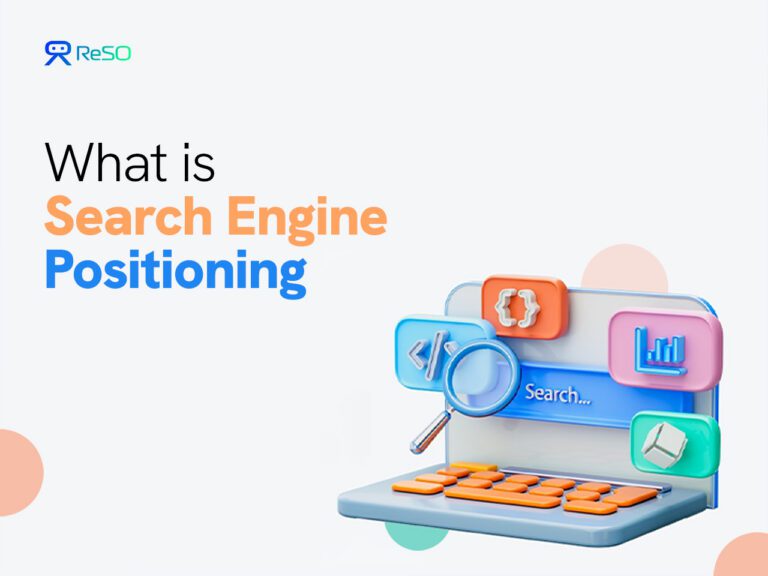
Search Engine Positioning in AI is the discipline of shaping how search engines and AI answer systems interpret, represent, and recommend a brand, not just where a page ranks for a keyword.
Search Engine Positioning determines whether systems like ChatGPT, Google AIO, and Perplexity recognize a company as a credible entity, associate it with the right use cases, and feel confident citing it in synthesized answers.
For B2B SaaS teams, Search Engine Positioning has become a practical question: “When prospects ask AI tools for recommendations in our category, do those systems include us, and do they describe us correctly?”
What is Search Engine Positioning in AI?
Search Engine Positioning in AI is the process of improving how search engines and AI answer systems identify a brand as an entity, interpret its meaning in context, and decide whether it is trustworthy enough to cite or recommend in response to relevant queries.
Search Engine Positioning in AI spans traditional search surfaces (ranked results, knowledge panels) and AI-mediated surfaces (summaries, citations, recommended vendors).
Search Engine Positioning in AI matters because AI systems increasingly act as the first layer of discovery. When an AI system forms an incomplete or incorrect understanding of a brand, every downstream output: summaries, comparisons, “best tools” lists, can reinforce the wrong narrative.
How is Search Engine Positioning different from “SEO rankings”?
Traditional “search engine positioning” historically meant ranking position for a keyword. In an AI-shaped discovery environment, “positioning” is better understood as interpretation quality: what the system believes a brand is, what it associates the brand with, and whether it trusts the brand enough to include it in answers.
Rankings still matter for traffic-driven SEO, but rankings alone do not guarantee inclusion in AI answers. AI systems often synthesize responses from a small set of sources they consider credible and contextually relevant, which means the “position” a brand holds inside the answer can diverge from where any single page ranks in the SERP.
What are the key characteristics of Search Engine Positioning in AI?
- Entity recognition is the foundation: Search Engine Positioning depends on a brand being recognized as a distinct entity with consistent attributes (name, category, offerings, competitors, geography, audience). Entity confusion creates inconsistent or missing recommendations.
- Contextual relevance drives when a brand is “eligible.” Search Engine Positioning improves when AI systems consistently connect a brand to the right intents, prompts, and decision contexts (for example: “best SOC 2 compliance tools for SaaS” versus generic “security”).
- Citation and answer inclusion are explicit outcomes. In AI-mediated discovery, strong Search Engine Positioning shows up as mentions, citations, and recommended-vendor placements in systems such as Google AIO, ChatGPT, and Perplexity.
- Evidence strength is a ranking signal for answers. Original research, clear claims, and verifiable references increase the probability that an AI system can “justify” citing a source without hallucinating. Search Engine Positioning improves when the web contains high-confidence evidence about the brand.
- Trust signals accumulate across the whole web. Search Engine Positioning is influenced by brand mentions, reviews, authoritative citations, consistent profiles, and transparent credibility markers that map to E-E-A-T-style evaluation.
- Cross-system consistency matters more than any one channel. Search Engine Positioning is not limited to one crawler or one model. Brands often appear differently across Google, Bing-connected systems, and LLM answer engines, so positioning work must be validated across multiple surfaces.
These characteristics share a practical theme: Search Engine Positioning in AI is less about “winning a spot” and more about being understood well enough to be reused accurately.
How is Search Engine Positioning in AI used in practice?
1) Category and use-case association
Search Engine Positioning directly affects whether a brand is recommended when users ask questions like:
- “Best contract management software for mid-market SaaS”
- “Tools like X, but cheaper”
- “SOC 2 vendors for startups”
In these queries, AI systems often act like a synthesis layer that filters to a shortlist. Strong Search Engine Positioning increases the odds that the brand is included and described using the correct positioning language (category, ICP, differentiators, integrations).
2) Competitive comparisons
Search Engine Positioning matters when users ask:
- “X vs Y: which is better for Z?”
- “Alternatives to X”
- “Is Y good for enterprise?”
If the web’s signals about the brand are fragmented, AI comparisons tend to collapse into generic statements. Search Engine Positioning improves when the brand has clear, repeated, evidence-backed claims that models can safely paraphrase.
3) Credibility checks
B2B buyers increasingly use AI to validate trust quickly:
- “Is [Brand] legit?”
- “Does [Brand] integrate with Salesforce?”
- “Is [Brand] SOC 2 compliant?”
Search Engine Positioning is strengthened when the answers to these questions are explicit, consistent, and supported by corroborating sources across the open web.
4) Thought leadership and citation capture
AI tools cite sources when users ask “why” and “how” questions:
- “How to measure LLM visibility for B2B SaaS”
- “What influences citations in AI Overviews”
- “What is Generative Engine Optimization?”
Search Engine Positioning improves when a brand publishes durable reference content that is easy to extract, verify, and cite. Research-backed pages can become “default sources” for AI retrieval over time.
Why does Search Engine Positioning in AI matter for B2B SaaS?
Search Engine Positioning in AI changes the economics of discovery in three ways.
- Answers compress choice. A ranked SERP might show ten blue links (plus ads and features). AI answers often present a smaller set of sources and a shorter list of recommended vendors, which makes inclusion more valuable and exclusion more costly.
- Interpretation becomes the bottleneck. When a model misunderstands a brand’s category, the model can exclude the brand from the very prompts that should mention it. A “good product.”
- AI systems reward evidence density. Pages and sources that contain clear definitions, concrete claims, and verifiable facts are easier for AI systems to reuse. The research pack highlights that structured formats, such as FAQ schema and evidence-rich content, correlate with higher citation likelihood in AI responses.
For SaaS leaders, Search Engine Positioning is not an abstract marketing concept. Search Engine Positioning influences:
- pipeline quality (who gets shortlisted),
- sales cycles (how quickly prospects trust basic claims),
- and category leadership (who becomes the “default” tool in AI answers).
What influences Search Engine Positioning in AI systems?
Search Engine Positioning in AI typically depends on five signal clusters.
1) Entity clarity signals
Entity clarity signals help systems decide that a brand is a single, consistent thing. Entity clarity is strengthened by consistent naming, unambiguous category labeling, structured data, and repeatable “about” statements across owned and third-party pages.
2) Context and semantic proximity signals
Context signals help systems map a brand to topics, problems, and adjacent entities. Context is strengthened when content repeatedly connects the brand to specific use cases, buyer roles, and comparison sets, rather than only describing generic features.
3) Evidence and verifiability signals
Evidence signals help systems justify statements. Evidence strength increases when claims are supported by primary sources (benchmarks, case studies, product docs, transparent methodology) and when third parties corroborate the claims.
4) Trust and authority signals (E-E-A-T-style)
Trust signals include consistent reputational cues across the web: authoritative mentions, high-quality reviews, known experts attached to content, and stable company facts. The research pack frames trust as a prerequisite for reliable inclusion.
5) Selection and inclusion mechanics
AI systems often choose sources based on a blend of relevance, authority, freshness, and extractability. Search Engine Positioning improves when content is structured so systems can quote and attribute accurately, including via Q&A sections and clear definitions.
Search Engine Positioning in AI at a glance
| Aspect | What it means | What to measure |
| Entity recognition | AI systems correctly identify the brand as a distinct entity | Brand name consistency, knowledge/profile alignment, entity confusion frequency |
| Context association | AI systems connect the brand to the right use cases | Coverage across category prompts, “best tools for X” inclusion rate |
| Citation eligibility | AI systems can safely cite the brand’s content | Citation frequency, source diversity, extractable proof points |
| Evidence strength | Claims about the brand are verifiable and corroborated | Presence of benchmarks, case evidence, and transparent docs |
| Trust signals | The web provides credibility cues AI systems trust | Authoritative mentions, reviews, and expert attribution consistency |
Many teams still measure only classic SEO outcomes (rankings, clicks, sessions). Search Engine Positioning in AI adds a second layer: representation outcomes.
Ready to improve how AI systems position your brand? Book a call with ReSO, which helps SaaS teams analyze how brands appear, are cited, and are recommended across AI-mediated answer systems.