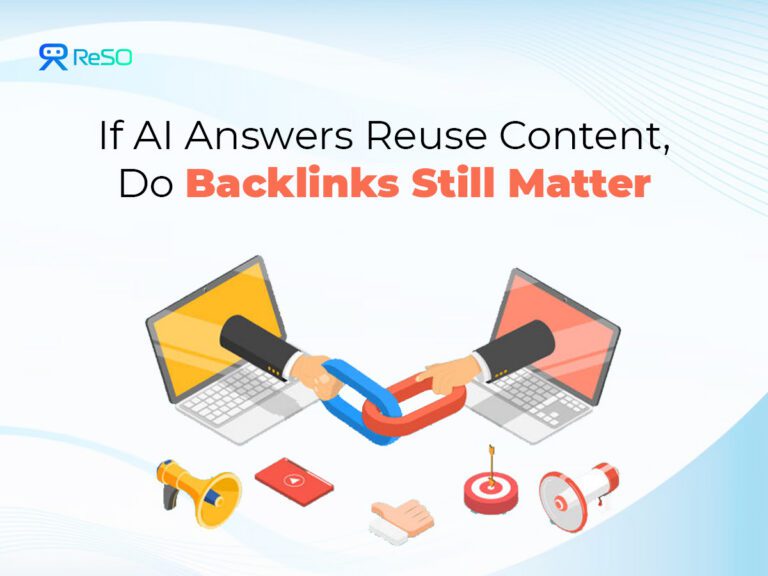
AI answer engines increasingly surface information without sending clicks. Users ask ChatGPT, “How do I optimize content for enterprise CRM demos?” and receive synthesized recommendations, no blue links, no website visits necessary. This zero-click reality has created genuine confusion among SEO and growth teams: if AI can read, reuse, and summarize content directly from websites, what is the point of earning backlinks anymore?
The question matters because backlinks have been the cornerstone of digital visibility for over two decades. Google’s original PageRank algorithm made them fundamental trust signals. Teams have invested countless hours in link-building campaigns, guest posting, and digital PR, all to earn those authoritative votes of confidence. Now, with AI systems like ChatGPT providing answers without clicks, many wonder if that entire foundation is crumbling.
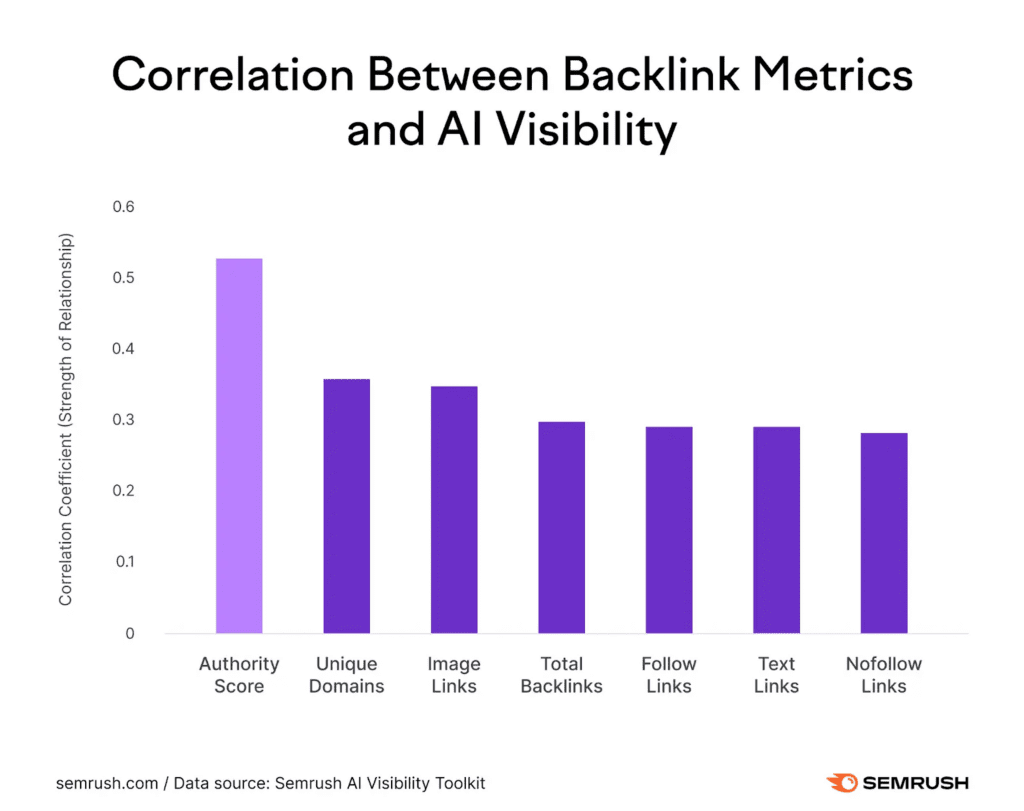
According to comprehensive research from Semrush analyzing AI visibility patterns, domain authority built through backlinks shows a 0.23-0.36 correlation with AI mentions. While link quality demonstrates an even stronger 0.65 correlation (Pearson) with AI citations. Teams that stop building links risk losing trust, eligibility, and authority inside AI answers, even if their content is strong.
This means backlinks boost AI visibility mainly through quality and domain authority, not raw volume; teams ignoring links lose trust signals despite great content.
How Backlinks Function in AI-Powered Search
The Traditional Backlink Model
Backlinks used to work in a simple loop:
- Authoritative sites linked to you
- Search engines treated those links as votes
- Enough high‑quality votes pushed your pages up the rankings (and brought traffic).
That logic still partly holds. In an analysis of 75,000 brands, 76.10% of pages cited in Google’s AI Overviews also rank in the top 10 organic results, showing that strong traditional rankings and AI citations usually go together. If you want to appear in AI‑generated answers, earning high positions in classic search is still a critical first step.
How AI Transforms Backlink Value
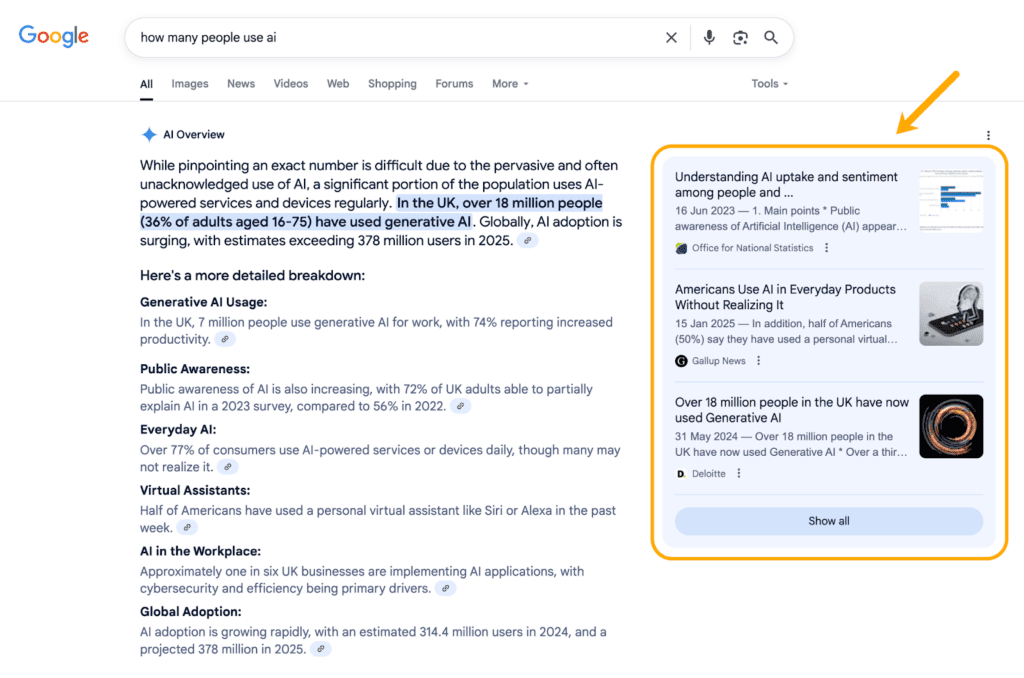
Instead of using links mainly as ranking factors, AI treats them as trust and authority signals to decide which sources deserve citations in answers.
Editorial.link’s analysis of AI citation patterns found link quality is the strongest predictor of visibility, with correlations of 0.65 (Pearson) and 0.57 (Spearman), higher than domain authority alone (0.23 – 0.36).
Surprisingly, nofollow links perform almost the same as follow links for AI visibility (0.340 vs 0.334 Pearson), implying systems care more about the mention and its context than the attribute. Even more striking, image‑based backlinks beat text links for AI citations (0.415 vs 0.334 Pearson), especially on higher‑authority domains.
The Counterintuitive Finding
Data from this SCRIBD doc flips the usual SEO story: sites with just 1-9 backlinks averaged 2,160 AI citations, while those with 10+ backlinks averaged only 681. That only makes sense if AI systems are prioritizing content quality and usefulness over raw link volume.
Niche sites with few links but deep, well‑structured content can win big in AI answers, while high‑authority domains with huge backlink profiles may be cited less if their content is shallow, outdated, or hard to parse. The takeaway: backlinks still set the authority baseline, but heavy AI citations demand content that’s specifically optimized for clarity, structure, and intent, not just for link‑building.
Brand Mention: The New Citation Currency
| Idea | What is happening? | Why it matters? |
| Mentions now matter like links | Google and Bing increasingly factor brand mentions and citations (even without hyperlinks) alongside traditional backlinks. | You can’t rely on links alone; search engines read unlinked mentions as additional authority signals. |
| How engines treat mentions | Google tends to use mentions to reinforce link authority, while Bing can surface strong entities and on‑page signals even without links. | Strong, consistent mentions can help you show up, especially on Bing, even when links are sparse. |
| AI platforms and mentions | AI tools like ChatGPT heavily cite Wikipedia, Reddit, and authoritative listicles, so positive discussions there make brands citation‑worthy, even without hyperlinks. | If users talk about you on trusted platforms, AI is more likely to recommend you in “best tools” and comparison answers. |
| Strategic takeaway | Winners in AI visibility mix robust backlink profiles with broad, contextual brand mentions across review sites, comparisons, communities, and media. | Build a dual strategy: earn quality links and seed accurate, valuable mentions wherever AI systems already like to pull sources. |
Which Is Most Likely to Require a Citation?
- AI prefers comparison content, not slogans: AI assistants mostly cite objective formats: reviews, “best of” listicles, buyer’s guides, and editorial explainers, rather than brand homepages or salesy product pages.
- Third‑party validation beats “we’re the best”: When someone asks ChatGPT for recommendations, it looks for TechRadar‑style comparisons, G2 review data, or Reddit discussions that offer real pros/cons; not your own marketing copy.
- Backlinks + mentions are now a package deal: Backlinks to your site still signal authority, but AI visibility also depends on being mentioned inside those comparison pieces, review platforms, and authoritative listicles that AI loves to quote.
Do Backlinks Still Matter? The Data Says Yes, But Differently
Backlinks still matter in AI, but what they do has changed.
Surveys show 95% of SEOs still rate backlinks as “critical” or “very important,” and studies keep finding strong correlations between link strength, organic rankings, and AI citations. AI systems still need authority signals, and backlinks remain the main way to prove credibility.
The shift is from volume to quality + context. Instead of “get 100 links,” the effective play is “get ~10 links from authoritative, context‑relevant sites, inside content aligned to your target topics and entities.”
AI Overviews heavily favor big, authoritative domains with strong backlink profiles, while leaked Google docs and independent analyses indicate Google now cares far more about link relevance and domain quality than raw counts.
AI Citations vs Backlinks: Understanding the Relationship
| Concept | What it means | Practical implication |
| Backlinks = foundational authority | Quality backlinks build domain authority, so AI systems see your site as credible enough to cite at all. | You still need a solid backlink profile; without it, even great content may be ignored by AI systems. |
| AI citations = active relevance | Citations in AI answers show your brand is currently being picked as useful at the exact moment of user need. | Track how often you’re cited in AI answers as a real‑time signal of topical relevance, not just historic authority. |
| Shared strategy for links + citations | Yoast’s research shows the same moves can earn both backlinks and AI citations: original research, guest content, PR, and third‑party mentions. | Create linkable, data‑rich assets and collaborate with publishers so journalists, bloggers, and AIs all have strong reasons to reference you. |
| Context beats the href tag | AI engines choose sources based less on raw link metrics and more on clarity, depth, structure, and semantic relevance. | Optimise content for extractability (clean sections, clear claims, rich context) so LLMs can easily lift and cite your material, rather than chasing links alone. |
The Strategic Shift: From Link-Building to Authority-Building
5 Backlink Strategies for AI Citations:
- Quality > Volume: Ditch spammy links: target AI-cited domains like Wikipedia, media outlets, Reddit, and niche pubs.
- Topical Relevance Wins: DR 50 niche link > DR 90 unrelated; AI checks semantic context.
- AI-Extractable Content: Use clear product pages, FAQs, pricing, cases; keep fresh.
- Semantic Markup: Structured data helps AI parse your content secondhand.
- Diversify Signals: Mix backlinks with unlinked mentions (Reddit, G2, Wikipedia) for authority.
Backlinks still matter; what changed is how they matter.
However, the playbook is different now.
- Volume is less important than links from domains AI already trusts
- Image links can outperform text links
- Nofollow links behave almost the same as follow links for AI citations, while pure brand mentions on sites like Wikipedia and Reddit carry real weight.
The winning strategy: treat backlinks as the foundation, then layer on brand mentions, review‑site presence, comparison content, and community discussions, all supported by AI‑ready on‑site content (clear structure, schema, freshness).
Authority still wins, but today it has to exist across links, mentions, and content quality, not backlinks alone.
If you’re looking to know how and where your brand is cited by AI in 2026, book a call with ReSo here.