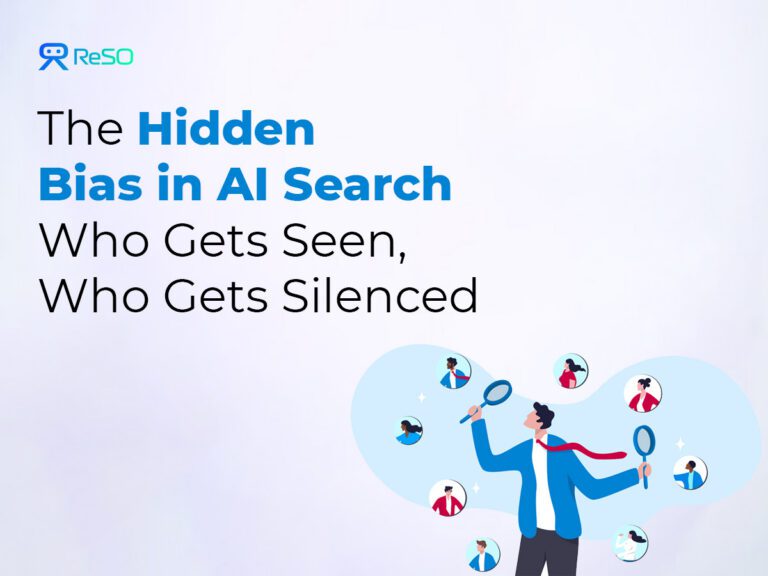
Every time someone asks ChatGPT a question, searches on Perplexity, or uses Google’s AI Overviews, an invisible selection process happens. Out of millions of possible sources, the AI displays only a handful. Most users assume this selection is neutral and objective, but it’s not.
Bias isn’t a bug in AI. It’s woven into how large language models work. For businesses and creators, the risk of being excluded from AI search results is real and growing. As of 2025, 13.14% of all search queries now trigger AI Overviews, a number that keeps climbing. (Source: Semrush)
When AI determines what information matters, whoever gets left out fades into digital invisibility.
This is happening right now, shaping who gets seen and who is silenced in the digital economy.
Key Takeaways:
- AI search platforms select only a few sources out of millions, and this selection is influenced by embedded biases, not neutral objectivity.
- Large Language Models prioritize content from high-authority domains, frequently cited sources, and recent or popular information, marginalizing niche voices and new entrants.
- Biases in AI search include demographic, geographic, topic-based, source type, and temporal biases, systematically prioritizing certain perspectives while silencing others.
- Being excluded from AI search results risks losing discovery, revenue, trust, and market share, creating a winner-take-all dynamic favoring established brands.
- Businesses must proactively build authoritative digital footprints, diversify platform presence, optimize content structure, and earn credible citations to improve AI visibility.
- Continual monitoring, engagement with AI feedback, ethical transparency, and focus on original expertise are essential strategies to stay visible and trusted in an evolving AI search landscape.
How LLMs Decide What to Show
Training Data Are The Foundation
LLMs are trained on huge datasets scraped from the internet, but not every source counts the same. High-authority domains, frequently-cited sources, and content with certain quality signals get more weight.
If your content isn’t well-represented in the training set, it basically doesn’t exist for the model.
Position bias affects what gets pulled: MIT research shows that LLMs overemphasize information at the beginning and end of documents, skipping the middle (“position bias”). Even if your content is in the model, how you structure it can make or break whether it gets retrieved.
Recency and popularity create feedback loops: LLMs favor information that’s recent and appears frequently across multiple sources.
This privileges established brands and trending topics, while newcomers and niche experts are deprioritized.
Citation networks decide algorithmic authority
LLMs mimic academic citation patterns: the more a source gets cited, the more authority it gets, creating a winner-take-all dynamic.
Alignment and safety filters shape results
To prevent harmful outputs, LLMs deploy filters. Necessary as they are, these also suppress some legitimate viewpoints, especially on sensitive topics. What’s “safe” vs. “unsafe” is a human, subjective choice, now built into the system.
A 2025 PNAS study found LLMs now prefer AI-generated content 78% of the time for academic papers, versus 51% human preference. As more AI-generated content populates the web, this preference may marginalize authentic human voices further, resulting in a self-reinforcing cycle.
For users, there’s little transparency in why they see what they see. For businesses and creators, it’s a competition happening on an invisible, always-shifting playing field.
The Systematic Effects of AI Bias in Search
| BIAS | DESCRIPTION | IMPACT |
| Demographic | LLMs reflect stereotype biases from training data involving race, gender, religion, and health. | Certain demographic groups and perspectives get prioritized or silenced. |
| Geographic | English-language, Western sources dominate LLM training data. | Western viewpoints get algorithmic preference; non-Western/non-English views see less exposure. |
| Topic | Dominance of established institutions in certain fields like medicine and finance in training data. | Niche or alternative perspectives are buried and underrepresented. |
| Source Type | Preference for established publishers, academic papers, and government sites by LLMs. | Independent voices, blogs, startups sidelined despite quality content. |
| Temporal | Preference for recent content over older, foundational research or evergreen resources. | Deep, long-standing insights are overlooked in favor of newer but potentially less substantive sources. |
Risks for Businesses and Brands
Lost discovery means lost revenue
As more people rely on AI for research and decision-making, being omitted from results erases your brand’s visibility. Perplexity AI has about 22 million monthly active users in 2025: if your brand isn’t shown, you’re invisible to millions.
Competitor advantage
AI usually references three to five sources. If your competitors show up and you don’t, their perceived authority and customer acquisition snowball, while you fall further behind.
Trust erosion
If your brand isn’t recommended by AI, users may doubt your relevance or credibility, even if they discover you elsewhere.
Market share concentrates
With algorithms amplifying the rich-get-richer dynamic, challengers find it ever harder to break through. This hurts marketplace diversity and innovation.
Strategic planning gets harder
The opacity and constant evolution of AI ranking make it tough to predict or measure what works. Hence, making marketing and investment planning riskier than ever.
Dependency increases
As AI-powered search takes over, brands become more dependent on a handful of platforms, with little recourse if rules change or results are unfair. This isn’t just a marketing problem. It’s existential for brands in an AI-first future.
How to Protect Brand Visibility in AI-Driven Search
- Build an authoritative digital footprint: create well-sourced, deep content to show expertise.
- Diversify platform presence: be on multiple AI platforms and maintain strong LinkedIn and forum profiles.
- Optimize content for AI: use clear headers, summaries, and structured data; highlight key info at start and end.
- Earn citations from reputable sources: gain references from publishers, academics, and industry leaders.
- Be transparent and ethical: ensure content accuracy and clear author credentials.
- Monitor AI visibility: track brand mentions on AI platforms and adapt strategies if excluded.
- Engage with AI feedback channels: report misrepresentations and document recurring issues.
- Focus on original, unique content: prioritize genuine expertise over AI-generated material.
- Build direct audience relationships: use email lists and communities to reduce algorithm dependency.
- Stay adaptable: keep up with AI trends and update strategies regularly.
The Future: Visibility Is Survival
AI search is changing how people discover brands and information. AI bias is not going away soon, so awareness and action are essential. Waiting for platforms to become fair is not a strategy: actively monitoring, optimizing, and building genuine authority is how you stay seen.
The companies that thrive in AI search are those that understand how the game is played, recognize underlying biases, and adapt their strategies to stay visible and trusted. Today, visibility is about genuine expertise and strategic adaptability, not just SEO or paid ads.
Those who master this new landscape will seize opportunities. Those who don’t will fade, wondering why the customers who once found them have disappeared. And if you’re looking to make sure you don’t disappear in the future under AI’s visibility forum, book a call with us now.
Frequently Asked Questions
How does AI decide which sources to show and which to exclude?
AI search engines select sources based on authority signals, citation frequency, semantic relevance, recency, and content structure. Sources that are frequently referenced, clearly structured, and trusted across the web are favored, while low-signal or poorly contextualized content is excluded.
What types of bias exist in AI search results?
AI search results are shaped by training-data bias, citation bias, source authority bias, recency bias, geographic and language bias, and safety-filter bias, which together favor established, frequently cited sources while marginalizing newer, niche, or non-Western perspectives.
Why do established brands dominate AI search visibility over new or niche companies?
Established brands dominate AI search visibility because LLMs prioritize frequently cited, high-authority, and widely repeated sources.
Existing citation networks, brand mentions, and historical coverage create trust signals that AI reuses, making newer or niche companies harder to surface.
What risks do businesses face if they are not cited by AI search tools?
Businesses that are not cited by AI search tools lose discovery, perceived authority, and demand at the decision stage. This leads to reduced visibility, weaker trust, declining pipeline, and competitor lock-in, as AI answers shape shortlists before users ever visit websites.
How can brands improve visibility and reduce bias impact in AI search results?
Brands can improve AI search visibility by building clear authority signals:
- Publish original
- Well-structured content
- Earn third-party citations
- Reinforce consistent entity definitions
- Stay active across trusted platforms
Monitoring AI mentions and updating content regularly helps reduce bias-driven exclusion.