AI crawlers have quietly become some of the heaviest users of the internet, with every major crawling bot now scanning more pages than any human ever could. They scan through more content than any human ever could, pulling in massive amounts of data that content creators and businesses have spent real time and money producing.
Until now, content owners faced only two choices:
- Block these AI crawlers
- Give away their hard-earned content for free.
However, there’s a third way that Cloudflare is pioneering, and it’s about to change the way we think about content on the internet: charging AI crawlers per crawl.
Let’s break this down.
Key Takeaways
AI crawlers eat up more content than humans, but rarely drive traffic back to your site.
Cloudflare’s new pay-per-crawl system lets you charge AI bots for accessing your content, finally monetizing machine consumption.
The ratio of crawls to actual visits is crazy low: OpenAI crawls 1,700 times for every single visit it sends back.
This shift opens doors for tiered licensing, where you can charge differently based on who’s crawling and why.
To stay ahead, rethink your content strategy and revenue model for a future driven by AI bots, not just humans.
From Free Crawling to Paid Machine Access
Content creators, especially in the B2B world, rely on traffic and engagement to fuel their business models. But AI crawlers, including every large-scale crawling bot used by companies like OpenAI and Anthropic, have been sweeping websites without paying a cent, often not even sending users back to those sites.
That means publishers get barely any meaningful traffic or revenue from those visits. The traditional model of free crawling is collapsing. That’s why Cloudflare’s new “pay per crawl” system is so important.
So, how does this pay per crawl system work? It’s straightforward:
- A crawler requests content from your website.
- If the crawler is approved and includes payment, the server serves the content.
- If not, the server pushes back an HTTP 402 “Payment Required” response.
- You, as the content owner, control which crawlers get access, whether to allow them for free, charge them, or block them entirely.
- Prices per crawl are set by you, and Cloudflare handles the enforcement, authentication, and billing.
What this really means is that content creators can reclaim control at an internet scale. Instead of passively feeding every AI model that comes knocking on the digital door, you establish clear, transparent rules for how your content is accessed and monetized.
The Math Behind the Imbalance: Crawls vs Visits
According to Cloudflare, major AI bot traffic is hugely disproportionate compared to the visits they actually return. Google, for example, sends roughly one visit back to a website for every 14 times it scrapes a page. But OpenAI’s crawlers only send back one visit for every 1,700 times they scrape.
Anthropic does even worse with one visit per 73,000 crawls. That’s not just inefficient. It’s unsustainable. It’s like handing out samples without ever making a sale.
So what does this mean for B2B companies: AI models are becoming a major consumer of content, but that consumption doesn’t translate into meaningful website traffic or leads unless you take steps to monetize it directly. Cloudflare’s pay per crawl is a way to put a price on that consumption.
Now, there’s an engineering and infrastructure angle here too.
Many publishers don’t have the resources or time to build complex paywalls or negotiate deals with every AI company. This system automates everything. Or you pick your pricing, manage crawler access in one place, and Cloudflare does the heavy lifting behind the scenes. It’s like giving yourself a digital toll booth that can keep pace with internet-scale crawling.
Suppose you are in a world where every crawl or pageview can be priced according to its value, and content isn’t just locked behind user paywalls, it’s priced by machine access.
That opens pathways for innovative licensing models that differentiate by who the bot is, their intended use, or the AI model type accessing the data.
For B2B companies, this opens some interesting possibilities:
- You can open up your content for machine consumption but monetize it directly, reducing the risk of losing business to AI content scraping.
- You can create multiple tiers of licensing based on the bots crawling, think a lower rate for internal training versus a higher rate for commercial AI services.
- You’re preparing your digital ecosystem for the agent-driven web, where AI agents will scour, remix, and monetize content on a scale we’re only beginning to grasp.
What this really means is that your content strategy and revenue models need to evolve with the technology shaping the internet.
What This Means for B2B Companies
Now, for a few stats focused on B2B content marketing that put this all in perspective. According to the Content Marketing Institute’s 2025 B2B Content Marketing Benchmarks research, 57% of B2B marketers cited “creating the right content for the audience” as a challenge last year, but that number has dropped to 40% this year
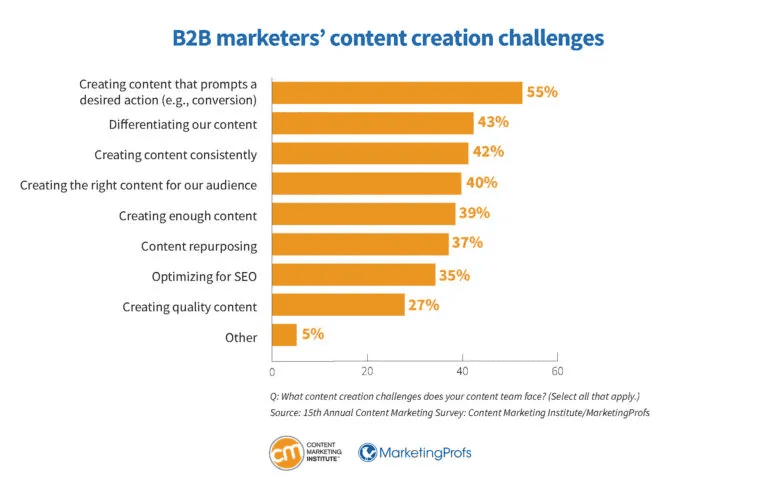
What this tells us is that B2B marketers are getting smarter about content. However, fewer than half have a scalable model for content creation, which creates bottlenecks in execution and audience engagement.
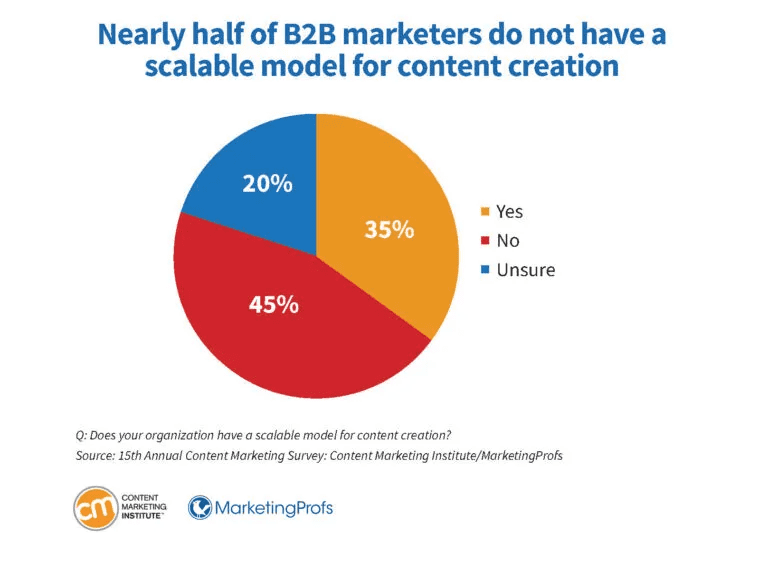
Here’s the thing about content ROI measurement: it’s often incomplete. Many B2B marketers look only at the costs of distributing content, like advertising spend, while ignoring the creation costs, the time and money spent scripting, designing, and producing that content.
So even when AI crawlers are pulling your content for free, you don’t see a direct connection to ROI impact comprehensively. If pay per crawl takes hold, it gives a clear way to translate AI consumption into actual revenue, improving that missing link in content ROI accounting.
Another stat that matters is the growing dominance of bots online, especially the surge in AI bot traffic across B2B and content-heavy websites. A 2025 study from Stan Ventures shows that between 42% and 70% of all internet traffic is now generated by bots, with AI bots increasingly leading this charge.
What this means for your B2B site is that you’re no longer playing by human user rules alone. Bots are ramping up their consumption, from scraping to interaction, and it’s critical to govern how and when you grant them access.
Cloudflare’s system handles this by using the HTTP 402 status code. This is a rarely used but officially recognized way to say “hey, payment required.” It’s transparent for bot operators, clean for site managers, and sets a new standard for how the web’s infrastructure can evolve with AI.
As more businesses adopt pay-per-crawl, AI companies will naturally have to factor content access costs into their models, which could level the playing field for content creators and allow sustainable growth of quality material.
Rethinking Content for an AI-Driven Web
How would your B2B content marketing strategy shift if every AI pageview had a price tag? What new partnerships or licensing models could emerge if you flipped the game from free extraction to paid consumption?
Cloudflare isn’t just solving a crawler problem.
- They’re building the infrastructure that supports the future economy of the web, a web powered by AI agents, where content isn’t just consumed, it’s part of a transparent, fair, and monetized ecosystem.
- It’s a line in the sand for content creators: You no longer need to choose between letting AI scrape you dry or locking content behind user paywalls and losing reach. With pay per crawl, you get control, choice, and a clear path to monetize AI-driven access.
- This is about more than technology. It’s about valuing the work that goes into creating content and ensuring that the exploding use of AI on the internet doesn’t come at your expense. It’s a reset for the digital economy, and it’s starting now.
Book your call with us to enhance your AI discoverability.