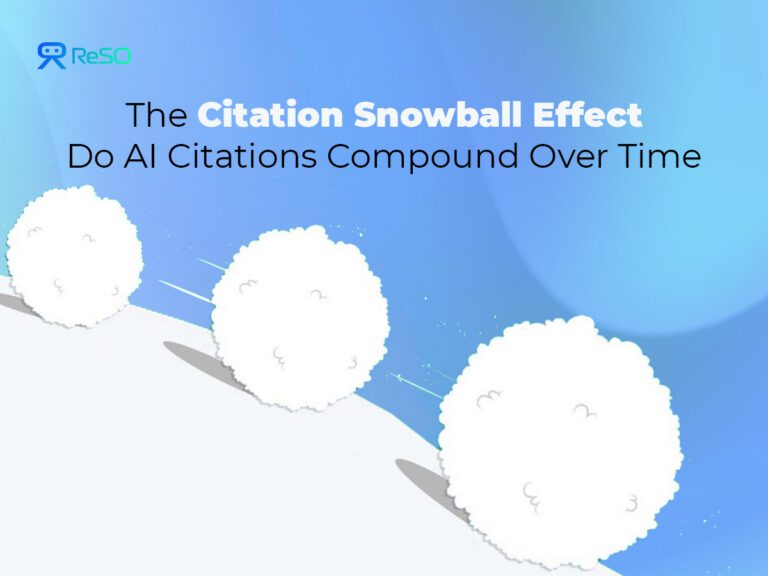
The “Citation Snowball Effect” refers to a potential feedback loop where once an AI search engine cites a page from a given domain, it becomes more likely to cite other pages from that same domain on related queries.
Our investigation of over 5,000 prompts and more than 5 million citations finds that there is some technical basis for this effect, but with important caveats.
Modern Retrieval-Augmented Generation (RAG) pipelines are designed to prioritize relevant and trusted content, which can lead to trusted domains gaining momentum in citations. However, these systems also employ diversity-promoting algorithms to avoid over-reliance on a single source.
In summary, high-authority domains that prove useful can indeed enjoy increased visibility in AI-driven answers, yet mechanisms like re-ranking and filtering temper an uncontrolled “rich-get-richer” runaway. Below, we examine this across four technical layers – from crawl prioritization to retrieval, reranking, and the diversity constraints that limit runaway effects and conclude with a verdict on the snowball effect’s reality.
Why Would Citations Lead to More Citations?
The snowball effect operates through four technical layers. Each creates a different type of feedback between current citations and future citation probability.
- Pre-Retrieval (Crawl Budget): Cited content gets crawled more frequently, which means more of your pages enter the index, which means more chances to match future queries.
- Retrieval (Topical Authority): When AI systems find one page from your domain, they effectively discover your entire topic cluster. Dense coverage in a semantic neighbourhood increases retrieval odds for related queries.
- Reranking (Authority Signals): Ranking models learn from user engagement. Sources that perform well after being cited accumulate preference signals that carry forward.
- Constraints (Diversity Mechanisms): Systems cap domain authority per query and penalise same-source clustering within responses. These prevent runaway snowball effects.
The Mechanisms: How Citation Advantages Compound
Four technical layers determine whether early citations translate into sustained advantage.
Crawl Feedback Loops
AI crawlers don’t visit all websites equally. Content that receives engagement gets crawled more frequently; industry observations suggest high-engagement pages receive visits at rates 10-150x higher than baseline.
More crawling means more of a domain’s content enters the index. More indexed content means more opportunities to match future queries. A brand cited today has more pages available for retrieval tomorrow than a brand that hasn’t been cited at all.
The implication: early citations create indexing advantages that compound over time. The gap between “cited once” and “never cited” widens as crawlers prioritise the already-successful domain. This is sometimes called “citation velocity”; how often a page or domain is referenced affects its crawl priority.
Topical Authority Accumulation
AI retrieval works through semantic similarity. When a query arrives, systems convert it to mathematical representations and search for content with similar representations.
- Domains that publish extensively within a topic area cluster tightly in this mathematical space.
- When one page from a dense cluster gets cited, the system has effectively “found” the entire neighbourhood.
- Future queries touching that topic have a higher probability of retrieving something from the same domain.
- A brand with 50 articles on a narrow topic establishes presence across many query variations.
- A competitor with one comprehensive guide appears for fewer variations, even if the single guide is higher quality.
Early citations help AI systems discover the full extent of a domain’s coverage.
Engagement-Based Learning
Modern AI systems learn from user behaviour. When users click on a cited source and spend time with it, the system records that signal. Over repeated interactions, the ranking model learns to associate certain domains with certain query patterns.
The feedback cycle works as:
citation appears → user engages → system records positive signal → model adjusts → future similar queries favour that source → more engagement → stronger signal.
Research on feedback loops in LLM systems demonstrates how outputs affect subsequent outputs through these reinforcement patterns.
This mirrors the “Matthew Effect” documented in academic citation research; studies show that LLMs exhibit heightened preference for already-cited sources, essentially amplifying the “rich-get-richer” dynamic. Brands that get cited first accumulate engagement data that trains the model in their favour. Brands that never get cited generate no engagement data; they remain invisible to this learning process.
Where the Snowball Hits Limits
Diversity mechanisms prevent any single source from dominating.
Maximum Marginal Relevance (MMR) is a technique that penalises selecting documents similar to ones already chosen. Originally developed at CMU, MMR balances relevance against diversity by reducing the score of candidates that overlap with already-selected documents. In practice, citing one page from a domain makes citing another page from that same domain less likely within the same response.
Domain trust caps normalise authority signals per query. Most implementations prevent any single domain from receiving outsized weight regardless of accumulated advantage.
Reranker imperfection introduces randomness that helps underdogs. Analysis suggests AI rerankers select based on formatting and structure rather than source authority in roughly 40% of decisions. Well-structured content from unknown domains can beat established sources nearly half the time.
Content optimisation levels the field. Research on Generative Engine Optimization found that when brands optimise their content structure, lower-ranked sites see larger percentage gains (up to 115%) than incumbents, who may actually lose relative visibility.
What Does This Mean?
The snowball effect operates as an equilibrium between compounding forces and limiting mechanisms.
| Type | Mechanism | Effect |
| Compounding | Crawl feedback | Cited domains get indexed faster and deeper |
| Compounding | Topical clustering | More content discovered increases retrieval odds |
| Compounding | Engagement learning | Success trains future preference |
| Limiting | MMR diversity | Same-domain clustering penalised within responses |
| Limiting | Domain caps | Authority normalised per query |
| Limiting | Reranker variance | Formatting beats authority ~40% of the time |
For Established Brands
Where snowball effects work in your favour:
- Brand recognition remains the strongest single predictor of citation likelihood
- Multi-platform presence compounds credibility signals
- Existing content depth provides topical authority that new entrants can’t quickly match
- Higher crawl frequencies mean faster indexing of new content
Where constraints limit accumulation:
- When competitors optimise content structure, your relative advantage shrinks
- Platform divergence means dominance on ChatGPT doesn’t guarantee Perplexity citations
- Recency requirements mean old content loses advantages regardless of historical success
For Smaller Sites
Viable pathways despite authority gaps:
- Content optimisation produces larger percentage gains for lower-ranked sites than for incumbents
- Topical precision can overcome authority at the retrieval layer; semantic match matters before domain reputation
- Reranker variance means well-formatted content wins a significant share of decisions
- Recency bias creates openings through update frequency rather than accumulated history
- Narrow semantic clustering lets smaller sites own specific topic neighbourhoods
What Should You Do?
- Get cited once, anywhere
- The gap between “cited once” and “never cited” matters more than the gap between “cited once” and “cited five times”
- First citation triggers crawl feedback and engagement learning
- Target a single platform first rather than spreading effort thin
- Build topical density, not breadth
- Multiple focused articles outperform comprehensive guides for AI retrieval
- Aim to cluster tightly in semantic space around your core topics
- Dense coverage increases retrieval probability across query variations
- Structure content for reranker success
- Clear answer formatting wins in 40% of decisions regardless of authority
- Self-contained sections that make sense without context get extracted more easily
- Specific claims with attribution outperform general statements
- Maintain recency signals
- AI systems heavily weight recent content
- Update existing content rather than letting it age
- Publish consistently rather than in bursts
- Accept platform-specific dynamics
- Citation momentum doesn’t transfer across platforms
- Monitor and optimise for each platform separately
- Prioritise platforms where you have existing traction
If you are trying to understand whether citation momentum is building around your brand, most traditional analytics will not show you what AI systems are actually retrieving, citing, or recommending. ReSO analyses how your brand appears across AI answer systems, identifies citation gaps, and surfaces the citations influencing visibility. If you want to understand where your citation advantage is strengthening, where competitors are gaining ground, and what to prioritise next, book a call with ReSO to review your AI search visibility and opportunity areas.