AI engines are rewriting how discovery works. Buyers now ask ChatGPT, Perplexity, and other LLMs for recommendations, and the models decide which brands appear, which URLs they cite, and whose content they trust.
Generative Engine Optimization (GEO) is the discipline that makes this visibility measurable and improvable. It focuses on the signals LLMs actually use: prompt-level presence, citation patterns, source authority, structured data, and technical clarity.
To win inside AI-generated answers, you need clarity on which capabilities matter most, and a platform that can scale with how AI search is evolving. This guide breaks down the GEO platforms shaping the ecosystem, each addressing a specific layer: content authority, messaging clarity, or AI-driven visibility.
Key Takeaways
- GEO is now essential because AI answers, not blue links, are where buyers first discover brands.
- Each tool below supports a different layer of GEO maturity, from basic visibility checks to full AI-search intelligence.
- SEO strengthens the signals AI models trust, but only GEO determines whether your brand gets mentioned or cited.
- Teams should choose a tool based on their current visibility stage, not trends or hype.
- ReSO stands out as the only platform offering end-to-end GEO intelligence across prompts, citations, competitors, and technical readiness.
ReSO
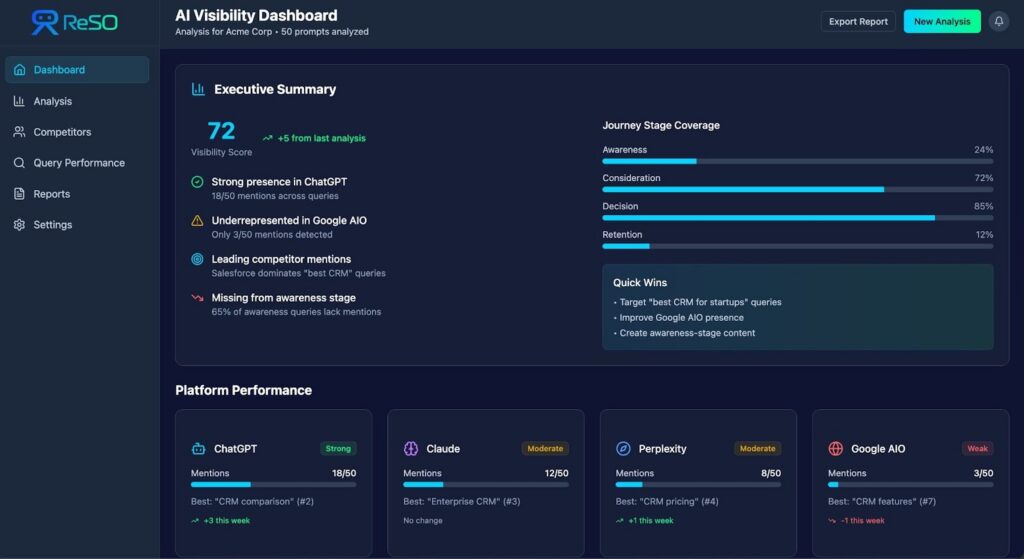
ReSO is a full-stack Generative Engine Optimization platform designed to help companies understand and improve their visibility inside AI-generated answers. As AI search becomes the first touchpoint for buyers, the platform focuses on the signals that actually determine whether a brand appears in ChatGPT, Perplexity, and AI Overview experiences.
Key Features
1. Prompt Intelligence
Reso maps the real questions buyers ask throughout the journey, from early awareness prompts (“top tools for…”) to deep evaluation queries (“is X better than Y?”). This reveals where your brand should appear, which matters most, and how consistently you’re being surfaced across models.
2. AI Visibility Audit
The platform tracks mentions, citations, and recommendations across major LLMs, showing:
- how often your brand appears,
- in which models,
- for which prompt categories,
- and how that compares to competitors.
It’s the closest thing to “SERP monitoring” for AI-generated answers.
3. Source & Gap Analysis
Reso identifies which URLs and domains LLMs rely on to answer queries in your category, and where competitors are being cited instead of you. This helps teams understand the structural reasons behind their visibility gaps: missing topical depth, outdated sources, untrusted pages, thin third-party coverage, etc.
4. Technical Optimization
LLMs rely heavily on structured signals. Reso surfaces:
- Schema gaps
- Metadata inconsistencies
- Crawl issues
- Broken internal signals
- Missing entity associations
These insights highlight the technical barriers preventing models from discovering, trusting, or citing your content.
5. Content Precision
The platform recommends what to update, consolidate, or create next to increase the likelihood of getting mentioned for high-value prompts. Instead of broad keyword lists, you get AI-specific guidance tied to buyer language and model behavior.
Why teams choose it
Reso connects every part of the AI visibility problem: prompts, citations, sources, technical readiness, and competitive gaps—into one workflow. The result is a clear picture of where a brand stands inside AI-generated answers, and what needs to happen next to improve that presence.
Profound
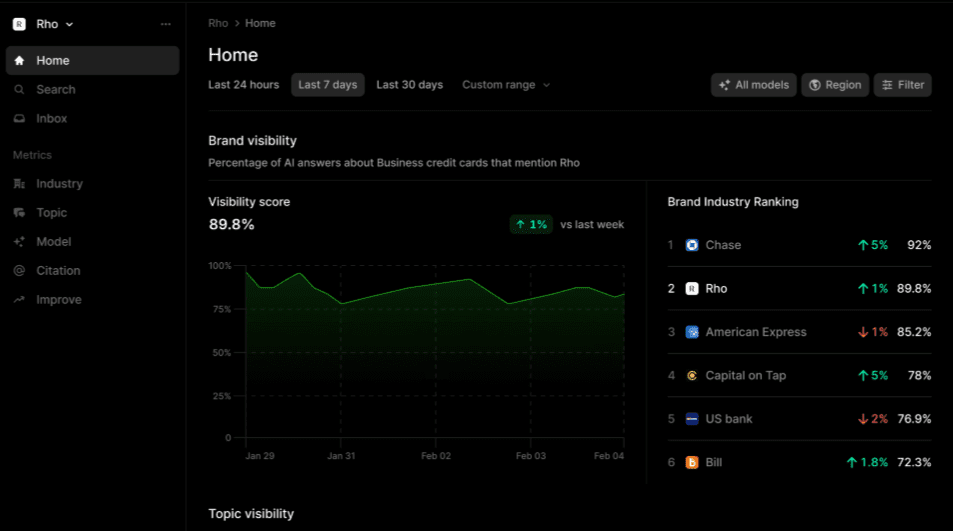
Profound isn’t a GEO platform in the strict sense; it doesn’t track LLM citations or prompt-level visibility. However, it plays a useful role in shaping how AI models might interpret your brand’s messaging. The platform uses AI evaluators to score concepts, value props, and strategic narratives, helping teams refine how they communicate across channels.
Key Features
1. Message Testing & Concept Scoring
Profound evaluates product messaging, brand statements, and positioning ideas to show how clearly they land. It highlights strengths, gaps, and blind spots based on how AI models perceive the narrative.
2. Comparative Analysis
Brands can benchmark their messaging against competitors or category leaders. This helps teams understand whether their value prop feels distinct, generic, or overly technical.
3. Narrative Optimization
The tool offers suggestions to strengthen clarity, coherence, or tone, useful for refining content before it becomes part of your website, sales materials, or thought-leadership assets.
WriteSonic
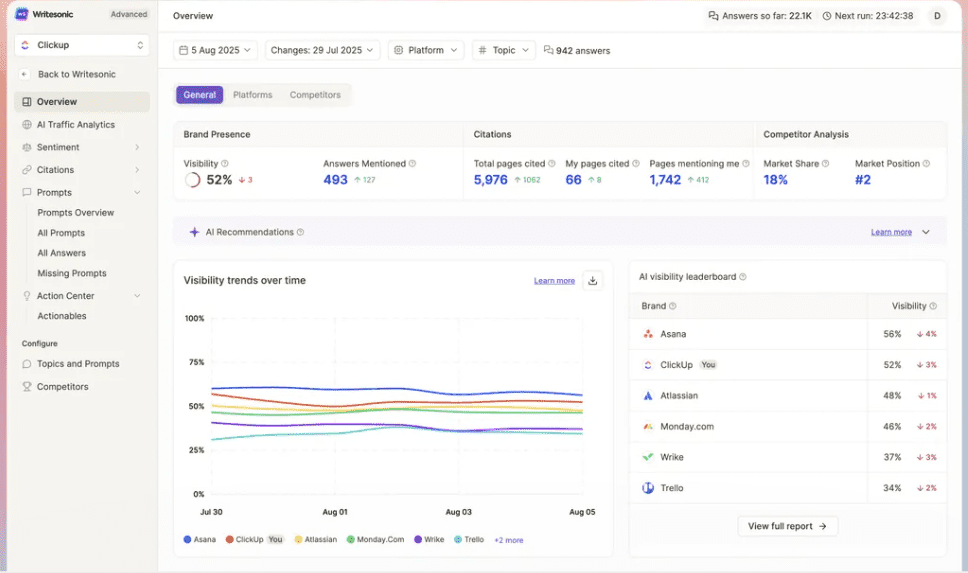
WriteSonic combines AI content generation with a growing suite of tools designed to help brands adapt their content for modern search environments, including AI Overviews and LLM-driven answer engines.
Key Features
1. AI Content Generation
WriteSonic helps teams produce long-form articles, product pages, social copy, and SEO assets quickly. The platform includes templates and guided structures aligned with search-friendly writing practices.
2. AI Overview & SERP Optimization
The tool provides recommendations for improving content visibility across search engines by experimenting with AI-generated summaries. It highlights content depth, topical coverage, and authority signals that influence how models pull information.
3. Topic & Intent Mapping
WriteSonic can analyze keywords, topics, and competitor content to suggest angles that align with what AI models typically surface in summaries or featured responses.
4. Integrated Research & Fact Assistance
Writers can bring in citations, stats, and external references from within the editor, improving the information quality that AI models look for when selecting sources.
Peec AI
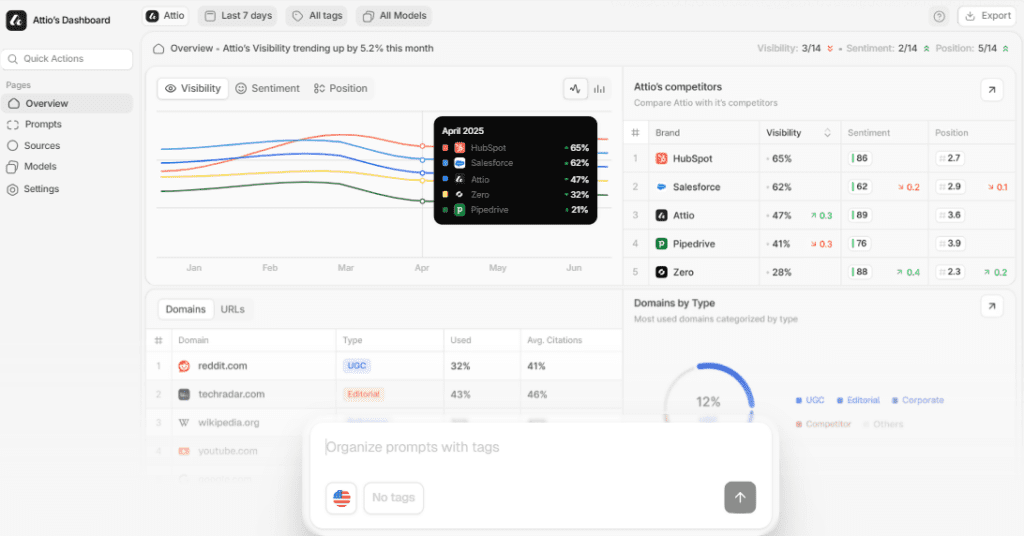
Peec.ai offers a streamlined layer of AI visibility analysis by checking how large language models reference, understand, and describe your brand across prompts.
Key Features
1. AI Response Monitoring
Peec evaluates how different LLMs answer prompts related to your product, category, or competitors.
2. Brand Context Accuracy
The tool checks whether AI-generated explanations, summaries, or comparisons accurately reflect your messaging and value props. This is especially useful for brands with nuanced or technical offerings.
3. Competitor Prompt Checks
Peec runs parallel prompts for competitors, offering a quick way to see where your brand stands across similar queries and what angles other players are being cited for.
Chatrank
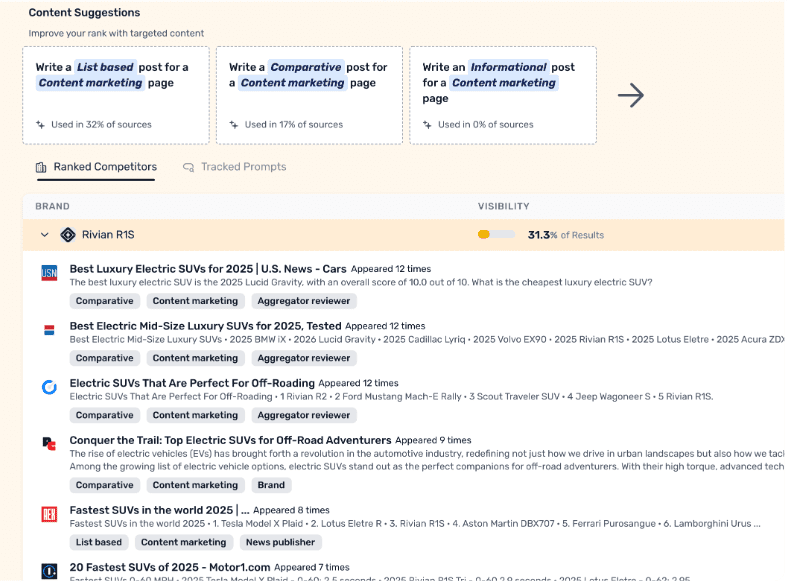
Chatrank provides a basic layer of AI visibility monitoring, helping brands understand whether they appear inside conversational responses from popular LLMs. It focuses on surface-level signals: mentions, basic contextual accuracy, and response patterns, making it a lightweight entry point for teams starting to explore GEO.
Key Features
1. Assistant-Level Presence Checks
Chatrank evaluates how often your brand shows up when users ask relevant prompts in leading AI assistants. It offers quick directional insight into visibility without complexity.
2. Simple Mention Tracking
The platform highlights when and where your brand is referenced, giving teams an easy way to track improvements or declines over time.
3. Basic Competitive Signals
Chatrank runs similar prompts for competitors, allowing for high-level comparison across product categories or industries.
Ahrefs
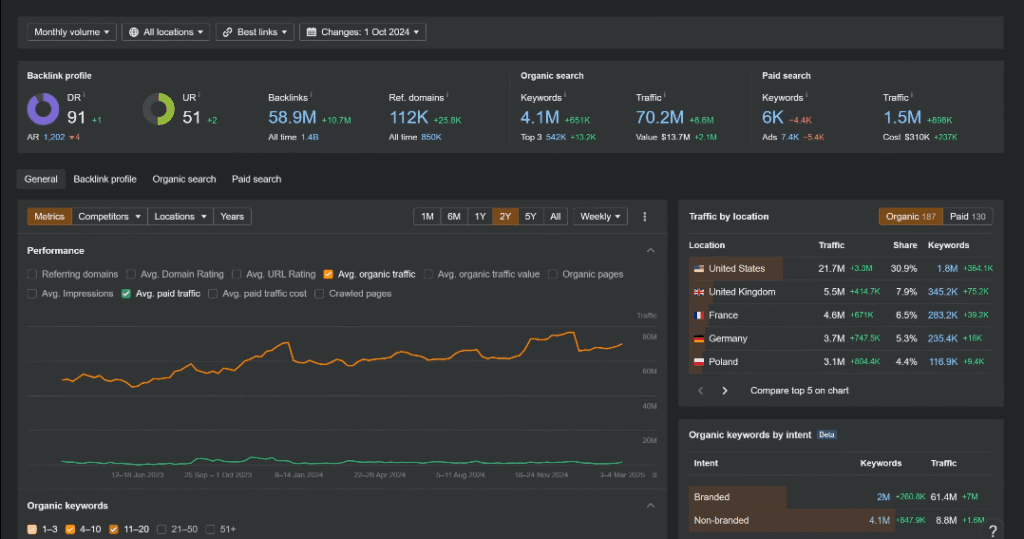
Ahrefs remains one of the most comprehensive SEO platforms on the market, and its role in the GEO ecosystem comes from the signals it helps teams strengthen, including domain authority, backlink profiles, topical depth, and content structure. While it doesn’t track AI-specific mentions, these underlying assets strongly influence which sources LLMs pull from when generating answers.
Key Features
1. Backlink & Authority Intelligence
Ahrefs provides deep analysis of backlinks, referring domains, and link quality, core signals that both search engines and AI models use to determine trustworthy sources.
2. Content & Topic Explorer
With Topic Explorer and Content Gap tools, teams can identify high-value subjects, missing content areas, and competitor coverage, useful inputs when deciding what content to build to support AI visibility.
3. SERP & Trend Monitoring
Ahrefs continuously tracks ranking shifts and emerging search trends.
4. Site Health Audits
Structured data, page experience, and technical readiness still impact LLM crawlability and source prioritization. Ahrefs’ audits help keep the foundation strong.
Semrush
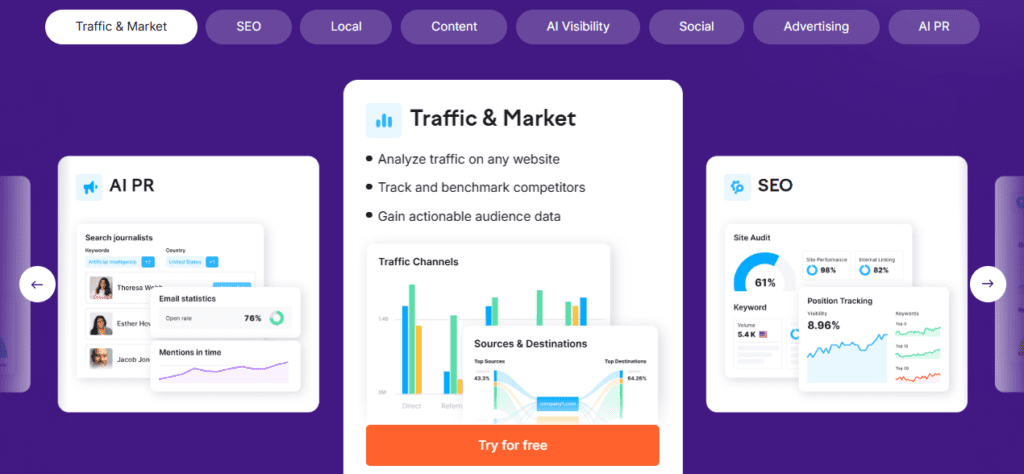
Semrush is an all-in-one marketing and SEO suite that helps teams plan, create, and optimize content for search. Its relevance to GEO comes from how it connects keyword intent, content performance, and visibility across evolving SERP features, many of which now include AI-generated or AI-assisted elements.
Key Features
1. Keyword & Intent Research
Semrush maps keywords to intent types (informational, commercial, transactional), helping teams structure content that aligns with how users phrase queries, useful groundwork for both search engines and LLM prompts.
2. Content Audit & Scoring
The platform evaluates existing pages for depth, readability, topical coverage, and optimization quality. Strong, well-structured content increases the likelihood of being surfaced or cited by AI systems.
3. SERP Feature Tracking
Semrush tracks how often your pages appear in rich results, snippets, and other enhanced SERP placements. As search interfaces become more AI-driven, these signals help teams understand which content formats and topics gain enhanced visibility.
4. Competitive Benchmarking
Teams can see which topics, keywords, and pages competitors dominate. These insights help prioritize content that supports both SEO and GEO goals.
AthenaHQ
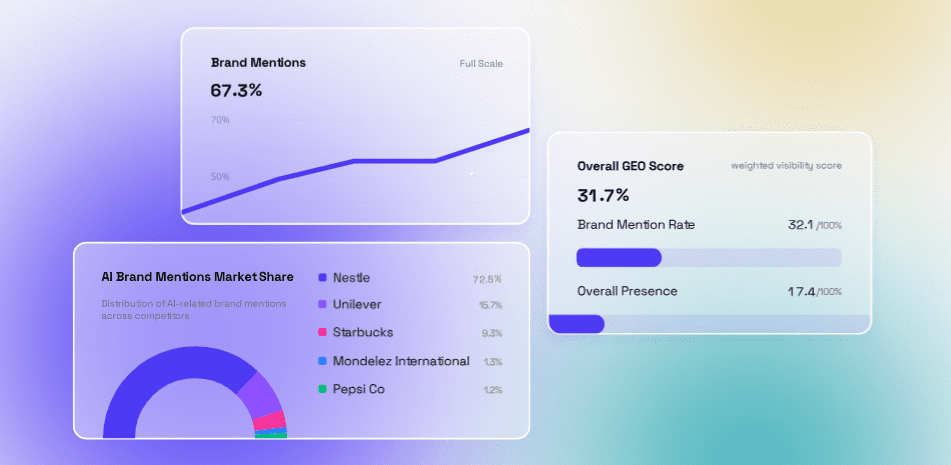
AthenaHQ focuses on how effectively a company’s messaging resonates, both with buyers and with AI systems that increasingly summarize, compare, and contextualize products. While it doesn’t measure visibility inside AI-generated answers, it helps teams strengthen the clarity and precision of the narratives that influence how models describe their brand.
Key Features
1. Messaging Analysis
AthenaHQ evaluates sales narratives, product descriptions, and positioning statements to identify clarity gaps, overused phrasing, or value props that don’t land strongly.
2. AI Interpretation Insights
The tool highlights how AI systems interpret your messaging. This is especially useful for teams in technical, regulated, or nuanced industries where accuracy matters.
3. Buyer Journey Alignment
AthenaHQ assesses whether messaging fits the stages of the buyer journey, awareness, consideration, and comparison, making it easier to produce content that maps cleanly to real-world prompts.
4. Competitive Comparison
Teams can benchmark their messaging against competitors to understand where differentiation is strong or weak.
Now that we’ve broken down each platform, here’s how to decide which one fits your current stage of AI visibility.
Here’s a condensed view of how each platform compares across GEO-relevant capabilities. This table helps you see which tools solve which part of the visibility problem.
| Product | Starter Price | What It Actually Gives You | Key Features | Best For |
| ReSO | $299/month | Full-stack visibility across prompts, citations, sources, technical readiness, and content precision. | Prompt-level presence, LLM citations, source/domain patterns, schema gaps, entity associations, and content precision recommendations. | Teams wanting end-to-end GEO intelligence and a complete AI-visibility workflow. |
| Profound | $399/mo (Growth) | AI-based message testing and narrative clarity to shape how models interpret your brand. | Concept scoring, narrative clarity, and competitive messaging comparison. | Teams refining GTM messaging before scaling AI visibility. |
| WriteSonic | $39-49/month (entry tier for SEO + content) | AI-assisted content creation with emerging GEO-oriented optimization layers. | Content depth, topic coverage, AI-overview alignment, SERP + AI-summary optimization. | Content/SEO teams scaling production with light AI-visibility features. |
| Peec AI | €89/mo (25 prompts) | Lightweight AI-visibility monitoring based on brand and competitor prompt queries. | Prompt responses, brand-context accuracy, competitor comparisons. | Early-stage teams validating basic AI presence. |
| Chatrank | $249/month (Core) | Entry-level assistant-style presence checks and simple brand-mention tracking. | Brand mentions, response accuracy, and high-level visibility snapshots. | Small teams needing quick directional visibility signals. |
| Ahrefs | $129/mo (lite) | Authority + backlink intelligence that strengthens the upstream signals LLMs trust. | Backlink quality, referring domains, topical depth, site health, structured data issues. | SEO teams reinforcing credibility signals that affect AI model sourcing. |
| Semrush | $199/mo (starter) | SEO + content intelligence with GEO-adjacent capabilities and rich-intent insights. | Keyword intent, content scoring, SERP feature tracking, and competitive gaps. | Marketing teams aligning SEO and AI-search behavior. |
| AthenaHQ (athenahq.ai) | $295/mo (Self-serve) | Messaging clarity and AI-interpretation insights for better narrative precision. | AI interpretation checks, clarity scoring, competitor narrative mapping. | GTM teams ensuring models understand their positioning accurately. |
How to Choose the Right GEO Platform
Choosing a GEO platform comes down to identifying what limits your visibility today. Some teams need basic presence checks, others need stronger authority and content depth, and some need clearer messaging before improving AI visibility. If your goal is full-stack visibility, covering prompts, citations, sources, technical readiness, and content precision, you’ll need a platform built to handle all of these signals in one workflow.
The right choice is the tool that directly improves how often and how accurately AI models surface your brand. As AI search becomes a primary discovery channel, treating GEO as a measurable discipline gives teams a structural advantage in how consistently they appear inside AI-generated answers.
Every team will eventually need multiple layers of this stack. The key is to start with the tool that aligns closest to your current visibility gaps, and expand as AI search becomes a larger share of your buyer journey.
See how your brand appears inside AI-generated answers. Book a call with us and run a visibility audit across prompts, models, citations, and source patterns. For more resources on AI search, LLM visibility, and modern GEO workflows, explore the “Generative Search & AI Visibility” category.