Marketing in 2025 looks fundamentally different from what it did even two years ago. The catalyst? Artificial intelligence has moved from experimental curiosity to essential infrastructure. What started as cautious experimentation has evolved into widespread adoption that’s reshaping every aspect of how brands connect with audiences.
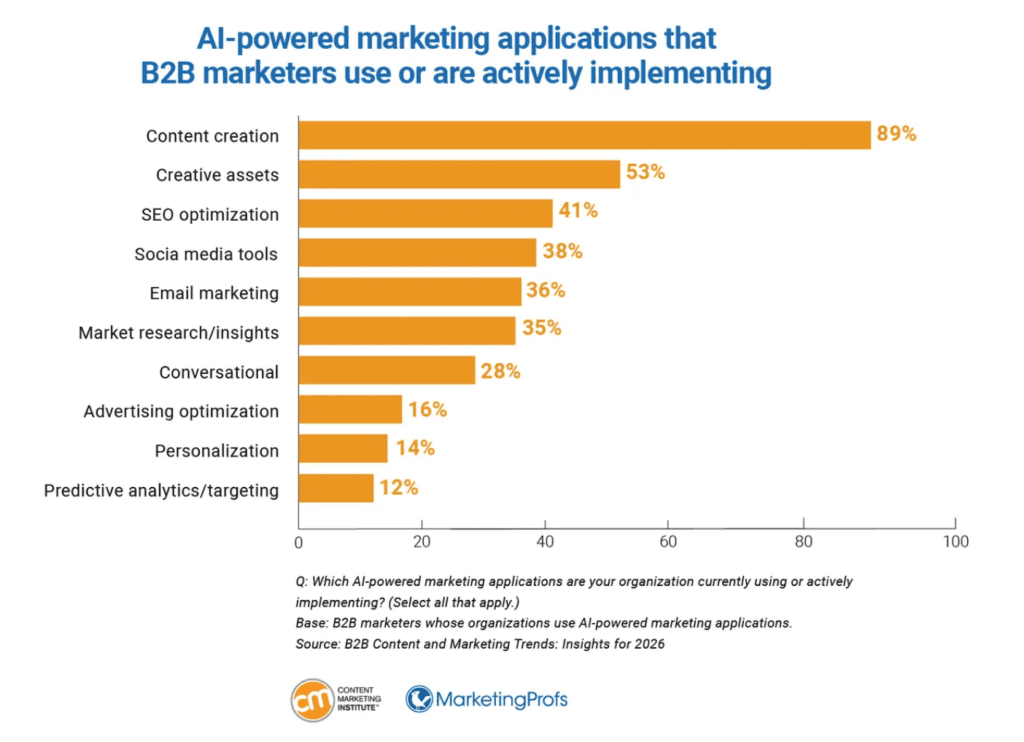
The data tells a remarkable story. The AI content marketing sector has exploded, with 89% using AI for content creation tools for generating or optimizing marketing copy/written content, enabling teams to increase productivity by 87% with it. This isn’t gradual evolution; it’s a revolution in how content marketing operates. (Source: Content Marketing Institute)
But adoption alone doesn’t explain the transformation. It’s the results that matter. This blog explores how marketers are actually using AI today, examines both the remarkable advantages and legitimate concerns through real examples, and provides essential tips for leveraging AI content effectively without sacrificing quality or authenticity. Whether you’re skeptical or already experimenting, understanding these patterns is crucial for remaining competitive.
An Exciting Example of a Viral AI Advertisement
Nothing demonstrates AI’s marketing power quite like campaigns that capture global attention. Let’s examine one that showcases both the creative potential and strategic brilliance of AI content.
Pizza Hut’s “Pepperoni Hug Spot” Campaign
What started as an AI-generated video quickly became a real-world marketing sensation that perfectly illustrates how brands can leverage Gen AI for breakthrough campaigns. An online video, powered by generative AI, introduced a fictional pizza chain called “Pepperoni Hug Spot.”
The video went viral almost overnight, gathering millions of views as viewers noticed striking similarities between this AI-generated brand and Pizza Hut’s actual branding.
Rather than ignore the buzz or issue cease-and-desist letters, Pizza Hut made a brilliant strategic decision. Working with the video’s creator and advertising agency Leo Burnett, they leaned into the hype.
Pizza Hut temporarily rebranded itself as “Pepperoni Hug Spot,” creating a real-world version of the fictional AI pizza chain. The pop-up launched with the same AI-inspired ads, branding, and even recipes straight from the viral video.
Why this matters: This campaign demonstrates several critical insights about AI content marketing. First, AI-generated content can achieve organic virality when it resonates culturally.
Second, brands willing to embrace unexpected AI-driven narratives can turn potential brand confusion into marketing gold. Third, the line between AI-generated fiction and brand reality can be blurred strategically when companies respond with creativity and speed.
The campaign generated massive earned media, social conversation, and brand engagement without requiring the typical multi-million-dollar production budgets of traditional viral campaigns. It showcased how Gen AI democratizes creative production, allowing bold ideas to reach audiences regardless of budget constraints.
Heinz’s AI Ketchup Visualization
Another compelling example comes from Heinz, which launched a collaboration with DALL-E to engage the public in visualizing its iconic ketchup bottle. The campaign invited users to input text prompts describing how they see Heinz bottles, with the AI generating high-quality images based on these descriptions.
The results were remarkable: unprecedented engagement generating over 800 million views and coverage in prestigious international media outlets. The campaign transformed customers into content creators, demonstrating how AI content can scale user-generated creativity while strengthening brand identity.
These examples aren’t anomalies: they’re early indicators of how AI content is transforming what’s possible in marketing. The brands winning aren’t necessarily those with the biggest budgets, but those that understand how to harness AI’s creative and viral potential.
The Ecosystem of AI Content Marketing
Understanding isolated examples is valuable, but grasping the broader space reveals why AI content marketing has become essential infrastructure rather than optional experimentation.
Widespread Adoption Across Functions
AI content has permeated virtually every marketing function. According to recent surveys, content optimization leads to AI adoption at 51% of marketing teams. (Source: Digital Marketing Institute)
This breadth of application explains why adoption rates are accelerating. AI is transforming entire workflows across content marketing operations. Teams that once spent days planning, creating, and optimizing campaigns can now accomplish the same work in hours, freeing resources for strategy and relationship building.
The Productivity Transformation
The efficiency gains from AI content marketing are substantial and measurable. Marketers report saving an average of 3 hours per piece of content and 2.5 hours per day overall when using AI tools. At scale, this productivity boost allows smaller teams to compete with larger competitors and frees resources for higher-value activities that AI cannot yet handle, like strategic thinking, authentic relationship building, and creative direction.
According to 42.2% of marketers in a survey, generative AI tools have transformed marketing strategies by improving content creation and campaign efficiency. This volume advantage matters in competitive markets where consistent presence and thought leadership determine visibility and authority.
Platform and Tool Preferences
| AI Tool | Market Status | Primary Use Case |
| ChatGPT | Market leader, highest share | Text generation & automation |
| Gemini | Growing enterprise adoption | Marketing automation & research |
| Claude | Significant niche adoption | Customer service, creative uses |
| Perplexity | Emerging, smaller share | Research-driven content creation |
This indicates that AI capabilities are becoming embedded across the marketing technology stack rather than remaining siloed in standalone tools.
This integration means marketers don’t need to completely overhaul their workflows: AI is being woven into familiar platforms, lowering adoption barriers and accelerating practical use.
The Quality Question
Perhaps the most important finding: 95% of marketers who adopted AI are highly likely to achieve effective marketing strategies, while 24% state their SEO performance has not changed. These aren’t marginal differences; they represent fundamental shifts in how high-quality content gets produced. (Source: Synthesia.io)
And concerns persist. This tension between performance and risk defines the current AI content marketing: enormous potential paired with legitimate concerns requiring thoughtful management.
AI’s Impact on Search and Discovery
The influence of AI content extends beyond creation to how content gets discovered. Importantly, there’s no correlation between AI content percentage and search ranking position or citation order in AI Overviews. This suggests that search algorithms don’t penalize AI content per se: they evaluate quality, relevance, and user value regardless of creation method.
Pros & Cons of AI-Generated Content
Like any powerful technology, AI content offers substantial advantages alongside legitimate concerns. Understanding both sides helps organizations implement AI thoughtfully.
| Pros of AI-Generated Content | Cons of AI-Generated Content |
| Marketers report improved speed in delivering content. | AI can produce generic, bland content without human oversight and refinement |
| Teams publish more content monthly with AI, enabling greater market presence | AI draws from existing data, potentially producing derivative content rather than innovative ideas |
| Marketers claim Gen AI content sometimes outperforms human content in engagement metrics | Maintaining an authentic brand voice across AI content requires careful prompting and editing |
| Reduces content production costs while maintaining or improving quality | AI can generate plausible-sounding but incorrect information requiring fact-checking |
| AI tools work continuously, enabling rapid response to trends and breaking news | Using customer data for AI personalization raises privacy questions and compliance issues |
| AI maintains consistent tone, style, and messaging across large content volumes | AI struggles with nuanced emotional intelligence that drives deeper human connections |
| AI helps optimize content for search while maintaining readability and value | Some audiences distrust AI content, potentially harming credibility if overused |
The pros substantially outweigh the cons for organizations implementing AI thoughtfully. Success requires treating AI as an augmentation tool: amplifying human creativity, not replacing it. The marketers thriving with AI content aren’t those viewing it as a complete replacement for human effort, but those understanding it as a powerful collaborator requiring strategic direction, ethical guardrails, and human oversight.
3 Essential Tips to Use AI Effectively in Content Marketing
Understanding AI’s potential and risks is valuable only if you know how to implement it effectively. Here are three essential strategies that separate successful AI content marketing from disappointing results.
1. Use AI for Drafting and Ideation, Not Final Output
The single most important principle for AI content success: treat AI as a starting point, not a finish line. The marketers saying that AI content outperforms human content aren’t simply pressing “generate” and publishing raw outputs. They’re using AI to accelerate the most time-consuming parts of content creation while applying human expertise where it matters most.
How to implement this: Use AI to generate multiple content outlines for a topic, providing diverse angles you might not have considered. Let AI draft first versions that you then substantially rewrite, refine, and enhance with unique insights. Have AI generate 10-15 headline options, then select and modify the most promising ones. Use AI for research synthesis, pulling together relevant information from multiple sources that you then analyze and contextualize with original thinking.
AI excels at producing raw material quickly but struggles with the nuance, strategic thinking, and authentic voice that distinguish exceptional content from mediocre content.
Content marketing leaders understand: AI handles scale and speed; humans handle strategy and authenticity. This division of labor maximizes the strengths of both while minimizing their respective weaknesses.
2. Maintain Rigorous Fact-Checking and Brand Alignment
AI’s ability to generate plausible-sounding content is both its greatest strength and most dangerous weakness. Without proper verification, AI content can confidently present incorrect information, outdated data, or misattributed sources.
How to implement this: Establish a verification protocol for all AI-generated content before publication. Every factual claim must be traced to a credible source. Every statistic must be verified against original data. Every attributed quote must be confirmed authentic. Create brand voice guidelines with specific examples that you use to train and evaluate AI outputs. Include approved terminology, prohibited phrases, tone examples, and brand values that should permeate all content.
Implement a human review stage where experienced team members assess not just accuracy but strategic alignment: does this content serve business objectives? Does it provide genuine value to the audience? Does it maintain brand integrity? Consider using AI detection tools not to avoid AI entirely, but to identify sections that sound too generic or formulaic, flagging them for human enhancement.
The critical insight: AI content that performs well is AI-assisted and human-perfected. It means savvy content marketers are using AI as one tool in a broader content creation process that includes substantial human contribution.
3. Blend AI Efficiency with Human Creativity and Authenticity
The future belongs to marketers who master the hybrid model leveraging AI for efficiency while preserving the human elements that create emotional connections, build trust, and differentiate brands. Gen AI tools are exceptional at patterns, structure, and synthesis, but they lack lived experience, emotional intelligence, and strategic business context that only humans possess.
How to implement this: Use AI to handle repeatable, pattern-based tasks: meta descriptions, social media post variations, email subject line testing, FAQ responses, and product description templates. Reserve human time for content requiring authentic experience: case studies showcasing real customer outcomes, thought leadership pieces expressing unique perspectives, brand storytelling that conveys values and mission, and content addressing sensitive or complex topics requiring nuance.
Create “AI + human” workflows where AI generates initial drafts, but humans add personal anecdotes, original insights, strategic framing, emotional resonance, and contextual relevance that AI cannot replicate. For example, let AI draft a blog post outline and first version, then have your subject matter expert add proprietary data, unique methodologies, lessons from actual client work, and forward-looking predictions based on market expertise.
Why this matters: The content marketing is becoming increasingly AI-saturated. In this environment, purely AI-generated content will become commoditized and undifferentiated. Competitive advantage will come from combining AI’s scale and efficiency with human creativity, expertise, and authenticity in ways that create genuinely valuable, distinctive content.
The AI Imperative
The viral examples like Pizza Hut’s “Pepperoni Hug Spot” and Heinz’s AI visualization campaign demonstrate that Gen AI can drive remarkable creative breakthroughs and audience engagement.
But success requires nuance. The pros and cons table reveals that AI content is a powerful tool demanding thoughtful implementation. The three essential tips: using AI for drafting not final output, maintaining rigorous verification, and blending AI efficiency with human creativity; provide a framework for extracting value while avoiding pitfalls.
The brands that will dominate the next decade aren’t those with the biggest budgets or longest histories. They’re those recognizing that AI content marketing has fundamentally changed the game and acting decisively to master these capabilities while preserving the human elements that build lasting customer relationships.
The transformation is already underway. The only question is whether your organization will lead it or struggle to catch up. The time to start is now. And if you’re looking to start now, book a call with ReSO here.