What was once experimental technology has become the foundation of competitive strategy. AI in marketing is the present reality reshaping how brands connect with customers, optimize campaigns, and drive measurable business outcomes.
The numbers tell a compelling story. The AI marketing market reached $47.32 billion in 2025 and is projected to soar to $107.5 billion by 2028. This is a revolution in how marketing gets done. (Source: seo.com)
For B2B marketing teams especially, AI represents more than efficiency gains. It’s the difference between reactive campaigns and predictive strategies, between generic outreach and hyper-personalization, between guessing what works and knowing with data-driven certainty.
AI attribution capabilities now allow marketers to trace customer journeys with unprecedented precision, while automation in marketing handles repetitive tasks that once consumed entire teams.
This blog explores how marketers are actually using AI today and the five most effective applications that deliver measurable results. Whether you’re a skeptic, an early adopter, or somewhere in between, understanding these strategies is essential for remaining competitive in 2025 and beyond.
How Do Marketers Use AI?
Before diving into specific strategies, it’s critical to understand the current state of AI adoption in marketing. The applications are broader and more sophisticated than many realize.
Content Creation And Optimization Lead The Way
There’s a fundamental shift in content workflows: AI doesn’t replace human creativity. If you really look and try, it amplifies it. Allowing marketers to produce more variations, test more approaches, and optimize based on actual performance data rather than intuition.
The speed advantage is substantial. Content created with AI can be generated five times faster than manually created content, enabling marketing teams to develop multiple versions targeting various audience segments without proportionally increasing resources.
For B2B marketing where personalization matters enormously but manual customization doesn’t scale, this capability transforms what’s possible.
Personalization And Customer Experience Enhancement
AI analyzes behavioral data, purchase history, engagement patterns, and micro-signals to predict what each customer needs before they explicitly express it. This predictive capability transforms marketing from reactive to proactive.
In B2B contexts, where sales cycles are longer and relationships more complex, AI-powered personalization can:
- Track prospects across multiple touchpoints
- Identify where they are in the buyer journey
- Serve content that moves them toward decisions
The result: more qualified leads, shorter sales cycles, and higher conversion rates.
Data Analysis And Predictive Insights
Marketing generates overwhelming data volumes: website analytics, social media engagement, email performance, customer behavior, and market trends. Humans can’t process this fast enough for real-time optimization.
AI excels here: analyzing massive datasets, identifying patterns invisible to human analysis. And recommending or implementing optimizations automatically.
AI attribution capabilities have become particularly sophisticated, tracking customer journeys across channels and touchpoints to determine which marketing efforts actually drive conversions. This moves B2B marketing beyond simplistic last-click attribution to understanding the complex interplay of awareness, consideration, and decision-stage touchpoints.
Social Media Monitoring And Sentiment Analysis
AI tools efficiently track and analyze online conversations at scale, providing real-time insights into customer sentiment and trends. For brands, this means detecting potential crises early, understanding how messaging resonates, and identifying opportunities to engage meaningfully with audiences. In 2025, 43% of marketers consider AI important to their social media strategy, with another 48% viewing it as somewhat important.
Customer Service Automation
AI chatbots and virtual assistants provide instant, 24/7 customer support while gathering valuable data on customer preferences and pain points. These systems don’t just answer questions: they qualify leads, schedule meetings, provide personalized recommendations, and escalate complex issues to humans when appropriate. The efficiency gains allow small teams to deliver customer experiences previously requiring much larger staffs.
Campaign Optimization And Automation In Marketing
AI continuously analyzes campaign performance across channels: email, paid advertising, social media, content marketing, and automatically adjusts budgets, targeting, creative, and timing to maximize ROI. Major advertising platforms now offer automated bidding and optimization that outperforms manual management, learning from millions of data points what works for specific objectives and audiences.
The pattern across all these applications: AI handles scale, speed, and optimization while humans focus on strategy, creativity, and relationship building. The most successful marketing teams aren’t choosing between AI and human talent, they’re combining both to achieve results neither could deliver alone.
5 Effective Ways To Use AI Effectively
Understanding how AI is used broadly is valuable, but practical implementation requires knowing which specific applications deliver the highest impact. Here are five proven strategies that consistently produce measurable results.
1. Predictive Lead Scoring and Intelligent Routing
Traditional lead scoring assigns points based on predetermined criteria—job title, company size, website visits. It’s better than nothing but often misses the mark. AI-powered lead scoring analyzes thousands of variables across millions of interactions to predict conversion likelihood with dramatically greater accuracy.
The system identifies which leads are ready to buy now versus those needing nurturing, then routes them appropriately. High-intent leads go immediately to sales with context about what they’ve engaged with and why they’re qualified. Others enter automated nurture sequences customized based on their specific interests, behaviors, and position in the buyer journey.
Why this matters for B2B marketing:
In complex B2B sales, timing is everything. Contacting a ready buyer at the right moment can mean the difference between winning and losing to competitors. AI attribution shows exactly which touchpoints influenced readiness, allowing you to double down on what works.
Implementation approach:
Integrate AI lead scoring tools with your CRM. Platforms like HubSpot, Marketo, and Salesforce Marketing Cloud offer built-in capabilities. Train systems on your historical conversion data so they learn what signals indicate purchase readiness in your specific market, not generic patterns that might not apply.
2. Hyper-Personalized Content and Dynamic Messaging
Generic messaging doesn’t work in 2025. Customers expect experiences tailored to their needs, and AI makes this possible at scale. Dynamic content adapts in real-time based on who’s viewing it, on what device, at what time, and with what previous context.
Website visitors see different hero images, CTAs, and product recommendations based on their profile and behavior. Email content dynamically adjusts: different subject lines, body copy, offers, and imagery for different segments, all tested and optimized automatically.
Social media ads generate variations targeting different audience segments with messaging tailored to each group’s preferences and pain points.
Why this matters for B2B marketing:
B2B buyers conduct extensive research before engaging with sales. They consume multiple content pieces, visit your site repeatedly, and compare alternatives.
Serving the same generic message to an early-stage researcher and a late-stage evaluator wastes opportunities. AI ensures each interaction feels relevant and valuable.
Implementation approach:
Use platforms like Dynamic Yield, Optimizely, or Adobe Target for web personalization. For email, tools like Mailchimp, ActiveCampaign, and HubSpot offer AI-powered dynamic content features.
Start with high-traffic pages and high-value email campaigns, measure lift, then expand based on results.
3. Automated Content Creation and Optimization
AI can now generate social media posts, email copy, ad variations, blog outlines, and even complete articles. More importantly, it can create multiple variations and automatically test them to identify what resonates with specific audiences.
According to industry data, 50% create content with artificial intelligence. (Source: SurveyMonkey)
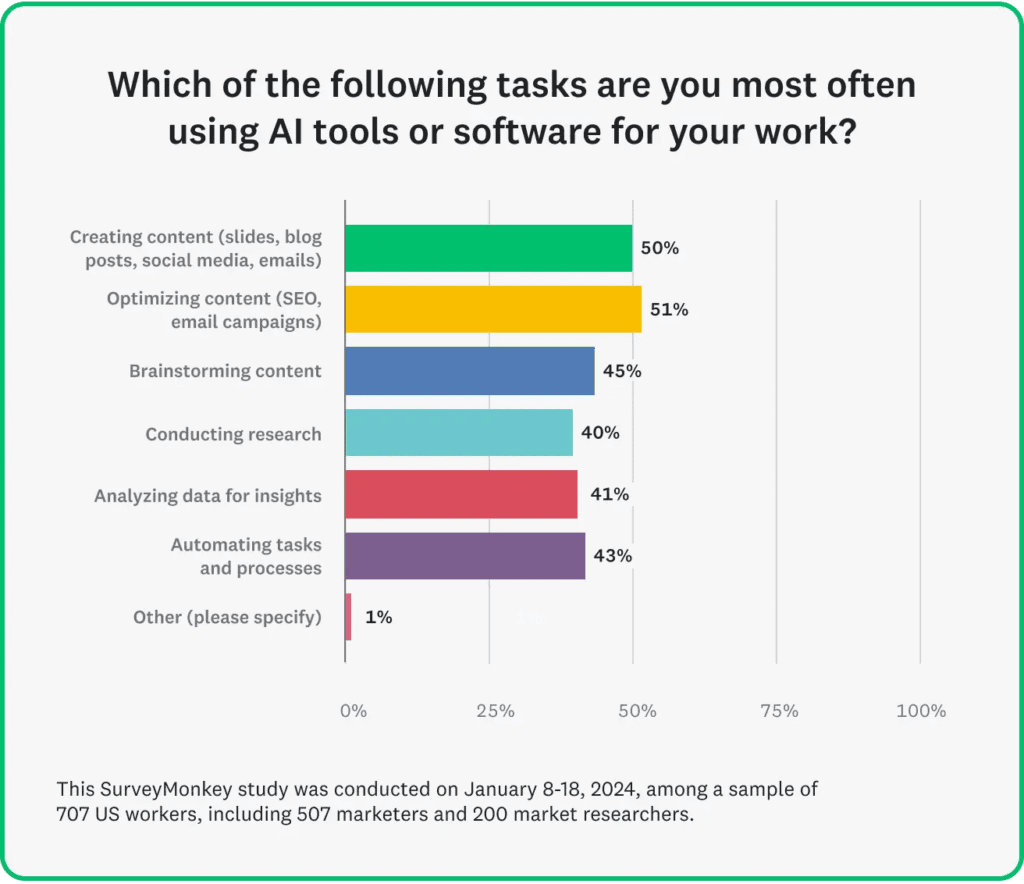
The transformation isn’t just speed; it’s the ability to test at scale. Where a human might craft three subject line variations for an email campaign, AI can generate and test fifty, identifying patterns about what works for different segments that humans would never detect.
Why this matters for B2B marketing:
B2B content marketing requires depth, accuracy, and credibility. AI doesn’t replace subject matter expertise but helps experts produce more content faster. It can draft initial outlines, suggest relevant statistics, generate multiple angle approaches, and optimize based on what actually drives engagement and conversions rather than what seems clever.
Implementation approach:
Tools like Jasper, Copy.ai, ChatGPT, and Claude excel at content generation. Start by using AI for drafts and variations while humans handle strategy, fact-checking, and refinement.
Establish clear brand voice guidelines and examples so AI-generated content maintains consistency. For automation in marketing workflows, integrate these tools with your content management and distribution systems.
4. Predictive Analytics for Budget Optimization
AI analyzes past campaign performance to predict future outcomes, then automatically adjusts budgets, targeting, creative, and timing to maximize ROI. The system identifies which audiences, channels, messages, and offers will perform best for specific objectives, then optimizes resource allocation accordingly.
This is forward-looking optimization. AI estimates:
- Customer churn risk
- Identifies upsell opportunities
- Predicts seasonal trends before they fully manifest
- Reallocates spending in real-time based on performance
Marketers using AI-powered automation are significantly more likely to report effective strategies, with AI attribution providing clear visibility into which investments drive results.
Why this matters for B2B marketing:
B2B marketing budgets face intense scrutiny. Proving ROI is essential for securing resources and demonstrating marketing’s contribution to revenue. AI attribution capabilities track prospects across complex, multi-touch journeys. And showing which campaigns, content pieces, and channels actually influence pipeline and closed-won deals rather than relying on simplistic last-touch models.
Implementation approach:
Most major advertising platforms: Google Ads, Facebook Ads, LinkedIn Ads; now offer automated bidding and optimization. Enable these features and let AI learn from your campaigns. For sophisticated predictive analytics across channels, consider platforms like Marketo Engage, HubSpot Marketing Hub, or Salesforce Marketing Cloud that integrate data from multiple sources.
5. Conversational Marketing with AI Chatbots
AI-powered chatbots handle customer inquiries 24/7, qualify leads, schedule meetings, answer FAQs, provide personalized recommendations, and gather valuable data; all without human intervention.
Modern chatbots powered by large language models understand context, handle complex queries, detect customer emotions to adjust responses appropriately, and integrate with CRM systems to pull customer history for informed assistance.
The sophistication has reached a point where many users can’t tell they’re interacting with AI rather than humans. More importantly, chatbots never tire, never miss a lead, and consistently apply qualification criteria, ensuring no opportunity falls through cracks due to human bandwidth limitations.
Why this matters for B2B marketing:
B2B buyers research outside traditional business hours. They visit websites evenings and weekends, when sales teams aren’t available. AI chatbots engage these prospects immediately, answer questions, provide relevant content, and schedule follow-up conversations with humans. This responsiveness dramatically improves conversion rates while allowing sales teams to focus on qualified conversations rather than initial information gathering.
Implementation approach:
Platforms like Drift, Intercom, or LiveChatAI offer sophisticated chatbot capabilities. For best results, train chatbots on actual customer data, FAQs, product information, and common objections. Start with frequently asked questions and appointment scheduling, then expand capabilities based on interaction patterns and user feedback.
Pros & Cons of AI in Marketing
Like any powerful technology, AI in marketing offers substantial benefits alongside legitimate concerns. Understanding both sides helps organizations implement AI thoughtfully rather than rushing in blindly or resisting unnecessarily.
| Pros | Cons |
| AI handles repetitive tasks 5x faster than manual processes, freeing teams for strategic work | Implementing AI tools and training teams requires significant upfront resources |
| 72% of marketers using AI personalize customer experiences at a scale previously impossible | Using customer data for AI raises privacy issues, especially with regulations like GDPR |
| AI attribution provides data-driven insights, replacing guesswork in strategy and budget allocation | 45% of marketers are still at the beginner stage; mastering AI capabilities takes time and training |
| AI chatbots and automation provide instant responses and engagement regardless of time zones | Over-reliance on AI can make marketing feel impersonal and generic if not balanced properly |
| AI forecasts customer behavior, churn risk, and campaign outcomes, enabling proactive strategies | AI can generate bland or incorrect content if not properly supervised and fact-checked |
| Small teams can achieve results previously requiring much larger staff through automation in marketing | Over-reliance on AI tools creates vulnerability if systems fail or change pricing/access |
| 88% daily AI usage shows adoption is becoming baseline; non-users risk falling behind | AI can perpetuate biases in data, raising questions about fairness in targeting and decision-making |
The pros substantially outweigh the cons for most organizations, but success requires thoughtful implementation. Start with clear use cases where AI solves specific problems, maintain human oversight of AI outputs, invest in training teams to use AI effectively, establish ethical guidelines for AI use, and continuously measure and optimize based on actual business outcomes.
The marketers winning with AI aren’t those treating it as magic or viewing it as threat; they’re those understanding it as a powerful tool requiring strategy, skill, and ongoing refinement to maximize value while minimizing risks.
The transformation of marketing through AI is already here. With 32% of marketing organizations fully implementing AI, and industry analysts forecast the market will reach $1.81 trillion from 2025 to 2030, the question is how quickly and effectively your organization can integrate these capabilities. (Source: SurveyMonkey)
The five strategies outlined: predictive lead scoring, hyper-personalization, automated content creation, predictive analytics, and conversational AI; represent proven approaches delivering measurable results across industries. Organizations implementing these strategies report higher conversion rates, lower acquisition costs, improved customer satisfaction, and better resource utilization.
For B2B marketing teams, especially, AI offers the ability to compete with larger competitors by amplifying small team capabilities through intelligent automation in marketing. AI attribution provides the visibility needed to prove marketing’s impact on revenue, while predictive capabilities enable proactive rather than reactive strategies.
The path forward is clear: start with one high-impact use case, implement thoughtfully with proper training and oversight, measure results rigorously, learn from experience, and expand based on what works. The competitive advantages AI provides compound over time: the systems learn, improve, and deliver increasing value with each campaign.
The brands that will dominate the next decade aren’t necessarily those with the biggest budgets or longest histories. They’re the ones recognizing that AI in marketing has fundamentally changed the game and acting decisively to master these new capabilities. The time to start is now. And you can book a call with us to get started now.