The rules of digital visibility have fundamentally changed. For two decades, brands fought for backlinks and Google’s first page. That war isn’t over, but a new frontline has opened. The new competition isn’t for backlinks; it’s for AI citations, mentioned inside LLM responses when users ask ChatGPT, Perplexity, or Gemini for recommendations or guidance.
AI-referred sessions jumped from 17,076 to 107,100 between January and May 2025, a staggering 527% increase according to analysis of 400+ websites. When someone asks, “What are the best project management tools?” and your brand isn’t cited, you effectively don’t exist in that user’s consideration set.
This isn’t traditional search optimization with a new name. Understanding LLM sourcing patterns, building citation authority, and optimizing for generative search ranking requires new strategies, new metrics, and new ways of thinking about brand visibility in ChatGPT and other AI platforms.
Key Takeaways
- AI citations within LLM responses (like ChatGPT, Perplexity, Gemini) are the new battlefield for brand visibility, overtaking traditional backlink strategies.
- AI-referred sessions surged 527% in early 2025; being excluded from AI citations means your brand is effectively invisible to potential customers asking AI tools.
- Each AI platform has unique citation preferences: ChatGPT favors encyclopedic content (Wikipedia), Perplexity emphasizes community sources (Reddit), and Google AI Overviews balance multimedia, user content, and traditional SEO signals.
- Structured content, proper schema, and consistent entity naming strengthen AI citation authority and create “citation moats” that competitors find hard to penetrate.
- Original data and proprietary research greatly increase citation frequency, serving as unique citation magnets that differentiate brands.
- Continuous AISO benchmarking like tracking AI citation frequency, competitive context, and gaps is essential to stay visible and optimize for evolving AI discovery.
The New Competition Isn’t for Backlinks
Traditional SEO built empires on earning links from authoritative sites to rank higher. But AI search operates differently. When a user asks ChatGPT, “What CRM should I use?” The model draws from training data, retrieves information from indexed sources, weighs authority signals, and selects a handful of brands to mention. If you’re not in that response, users never learn you exist.
The Fundamental Shift:
Traditional search presented options (10 blue links, ads) that users clicked and evaluated. AI search synthesizes information and delivers answers. Users often avoid clicking through, they trust the AI’s synthesis and act directly.
This creates winner-take-most dynamics. When ChatGPT recommends three project management tools, the fourth-best tool might as well not exist.
The Currency Has Changed
Backlinks still matter for authority signals, but AI citations become the primary discovery mechanism. AISO benchmarking requires tracking how often your brand is mentioned, in what context you’re cited, which competitors appear alongside you, and for which queries you appear.
Clutch, a B2B review platform, commands 84.5% of AI citations for agency recommendations according to an analysis of 456,570 citations across multiple platforms (Source: Hall). That dominance translates to outsized influence over purchasing decisions. For agencies not listed on Clutch, excellence doesn’t matter if AI never mentions them.
How ChatGPT, Perplexity, and Gemini Select Sources
Each platform has distinct selection mechanisms requiring tailored approaches to improve LLM sourcing patterns.
ChatGPT’s Preference Hierarchy
Analysis of 30 million citations from August 2024 to June 2025 reveals ChatGPT’s strong preference for encyclopedic, factual content (Source: Azoma). Wikipedia accounts for 7.8% of all ChatGPT citations, more than any other single source. Within the top 10 most-cited sources, Wikipedia represents 47.9% of citations. Reddit appears at 11.3%, suggesting ChatGPT values both established knowledge repositories and community-validated information.
For brand visibility in ChatGPT, ensure accurate Wikipedia representation (if notable), participate meaningfully in Reddit communities, create comprehensive encyclopedia-style content, and establish clear information architecture.
Perplexity’s Community Focus
Reddit dominates Perplexity’s top sources at 46.7% of citations, with community platforms receiving preferential treatment.
Perplexity now processes over 780 million monthly search queries as of May 2025, making it a significant discovery channel. Its algorithm values real-time information, community validation, diverse perspectives, and practical user-generated insights.
For brands, actively engage on Reddit and similar platforms, create content that generates authentic discussion, provide actionable information over marketing speak, and maintain presence where your audience congregates.
Google AI Overviews’ Balanced Approach
Google shows more distributed citation patterns: Reddit at 2.2%, YouTube at 9.5%, Quora at 3.6%, and Wikipedia at 5.7% (Source: Clickguard). This balanced distribution suggests Google weighs traditional domain authority, user-generated content quality, multimedia content, and established SEO signals. Effective generative search ranking requires presence across multiple content types, strong traditional SEO foundations, active community engagement, and multimedia content, particularly YouTube.
Domain-Level Patterns
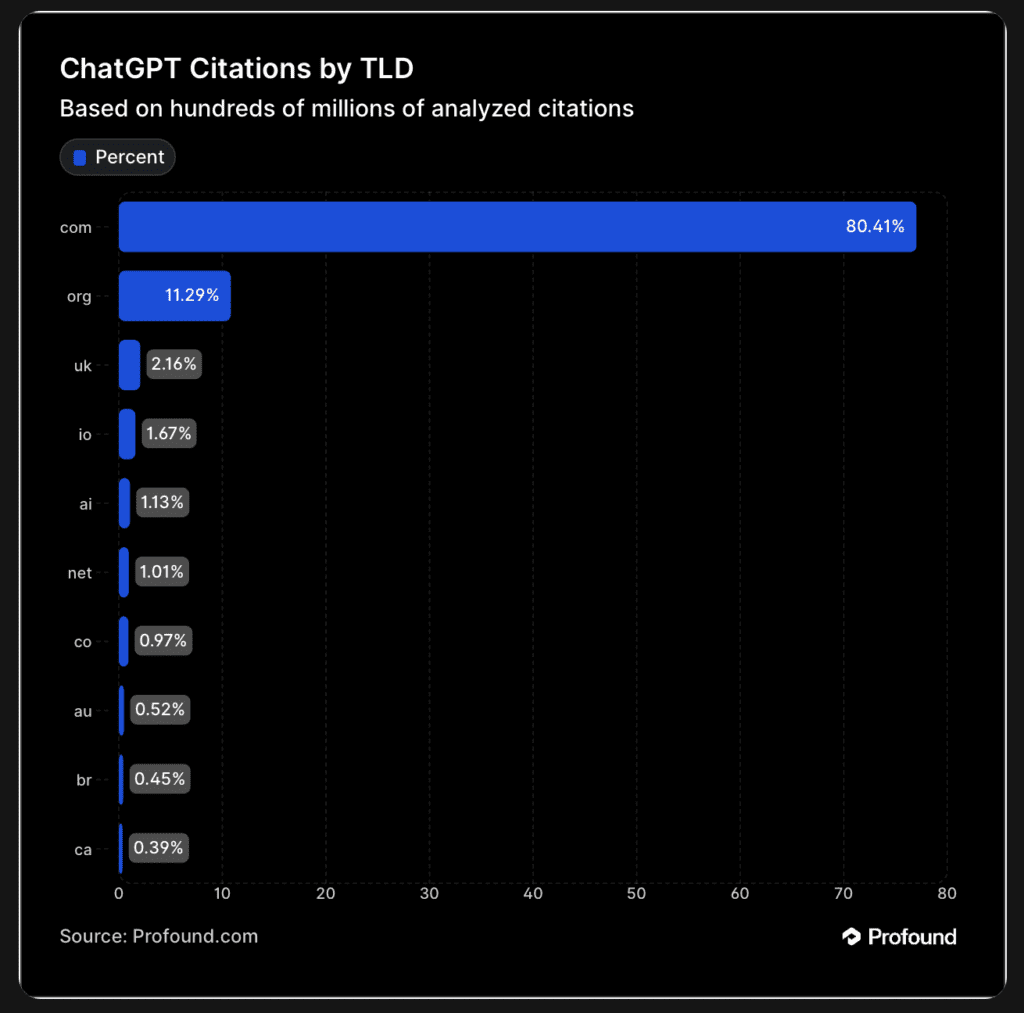
Across platforms, commercial (.com) domains represent over 80% of AI citations, non-profit (.org) sites are second at 11.29%, and newer TLDs like .io show growing presence. (Source: Profound)
One-size-fits-all approaches don’t work, brands need platform-specific strategies aligned with each AI system’s citation preferences.
Citation Frequency, Authority Clustering, and “AI Ranking”
Patterns are emerging about which brands get cited most frequently and why, providing the foundation for understanding AI ranking.
Citation Frequency Correlates With Specific Signals
Analysis of 400+ websites reveals sites with structured heading hierarchy are 40% more likely to be cited. Proper Article and FAQ schema increases citations by28%. (Source: Topmost Ads)
These signals reveal the “citation formula,” AI models favor content that is clearly structured, recently updated, externally validated, explicitly marked with schema, directly answering queries, and containing original data.
Authority Clustering is Emerging
Certain brands become “default citations” for entire categories. This clustering creates self-reinforcing cycles. When AI models frequently cite a brand, user validation through clicks signals back that citations were valuable, increasing likelihood of future citations. Early citation dominance creates cumulative advantages difficult for competitors to overcome.
“AI Ranking” Factors Are Becoming Measurable
Observable patterns suggest citation frequency is influenced by source authority (backlinks and mentions), content freshness (recent updates weighted heavily), structured data implementation (schema markup), direct answer formatting, original data and research, multimedia formats (especially video), and community validation.
The Citation Gap is Widening
First-party websites and local pages made up nearly 60% of citations. Being “good enough” isn’t sufficient, brands must achieve top-tier citation authority or risk invisibility in AI-driven discovery.(Source: Yext)
Building a “Citation Moat”
Leading brands are building sustainable advantages in AI citations that competitors struggle to overcome.
Structured Expertise as Foundation
The most reliably cited brands demonstrate expertise through comprehensive resource hubs on core topics, consistent heading hierarchies AI can parse, schema markup across all content, glossaries and definition pages, published original research, and detailed author credentials.
Consistent Naming Conventions Build Entity Recognition
AI models rely on entity recognition. Inconsistent naming confuses these systems. Maintain absolute consistency in product names, services, personnel, brand names, and industry terms.
Use consistent schema markup for Organization, Product, Person, and other entities. Link your brand entity across Wikipedia, Wikidata, Crunchbase, and LinkedIn to create a robust entity graph.
Link-to-Entity Signals Strengthen Attribution
When authoritative sources link to your brand with consistent language, it signals legitimacy worth citing. Build signals by earning Wikipedia mentions (if notable), getting trade publication coverage with consistent naming, listing in industry databases, maintaining strong employee LinkedIn profiles, and participating in industry associations.
Platform-Specific Presence Strategies
- For ChatGPT: Ensure Wikipedia presence, participate meaningfully on Reddit, create encyclopedia-style content, implement FAQ sections with schema, and maintain factual information architecture.
- For Perplexity: Actively engage on Reddit, be present on review platforms, create timely content addressing current discussions, provide practical information, and participate authentically in communities.
- For Google AI Overviews: Maintain strong YouTube presence, optimize for traditional SEO signals, engage on LinkedIn with thought leadership, create diverse content formats, and ensure technical SEO excellence.
- For Gemini: Publish or get cited in academic contexts, create technically rigorous content, implement comprehensive structured data, ensure accuracy and regular updates, and provide clear explanations of complex topics.
Original Data as Citation Magnets
Pages with original data see 4.1x more citations. Invest in proprietary research, conduct industry surveys, maintain benchmark databases, develop case studies with quantitative results, and create interactive tools generating unique data.(Source: Super Prompt)
This becomes citation bait that competitors can’t replicate.
AISO Benchmarking For Continuous Improvement
Track how often your brand appears in AI responses for target queries, monitor which competitors get cited alongside you, analyze citation context and framing, identify queries where you should be cited but aren’t, and measure citation frequency changes over time.
The Future of Brand Discovery
As AI-driven search captures greater market share, citation authority will determine brand visibility. The brands winning aren’t necessarily those with the biggest budgets, they’re the ones recognizing that discovery mechanisms have changed.
The citation moat concept isn’t about gaming systems. It’s about becoming the most authoritative, accessible, clearly structured source in your domain. AI models cite brands that provide clear, accurate, well-structured information reliably answering queries.
Begin tracking your brand visibility in ChatGPT, Perplexity, and other AI platforms now. Understand where you appear and where competitors dominate. Implement structural, content, and presence strategies that improve citation likelihood. Measure systematically and optimize continuously.
The new competition isn’t for backlinks. It’s for AI citations. Brands recognizing this reality will capture disproportionate discovery, consideration, and revenue as AI reshapes customer research.
The citation wars have begun, the question is, are you fighting for visibility? And if you want to effectively win the citation game, ReSO helps you with just that. Book a call with us here.