

Q: Be honest, what do you think? How much of a martech stack is actually utilized?
Before you lock in your answer, think about it for a second. When you look at your own martech setup, all the tools you’ve bought, trialed, inherited, or been “voluntold” to use, how many of them genuinely show up in your weekly workflow? Not the rosy picture in the procurement deck. Not the “we’ll use it eventually” hope. The real number your team touches consistently.
A) 80% – They’re pretty tech-savvy, right?
B) 65% – Most tools, but some go unused
C) 42% – Less than half (yikes!)
D) 25% – Just the basics
The answer is C – just 42%.
If you’ve ever felt overwhelmed by the endless parade of marketing tools, confused by all the AI buzzwords, or wondering how AI systems decide what to surface, from LLM mention tracking to conversational search prompts, you’re not alone.
This is the wild, wonderful, and sometimes downright frustrating world of marketing technology in 2025. We’re living through the biggest transformation in marketing since the internet went mainstream, and yet most of us are still figuring out what to actually do with AI, how much of our stack we really depend on, and what’s just noise.
So what does all of this mean for marketers right now? Here’s the short version:
Key Takeaways
- The Martech Paradox: It’s not that we need more tools, it’s that we need fewer tools that think together.
- Most marketers only use 42% of their martech stack. The opportunity now is mastering less, not adding more.
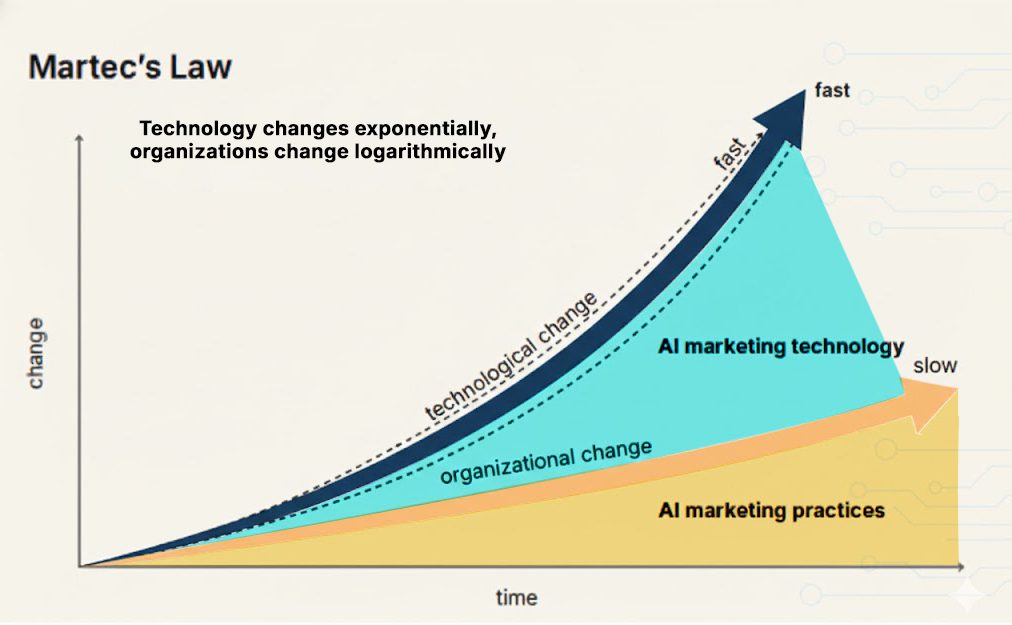
- Technology is evolving exponentially, but teams adapt logarithmically, creating a widening execution gap.
- Integration beats accumulation. Stacks that talk to each other outperform stacks that just look impressive.
- AI is redefining marketing workflows, shifting focus from automation to intelligent optimization.
- The future belongs to marketers who simplify, integrate, and adapt faster than the tools themselves.
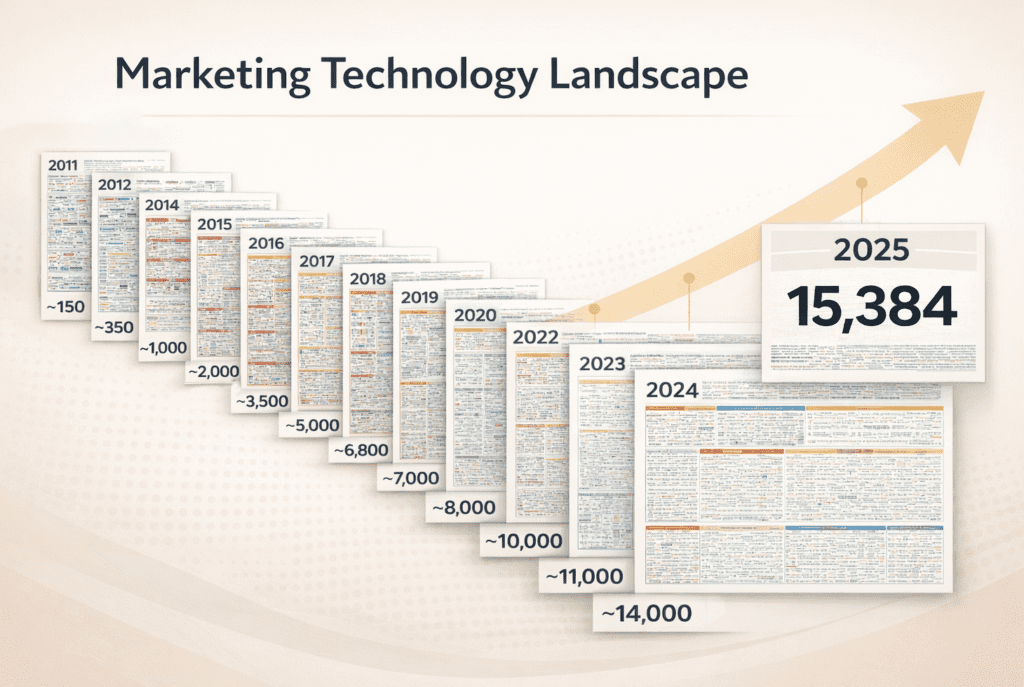
There are currently 15,384 different martech solutions available, and that’s just as of 2025. To put that in perspective, that’s more options than there are McDonald’s restaurants in the entire United States.
This explosion happened because every marketing challenge spawned its own specialized solution.
- Need to A/B test email subject lines? There’s a tool for that.
- Want to track how long people spend looking at your Instagram stories? Yep, there’s a tool for that, too.
- Curious about which customers are most likely to cancel their subscription? You guessed it, there’s definitely a tool for that.
The result? A martech stack that’s simultaneously more powerful than ever before. Which explains why we’re only using 42% of what we have access to.
The Great Martech Evolution: From 150 to 15,384 Tools (And Counting)
Source: Chiefmartech
The martech market didn’t just grow; it exploded.
| Year | Solutions | Theme | What Changed |
| 2011 | ~150 | The Basics Theme | Email, CRM, Analytics |
| 2012 | ~350 | Social Media Awakening | Facebook & Twitter tools |
| 2014 | ~1,000 | Digital Discovery | Lead scoring, automation |
| 2016 | ~3,500 | Mobile & Automation | Mobile marketing explodes |
| 2018 | ~5,000 | Data Becomes King | Analytics, CDPs, personalization |
| 2020 | ~8,000 | Integration Focus | Stacks connect, automation scales |
| 2025 | 15,384 | AI Revolution | 77% of new tools are AI-native |
Journey of a Martech Venture: From Garage Startup to Industry Giant
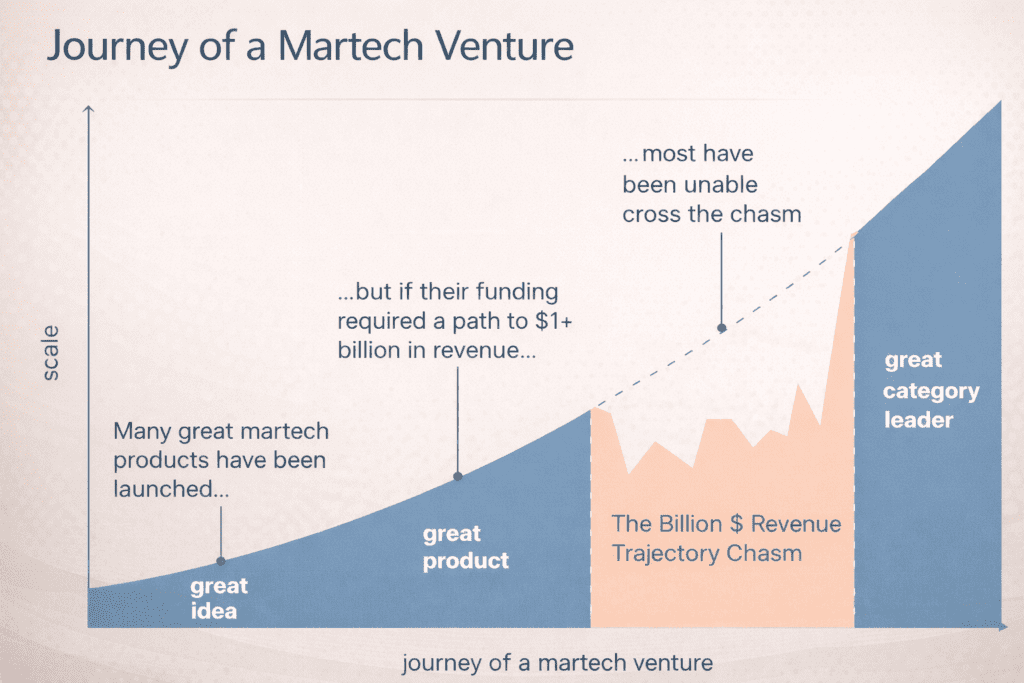
Ever wonder how all these martech tools you use every day actually got started? Let’s take a peek behind the curtain at the typical journey of a martech venture, because understanding where these tools come from helps you make better decisions about which ones to trust with your marketing budget.
Source: Chiefmartech
Stage 1: Great Idea
Many martech ventures kick off with a clever solution to a real marketing headache; a spark fueled by frustration and optimism.
The garage phase: raw innovation, shoestring budgets.
Stage 2: Great Product
Turning that idea into a product people actually use is huge. This is validation through early customers and enthusiastic feedback. It’s where things get exciting, but not every great product survives.
Stage 3: The Billion-Dollar Revenue Trajectory Chasm
This is the tough part, a gap most ventures don’t cross.
Scaling from a beloved product to a $1B business means facing fierce competition, relentless customer demands, and the reality of market fit. Most startups stumble here, either fizzling out or getting acquired.
Stage 4: Great Category Leader
Only a small handful make it over the chasm, becoming market leaders. They set industry standards and define “must-have” solutions for everyone else, the MailChimps and HubSpots of the world.
Why Gartner’s Hype Cycle Matters (And Where Your Martech Tools Really Stand)
Before we get into the martech madness, let’s talk about Gartner’s Hype Cycle, basically the GPS for navigating new technology without driving off a cliff.
The Five Stages of Tech Reality
Think of every new technology as going through five predictable phases, like the stages of grief, but for software:
1. Innovation Trigger → “Holy crap, this is amazing!”
Someone invents something cool. Early demos look incredible. The media goes crazy. No actual working products exist yet.
2. Peak of Inflated Expectations → “This will solve everything!”
Everyone thinks this technology will revolutionize their business overnight. Lots of hype, lots of promises, lots of disappointment brewing.
3. Trough of Disillusionment → “This is garbage.”
Reality hits hard. Projects fail. Companies give up. Only the truly useful stuff survives.
4. Slope of Enlightenment → “OK, this actually works for specific things.”
People figure out what the technology is actually good for. Better products emerge. Smart companies start seeing real benefits.
5. Plateau of Productivity → “Everyone uses this now.”
The technology becomes boring, reliable, and profitable. Like email or Google Analytics.
If the Hype Cycle explains the emotional journey of new tools, Martec’s Law explains the structural one, why organizations struggle to keep up.
The Real Problem: Moore’s Law vs. Martec’s Law
Moore’s Law used to be the gold standard; computing power doubled every 24 months, nice and predictable.
But AI just broke that completely. It’s like your iPhone getting 10x smarter every 7 months while you’re still figuring out how to use the camera.
AI capabilities are now doubling every 7 months, more than 3x faster than Moore’s Law.
Meanwhile, there’s Martec’s Law: Technology changes exponentially, but organizations change logarithmically. Technology is speeding up like a rocket ship, while your company changes like a snail climbing uphill.
Source: Chiefmartech
What This Actually Means
By 2030, AI systems will be handling month-long human projects with reasonable success rates. But your marketing team is still trying to figure out how to use the email automation features they bought two years ago.
The numbers are wild:
- Technology capability: Growing 3,000%+ every few years
- Organizational adaptation: Growing maybe 15-20% in the same timeframe
- The gap: Getting wider every single day
Why This Matters for Your Martech Stack
It also explains why that shiny new AI tool you bought six months ago already feels outdated, because it literally is. The AI market is moving so fast that by the time you’ve mastered one tool, three better versions have already launched.
You’re not behind because you’re slow. You’re behind because the technology is moving at an inhuman pace, and that’s completely normal. The key is choosing which changes to embrace and which to ignore, at least for now.
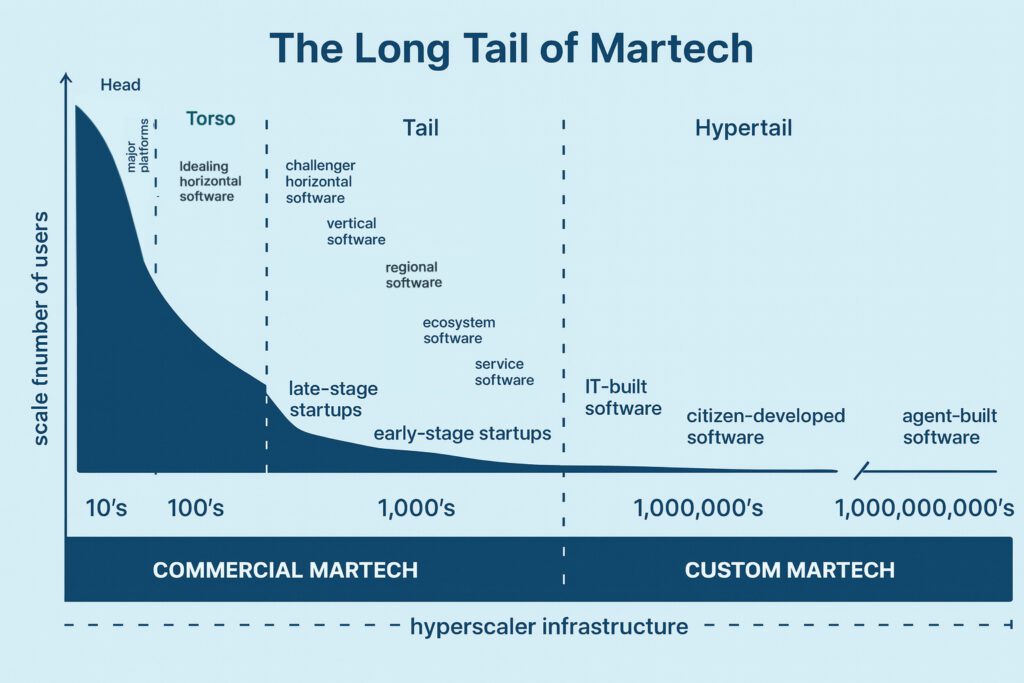
The Martech Food Chain: Understanding the Three-Tier System
Source: Chiefmartech
Looking at this curve, you can see exactly how the martech world is organized and where the real action happens.
The Head: Big Platforms, Big Price Tags (10s)
- These are your Adobe, Salesforce, HubSpot, and Google giants: everything under one roof, bulk pricing, but you’re stuck with what they offer.
- Trade-off: Comprehensive but expensive, integrated but potentially overwhelming.
The Torso: The Sweet Spot Specialists (100s-1000s)
- The companies that said, “We’ll do one thing incredibly well instead of everything okay.”
- Why they work: 26-37% of the market, $10-100M revenue range, and they actually answer the phone when you call support.
- The appeal: Better at their specialty, faster innovation, and reasonable pricing. You’re not just another ticket number.
The Tail: Innovation Central (1000s-10,000s)
- 47-56% of all martech tools live here, thousands of startups solving problems you didn’t know you had.
- AI-native tools, niche solutions, and platforms like resollm.ai are offering enterprise-quality AI marketing automation at startup-friendly prices.
- Why it matters: Innovation happens here first, and prices don’t require a board meeting to approve.
The Hypertail: The Wild West (1,000,000s+)
- Beyond commercial martech lie custom-built solutions, citizen-developed tools, and agent-built software. This is where companies create their own competitive advantages using no-code platforms and AI agents.
- The curve keeps extending right: more tools, more customization, more complexity.
Where Martech Actually Stands in 2025
The Clarity Curve
Source: Chiefmartech
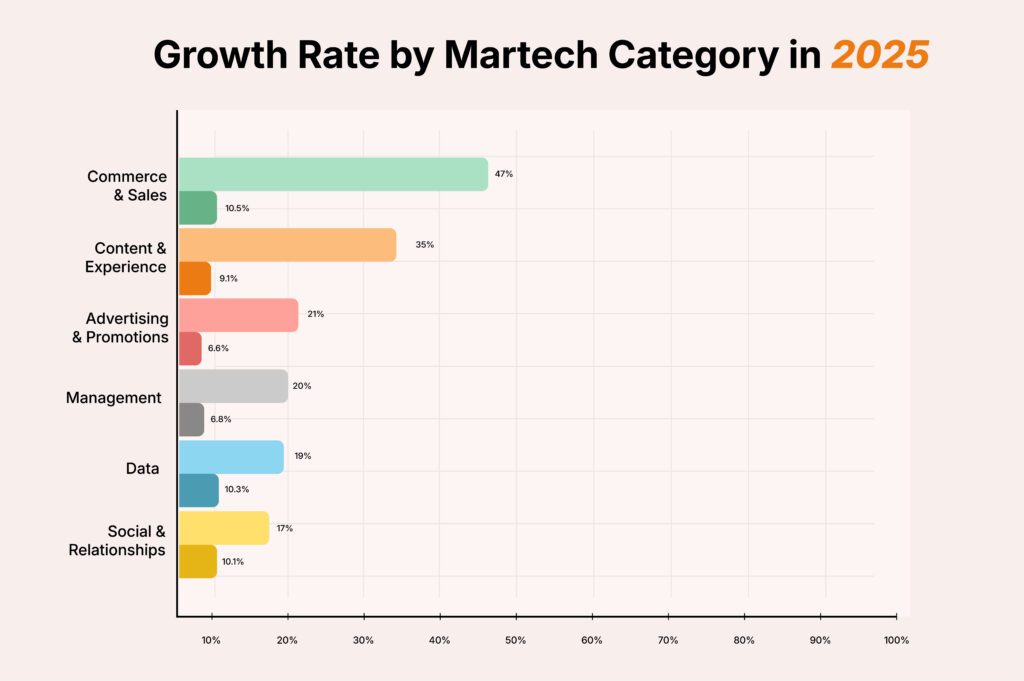
2024 was the year of chaos, a full-blown GenAI gold rush where every startup claimed to be “AI-powered” and every marketer added yet another tool to their stack. Growth was explosive, noisy, and unsustainable.
Then came 2025, the bend in the curve.
Marketers hit the wall of reality, budgets tightened, and clarity finally took over. The shift of “more tools = more results” gave way to The Clarity Curve, the natural evolution where hype gives way to focus, and efficiency becomes the new growth engine.
What the Clarity Curve Really Shows
Instead of focusing on the exact percentages in the graph, here’s what the curve actually implies:
- Categories tied directly to revenue rise to the top.
- Anything dependent on clean data becomes more valuable as AI spreads across workflows.
- Channels that support real relationships and authenticity maintain their place.
- Everything else, tools without clear ROI, gets squeezed out, ignored, or replaced.
This is also where generative search ranking becomes a real differentiator, not for keywords, but for structured signals and meaningful content.
Marketers who’ve crossed this curve share a common mindset:
- They no longer equate “more tools” with “more capability.”
- They prioritize revenue-connected categories like commerce and sales.
- They invest in data foundations because AI without clean data is just biased automation.
- They double down on relationship-building channels that consistently convert.
In short: winners simplify, focus, and integrate, not accumulate.
The Growth Paradox: More Tools, Smarter Choices
Source: Chiefmartech
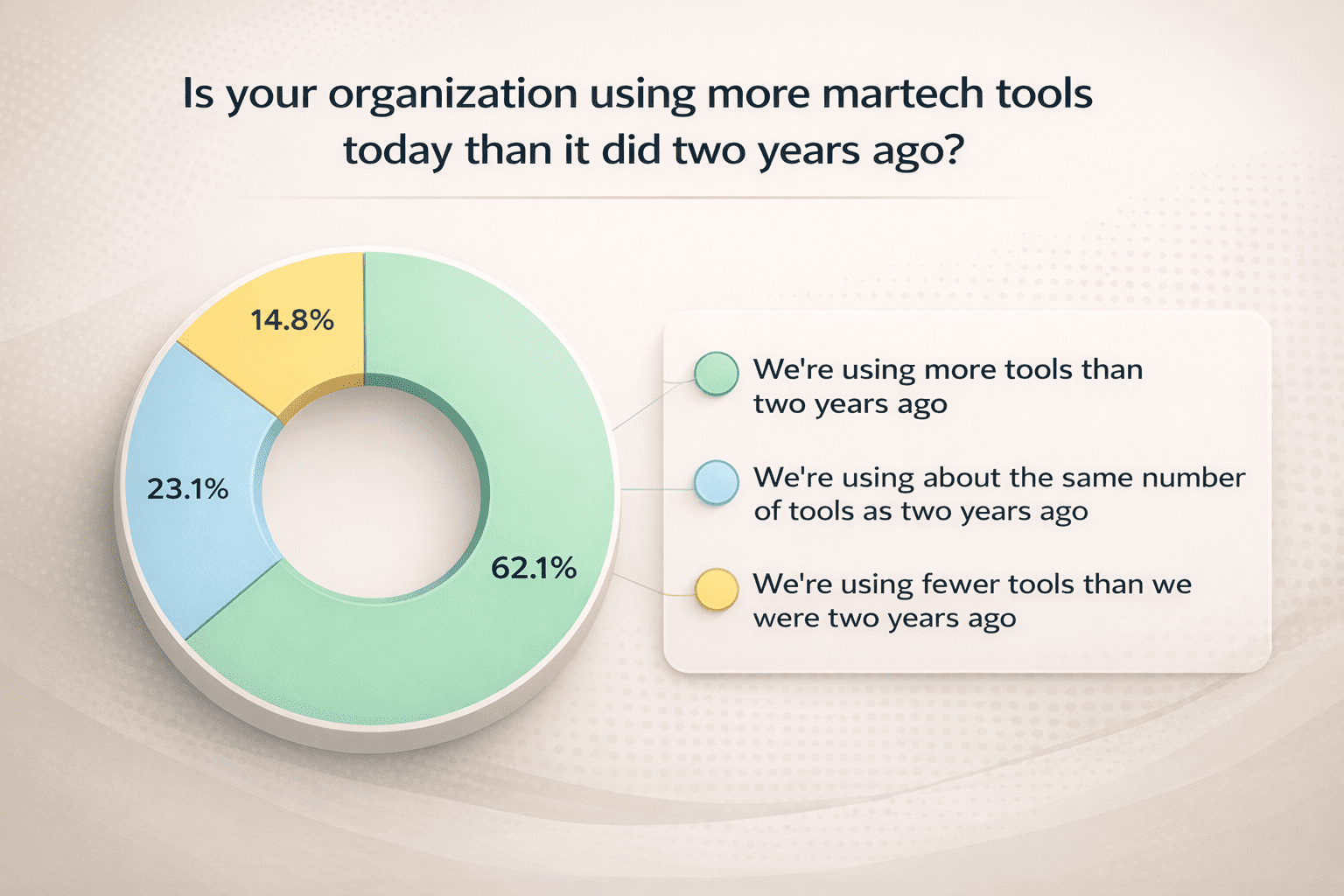
Let’s step back and look at what’s really happening inside martech stacks today, because the numbers tell a surprising story.
Even though most teams use only a portion of the tools they already have, the majority of companies are still expanding their stacks. On the surface, that looks contradictory. But it actually reflects two very different mindsets in the market.
The Two Tribes
1. The Smart Consolidators
This group isn’t adding more tools for the sake of it. They’re upgrading intelligently, replacing multiple disconnected tools with one solution that integrates everything they actually need. Their mindset is simple:
“Does this help everything work better together?”
They’re cleaning up, simplifying, and getting more value from fewer tools.
2. The Still-Confused Majority
This group keeps adding tools reactively.
- A new challenge? Buy a tool.
- A competitor adds a feature? Buy another tool.
- A vendor sends a convincing email? Add that too.
This is how stacks get bloated, complicated, and underused.
The Quiet Outliers: The Real Leaders
And then there’s a third group, the 15% who are actually shrinking their martech stack.
These are the real innovators, because reducing tools requires:
- Admitting some purchases didn’t deliver
- Letting go of sunk costs
- Challenging internal politics
- Choosing clarity over complexity
They aren’t “downsizing.”
They’re designing a stack that actually works.
The AI Adoption Reality Check
Source: Chiefmartech
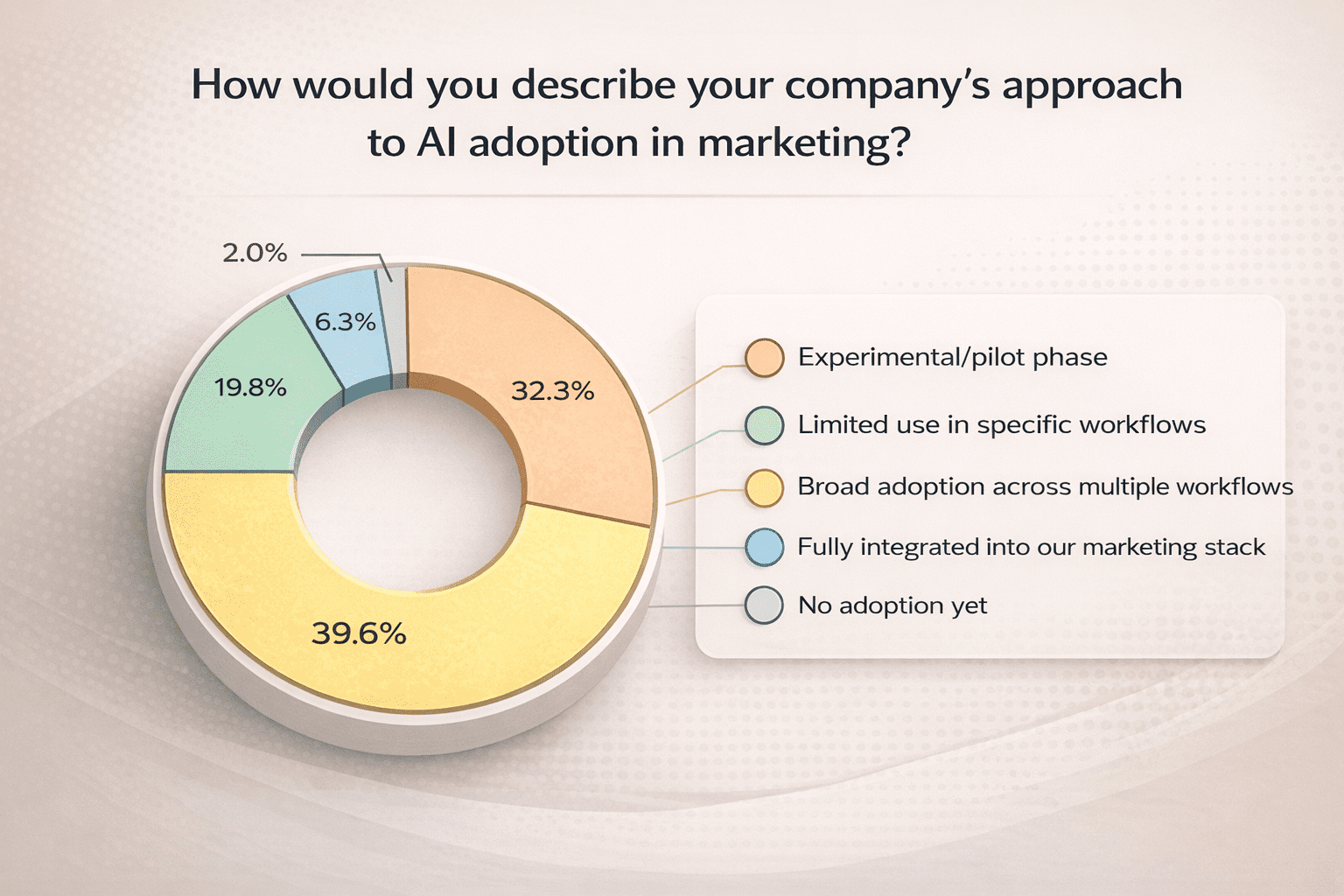
A lot of companies love to say they’re “using AI.” It looks great in a board deck and sounds futuristic in a leadership meeting. But when you dig deeper, most teams are barely scratching the surface.
The real gap isn’t between using AI and not using AI. It’s between dabbling and deploying.
The Four Types of AI Users (No Buzzwords, Just Reality)
1. The Experimenters
These teams are testing tools, running small experiments, and figuring out what AI even does. There’s curiosity, but no real structure or outcomes.
2. The Dabblers
This is the biggest group. They’ve activated a few AI features, but only at the surface level, a rewritten paragraph here, a predicted subject line there. On paper, it’s AI adoption. In reality, they’re tapping into maybe 5% of what AI can offer.
3. The Operators
These teams use AI across multiple workflows: segmentation, analytics, personalization, and optimization. Not everywhere, but enough to see real ROI.
4. The Integrators
This is the elite group. AI isn’t a feature or a tool; it’s stitched into how they operate. Workflows run autonomously, insights update themselves, and customer interactions scale without adding headcount.
These companies aren’t working harder. They’re operating on a different timeline entirely.
Where Most Companies Get Stuck
The dabblers are the riskiest group. Not because they’re wrong, but because they think they’re further ahead than they are.
They’ve “adopted AI,” but they haven’t:
- Cleaned their data
- Integrated workflows
- Updated processes
- Created cross-functional alignment
- Rebuilt marketing around speed and automation
So they stay where it’s comfortable, while competitors quietly sprint past them.
Meanwhile, the Integrators Are Scaling Like Crazy
The fully integrated teams are:
- Predicting churn before it happens
- Personalizing campaigns automatically
- Deploying AI agents for customer interactions
- Automating what others still do manually
- Making decisions 10x faster
- Letting AI handle tasks that used to take weeks
And here’s the scary part: their advantage compounds every single quarter.
At this point, almost everyone uses AI. That’s no longer impressive. What matters now is how you use it. And as AI becomes the default discovery layer, this is exactly what drives better generative engine optimization and stronger generative search ranking
So, now the question is: Are you operating like the top AI integrators or like everyone else who’s still dabbling?.
TL;DR
What This Means for Your Martech Strategy
These numbers reveal three critical insights:
1. Quality over Quantity is Winning
The “collect every shiny tool” is dead. Smart companies aren’t asking “What else can we add?” They’re asking, “What can we cut?”
If a tool doesn’t integrate seamlessly and drive real results, it’s just expensive clutter.
2. Revenue-Focused Tools Rule
Notice which tools are still growing? Commerce, sales, and data.
Why? Because they answer the only question that actually matters: “Does this make us money?”
If you can’t draw a straight line from your martech investment to revenue, you’re wasting budget. Period.
3. AI Hype ≠ AI Results
Sure, 72% of companies are “using AI.” But only 26% have actually figured it out.
The opportunity? Massive.
While most marketers are stuck playing with ChatGPT, the ones who actually integrate AI across their operations are lapping the competition.
Teams that operationalize AI end up strengthening their generative engine optimization automatically, because their data and workflows align with how LLMs surface answers.If this made you rethink your stack, you’ll want to see what else is coming. Get the next wave of insights at ReSO.