
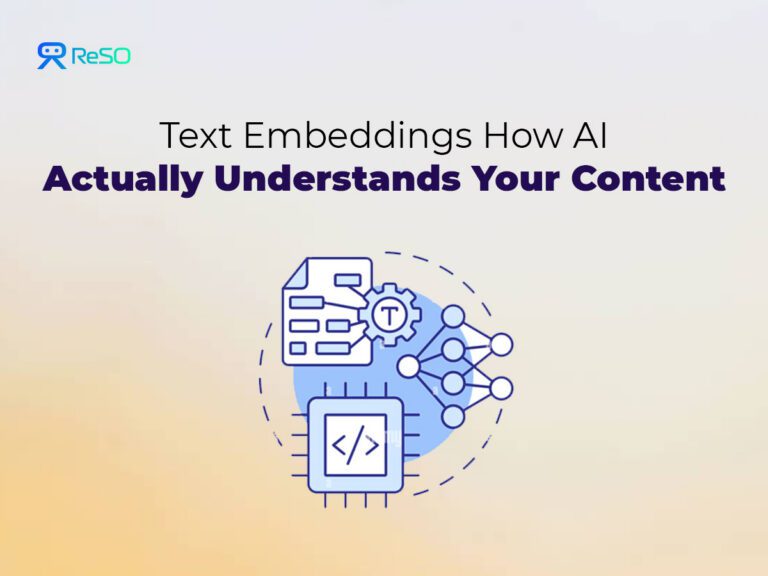
Embeddings are numerical representations of meaning that determine which content gets retrieved, cited, and recommended by AI search systems. Every time ChatGPT, Perplexity, or Google AI Overviews pulls information to answer a query, embeddings decide which passages make the cut.
For marketers, this mechanism explains why topical authority works, why thin content fails, and why semantic variation outperforms keyword repetition. Understanding embeddings transforms content strategy from pattern-following to purposeful architecture.
Why Does Following AI Search Advice Feel Like Guesswork?
Marketers hear the same recommendations repeatedly: build topical authority, add structured data, get cited by authoritative sources, and cover topics comprehensively. Most follow this advice without understanding why it works. That’s like following a recipe without understanding cooking; it works until you need to improvise, diagnose a failure, or adapt to new conditions.
The missing piece is the retrieval layer. When an AI system generates an answer, it doesn’t “know” everything; it retrieves relevant content from an index, evaluates what it finds, and synthesises a response. The mechanism that decides which content gets retrieved is an embedding-based similarity search. Every recommendation in GEO and AI search optimisation ultimately traces back to how embeddings function.
What Are Embeddings, and Why Should Marketers Care?
Embeddings convert text: a sentence, a paragraph, an entire page into a fixed-length list of numbers called a vector.
This vector encodes the meaning of the text so that similarity between pieces of content can be measured mathematically. Two texts about similar topics produce vectors that sit close together in a high-dimensional space; unrelated texts land far apart.
The map analogy: Embeddings turn your content library into points on a map where the geometry is semantic rather than literal. “Affordable electric cars” and “cheap EVs” end up as neighbouring points even though they share no words. A keyword-matching system would miss this connection entirely. AI search systems use this map to decide what to retrieve and recommend.
When OpenAI describes embeddings, they frame the output as a vector of floating-point numbers where “smaller distance equals more related meaning; larger distance equals less related meaning.” This distance, typically measured as cosine similarity, is the core retrieval signal.
How Do AI Search Systems Use Embeddings to Select Content?
Every major AI search platform: ChatGPT, Perplexity, Google AI Overviews, Gemini, relies on Retrieval Augmented Generation (RAG). The standard pipeline works like this:
- Ingest and index: Documents are split into chunks (typically a few hundred tokens), each chunk is converted into an embedding, and the embeddings are stored in a vector database.
- Retrieve: When a query arrives, it’s embedded using the same model, and the system finds the most semantically similar chunks via nearest-neighbour search.
- Re-rank: A more sophisticated model scores the top candidates for true relevance, filtering noise.
- Generate: The highest-ranked chunks are injected into the LLM’s context window as grounding material, and the model synthesises a cited response.
Most production systems now use hybrid retrieval, combining vector (semantic) search with keyword (BM25) search, because neither approach alone is sufficient. Microsoft’s Azure AI Search documentation explicitly recommends hybrid queries that “combine keyword and vector search for maximum recall.”
The critical insight: AI visibility is retrieval visibility. Your content must be easy for an embedding-based system to retrieve as high-quality, relevant chunks, then select as evidence.
Why Does Topical Authority Work in AI Search?
From an embedding perspective, topical authority is about vector geometry. When a website publishes comprehensive, interconnected content around a single theme, the embeddings of those pages form a dense cluster in vector space. When a retrieval system processes a query within that topic, multiple pages from the authoritative site appear among the nearest neighbours, reinforcing the site’s relevance signal across the cluster.
Google’s AI Mode and AI Overviews use a “query fan-out” technique, issuing multiple related searches across subtopics. Broad topic coverage increases the chance that your site has a good match for at least one fan-out subquery. Perplexity’s architecture describes hybrid retrieval and multi-stage ranking at fine-grained spans, implying that highly specific subtopic passages are valuable retrieval targets.
Practical translation: The more your site contains distinct, specific, high-quality passages that answer adjacent questions, the more opportunities you create for embedding-based retrieval to surface your domain.
A case study documented a 38x increase in website traffic after implementing semantic SEO and content clustering on 100+ existing blog posts that were previously unstructured and poorly interlinked.
Why Does Thin Content Fail in AI Search?
Thin content produces embedding vectors that are semantically vague; they don’t cluster strongly with any specific topic, meaning they fall outside the retrieval radius for most queries. Google’s AI Overviews are designed to identify “relevant, high-quality results”; when the system doesn’t have great information available, responses fail or degrade.
Semantic depth: comprehensive coverage, expertise, and topical authority are now a baseline requirement for visibility in modern AI search engines. Content that covers only surface-level definitions without addressing relationships, examples, edge cases, or practical applications doesn’t produce embeddings rich enough to match decomposed queries.
Why Does Semantic Variation Beat Keyword Repetition?
Repeating the same keyword 50 times doesn’t move an embedding vector in meaningful ways; the model already captured that concept on the first occurrence. What moves the vector is covering semantically related concepts, because each new entity, relationship, or sub-topic activates different dimensions of the embedding.
OpenAI’s retrieval documentation highlights that semantic search surfaces relevant results “even with few or no shared keywords.” Google’s Vertex AI documentation frames dense embeddings as enabling meaning-based passage search even when queries and content use different languages.
Content strategy implication: You get more retrieval surface area by covering a topic with varied phrasing and sub-angles: definitions, examples, edge cases, comparisons, step-by-step processes, than by repeating one target phrase. Advanced practitioners now use embeddings directly for synonym expansion, grouping related phrases by vector similarity rather than relying on keyword tools.
An analysis embedding both Google Ads search terms and Search Console queries into vector space found a 58.3% coverage score, meaning nearly half the paid terms weren’t reinforced organically. Embedding-based analysis revealed gaps that exact-match keyword analysis missed entirely.
How Does Content Freshness Affect Embedding-Based Retrieval?
Embeddings themselves don’t automatically make content “fresh.” Freshness is handled via indexing cadence, ranking signals, and metadata filtering. When AI systems re-crawl updated content, they generate fresh embeddings and insert a new “semantic snapshot” into the retrieval index. If the topical landscape has shifted, new terminology, updated data points, and evolved best practices, but your content hasn’t changed, its embeddings drift out of alignment with current queries.
Google’s ranking systems include explicit “freshness systems” designed to show fresher results when queries deserve freshness. Perplexity frames “completeness, freshness, and speed” as key criteria and describes ML-driven decisions about which URLs should be indexed or refreshed.
Marketer takeaway: Content maintenance is partly a retrieval problem. Being the most current trusted source increases the probability you’re among the retrieved candidates, especially for fast-moving niches.
What Can Marketing Teams Do With Embeddings?
Five use cases translate embedding capabilities into marketing operations:
Content deduplication and cannibalisation detection. Embed all pages on your domain, calculate pairwise cosine similarity, and flag pairs above a threshold (e.g., 0.85) as potential duplicates or cannibalisation risks. This catches cases where different wording communicates the same intent, invisible to keyword-level analysis.
Semantic keyword grouping. Embed keyword lists from Search Console, PPC campaigns, or research tools, then cluster using k-means or hierarchical clustering. Groups form around meaning rather than shared words, revealing true intent overlap and content brief opportunities.
Competitor content gap analysis. Embed your content library and a competitor’s, then identify clusters where they have dense coverage, and you don’t. One analysis using this approach found that addressing a missing subtopic around “cross-functional collaboration” drove 45% more organic traffic.
Customer support categorisation. Embed incoming tickets and cluster them to identify common issue themes, enable auto-routing by similarity to predefined categories, and surface emerging patterns the team hasn’t explicitly documented.
Internal semantic search. Replace keyword-based internal search with embedding-powered retrieval, so employees searching “how do I expense a business trip” find the policy document titled “Travel reimbursement procedures.”
How Do You Audit an Existing Content Library With Embeddings?
A practical workflow for content auditing:
- Extract and chunk: Pull all published content from your CMS. Segment long pages into meaningful sections by heading or topic shift.
- Embed: Pass each chunk through an embedding model.
- Calculate pairwise similarity: Compute cosine similarity between all content pairs. Flag high-similarity pairs (above 0.85) as cannibalisation risks.
- Cluster: Apply k-means or hierarchical clustering to group content by semantic theme. Evaluate whether each cluster has a clear pillar page and sufficient supporting coverage.
- Visualise: Use dimensionality reduction (UMAP or t-SNE) to create a 2D map of your content. Dense clusters indicate topical strength; isolated dots indicate orphaned content; empty regions indicate gaps.
- Act: Merge near-duplicate pages, expand thin clusters, create missing pillar pages, and build internal links between semantically related content.
Several SaaS platforms have productised this workflow for non-technical users. MarketMuse builds topic models and analyses content quality against competitors. Clearscope analyses top-ranking content to extract semantic relevance signals. Surfer SEO breaks down content scoring and offers audit tools for published pages.
For teams without technical resources, the most accessible path uses these tools that abstract the embedding layer entirely. For teams willing to experiment, exporting content to a no-code platform and generating embeddings via the OpenAI API costs almost nothing and produces actionable clustering output.
Curious how AI actually sees your content?
Book a ReSO demo to understand where you’re getting retrieved, cited, or missed across AI search, and what to fix to improve your visibility.