Search didn’t suddenly “become AI” in 2026; it became stateful.
For most of its history, Google Search treated every query as a reset. You asked a question, got results, clicked or refined, and started again. Even when AI Overviews were introduced, they mostly behaved like a terminal summary: helpful, fast, and done.
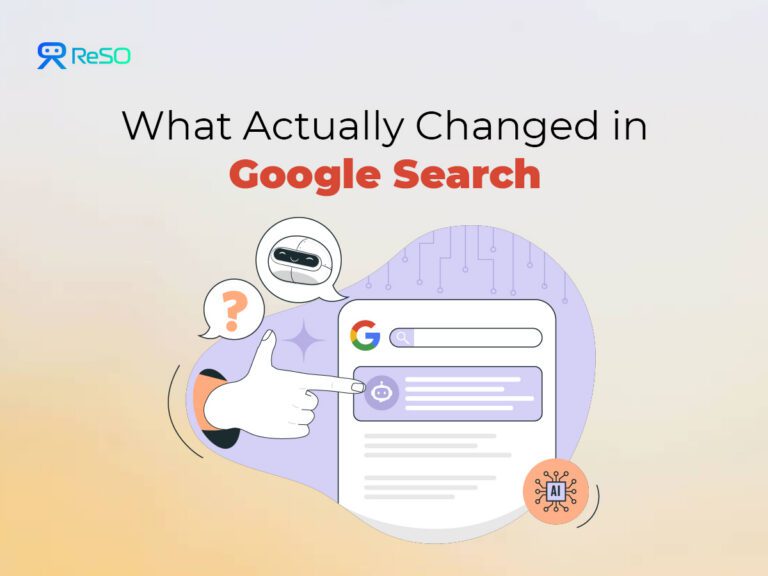
That model no longer holds, with follow-up questions now embedded directly inside AI Overviews and seamless continuation into AI Mode powered by Gemini 3; search is no longer a one-query, one-result interaction. It’s a continuous conversation that remembers context, builds on prior answers, and invites users to keep going without leaving the results page.
That shift has real consequences:
- For visibility, when clicks are no longer the primary signal of engagement
- For attribution, when answers persist across turns without repeated links
- For content strategy, when surviving the follow-up matters more than winning the first query
This article breaks down what changed, how AI Overviews and AI Mode now work together, and what this means for publishers and brands navigating zero-click, conversational search at scale. Because in a world of follow-ups, being findable once is not enough.
What Changed in Google Search in 2026?
The 2026 update didn’t introduce a new destination inside Search. There was no new tab, no explicit mode switch, no visible “AI upgrade” moment.
What changed was behavior. For the first time, users can ask follow-up questions directly from AI Overviews and continue that line of inquiry seamlessly into AI Mode, without rephrasing, restarting, or losing context. The system now treats the initial answer as shared ground, not a disposable result.
Three shifts matter most.
- First, follow-ups are now native to the overview itself. Instead of forcing users to reformulate a query or click away, Search invites the next question in place. The conversation begins where the summary ends.
- Second, context persists across layers. When a user moves from the overview into AI Mode, the system carries forward assumptions, entities, and intent from the earlier exchange. This is not a fresh query. It’s a continuation.
- Third, Gemini 3 now sits behind AI Overviews globally, which materially changes how responses are generated. The model is optimized for multi-turn reasoning, not single-shot answers. That matters because it shifts how information is selected, combined, and reused as the conversation evolves.
One clarification is critical: this is not a new feature surfaced inside Google Search. It’s a bridge between two previously separate behaviors: fast summaries and deeper exploration. Users don’t opt into depth anymore. The system nudges them forward by default.
AI Overviews are no longer the end of an answer; they are the beginning of a conversation.
Why the Follow-Up Flow Matters at Scale
The significance of embedded follow-ups isn’t about interface polish, it’s about where user attention now compounds.
AI Overviews already operate at mass-market scale. They appear at the very top of default search results and increasingly resolve intent without a click. By embedding follow-up questions directly into that surface, Google extends the session without handing the user back to the open web.
This has three systemic effects.
- Zero-click resolution increases by design. When clarification and expansion are offered inline, fewer users need to leave Search to continue learning. Each follow-up answered inside the interface removes another reason to click out.
- Time spent inside Search grows, not because users are passive, but because the system actively invites continuation. Exploration that once required multiple queries, tabs, and pages now unfolds inside a single conversational thread.
- Dependence on synthesized answers deepens. As users follow the system’s prompts forward, their understanding is shaped less by individual sources and more by how Google composes and sequences explanations across turns.
There’s an important nuance here.
- Google still includes links.
- Publishers are still cited.
But those links now compete with conversational momentum. This is why traditional visibility metrics start to mislead.
Ranking for the first query matters less when:
- The real differentiation happens in the second question
- Framing persists across turns
- Early explanations set the trajectory for everything that follows
Visibility is no longer about winning the opening move. It’s about whether your content survives the follow-up. If your explanation can’t be safely reused, extended, or paraphrased as the conversation evolves, it stops appearing quietly after the first turn.
What This Changes About User Behavior
The most visible change is how questions are formed. Queries get longer, more specific, and more conditional. Instead of restarting with a new keyword variation, users refine what they already asked. The system carries context forward, so there’s no penalty for being precise or exploratory.
Just as important is what disappears:
- Users no longer bounce between pages to assemble understanding.
- They don’t scan ten blue links looking for consensus.
- Exploration happens inline, guided by the system’s prompts rather than by SERP layout.
| Old search behavior | New AI-mediated behavior |
| One query → one click | One answer → one follow-up |
| Keyword refinement | Contextual clarification |
| Page hopping | Session continuity |
| Manual comparison | System-guided exploration |
This is why follow-ups are not just a UX improvement; they are a behavioral constraint.
Search sessions now reward:
- Clear initial framing
- Definitions that hold under pressure
- Explanations that can be extended without contradiction
And that sets up the next risk, because when context persists, errors persist too.
Accuracy, Control, and the Risk of Compounding Errors
Google has been explicit about one thing: AI Overviews can be wrong.
Generative answers may include mistakes, omissions, or oversimplifications, especially on complex or evolving topics.
What’s different now is how those mistakes persist.
In a follow-up-driven search flow, early framing becomes shared context. When that happens, errors don’t disappear; they compound.
This compounding happens for three reasons.
- There is no clean reset. Once a conversational thread begins, users can’t easily force a return to a neutral starting point. Even when links are present, the synthesized explanation sets the default frame.
- Coherence creates confidence.
Preserved context feels consistent, and consistency often reads as correctness. Unless the system introduces counterpoints, early framing hardens into accepted truth. - Corrections arrive late, if at all.
By the time a conflicting explanation appears, users are already anchored to a working model of the topic.
Explanations now need to be robust across reuse. In a follow-up-driven environment, safe explanations tend to share a few traits:
- Clear, bounded definitions
- Explicit assumptions and trade-offs
- Claims that remain valid when extended, compared, or paraphrased
This is why conversational search doesn’t just raise the bar for accuracy; it raises the bar for explainability that survives continuation.
Which leads directly to the publisher question, not about traffic or ranking, but about durability.
Can your explanation hold when the conversation moves on?
What This Means for Publishers and Brands
In a stateful search environment, visibility is no longer earned once. It’s earned across turns.
- Discovery now favors content that can be cited, paraphrased, and extended without breaking.
- Attribution becomes diffuse as explanations persist beyond the moment a link is shown.
- Presence matters more than position.
The practical shift is simple but uncomfortable: If your content only works for the first question, it’s fragile. If it can’t survive the second and third, it disappears.
For publishers and brands, the goal is no longer to win the click. It’s to create explanations that hold up when the conversation keeps going.
How Google’s Move Compares to Bing and ChatGPT Search
All major answer systems now support multi-turn exploration. What’s different is where the follow-up begins.
- Google starts the conversation at the very top of the default search results. Follow-ups are embedded inside AI Overviews, before users opt in. Continuation is assumed.
- Bing supports conversational search, but depth is visibly gated behind interaction choices.
- ChatGPT Search is conversational by design, but begins outside the traditional SERP. Users arrive expecting dialogue.
It’s Google refactoring search into a guided reasoning system, where the first answer quietly commits the user to what comes next.
If search visibility now compounds across turns, the hard part is no longer ranking; it’s knowing whether your explanations persist, mutate, or disappear as conversations evolve. And if you want to understand how visible you are in LLMs, you can book a call with ReSO and walk through it with us.