When analyzing brand mentions across ChatGPT, Claude, and Perplexity, researchers found that 85% of brand mentions come from external domains, while only 13.2% come directly from the brand’s own website. According to a separate analysis, brands are 6.5 times more likely to be cited through third-party sources than their own domains.
This is a complete inversion of everything marketers thought they understood about visibility. For two decades, the SEO playbook was straightforward: optimize your website, create great content, earn backlinks, and climb the rankings. Your owned properties were your foundation. Third-party mentions were nice supplements.
AI search flips that equation entirely. Your owned content now represents just 5-10% of what AI platforms reference when answering commercial queries.
For founders and marketers still thinking “SEO = my blog + backlinks,” this is your wake-up call. In AI-driven search, your carefully crafted homepage and product pages matter far less than what everyone else says about you.
Key Takeaways:
- 85% brand mentions from external domains vs 13.2% owned sites; brands 6.5x more likely to be cited through third-parties.
- Reviews, “best of” listicles, buyer’s guides, editorial explainers: structured formats that provide side-by-side context.
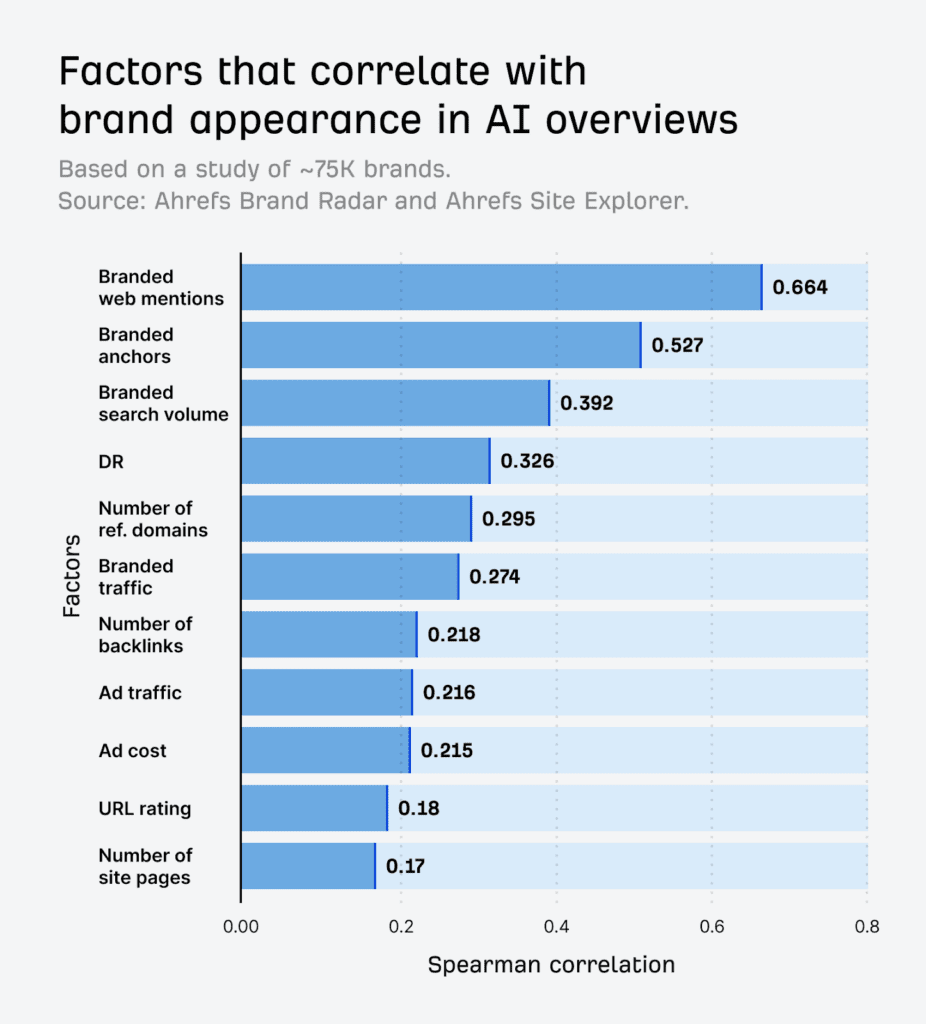
- Ahrefs finds branded web mentions (0.664 correlation) beat backlinks (0.218) for Google AI Overview appearances.
- Off-site playbook works like PR/media, review platforms, community, and partners
- Owned content must be “AI-ready.” Like schema markup, short copy-paste sentences, regular updates, neutral “source document” tone.
- Track citation rate vs rivals, share of voice in “best [category]” prompts, top citing domains, not rankings/traffic.
- Only 16% of brands track AI performance (McKinsey). Build your “off-site narrative” across 10-15 key domains now before competition catches up.
How AI Search Actually Chooses Brands
Third‑party sources dominate AI search because AI doesn’t work like old‑school search engines.
Traditional search indexed your pages, ranked them with signals like backlinks, and showed a list of links for queries like “AI search optimization strategies for B2B SaaS.” Users clicked through to vendor sites, review pages, and comparison articles, and did the evaluation themselves.
Now, when someone asks “What are the best AISO tactics for SaaS landing pages?” tools like ChatGPT synthesize the web into one confident answer, usually naming a few products and explaining who each is best for.
To do that, they pull from training data and live web content using retrieval‑augmented generation, but they don’t treat all pages equally.
Studies show AI systems lean toward objective, comparison‑style content: reviews, “best of” listicles, buyer’s guides, and editorial explainers, because those formats offer the side‑by‑side context people actually want.
Why Third-Party Sources Now Dominate Brand Visibility
Review sites and comparison listicles are over-represented. Wikipedia, Reddit, Forbes, and G2 dominate because they provide structured, comparative information that’s easily extracted and trusted by AI systems.
Brand mentions correlate strongly with AI visibility.
According to Ahrefs analysis, branded web mentions had a 0.664 correlation with appearances in Google AI Overviews: far stronger than backlinks (0.218 correlation).
Domains with millions of brand mentions on platforms like Quora and Reddit have higher chances of being cited than those with minimal activity.
This drives more awareness, leading to more mentions, reinforcing AI visibility. The rich get richer while brands without a strong off-site presence remain invisible, regardless of how great their owned content is.
When users ask product-specific questions like “What are the best productivity apps?” AI platforms frequently cite app stores and marketplace listings. These are third-party platforms where products are listed, compared, and reviewed, further evidence that AI prefers aggregated, comparative sources over individual brand pages.
Off‑Site Brand Building: New Playbook for AI Search
PR and media coverage.
Traditional PR gains new importance when major publications like Forbes, TechCrunch, or industry trade journals are heavily cited by AI. A well-placed profile, expert commentary, or feature story in high-authority media creates citable content that AI systems reference for years.
Guest content and thought leadership.
Contributing articles, guides, or analyses to established industry publications positions you as an expert while creating third-party content that AI can cite. Focus on sites that already rank well for topics in your domain.
Those are the sources AI platforms trust.
Podcast appearances and video content.
- YouTube videos are heavily cited in AI answers, particularly when they include transcripts AI can parse.
- Podcast appearances on established shows create another layer of third-party validation.
- Especially when episodes include show notes with your name and expertise area.
Co-marketing and partner pages.
Strategic partnerships that result in joint case studies, integration pages, or co-branded content create mutually beneficial mentions. When respected partners describe working with you on their high-authority sites, AI systems treat those as credible third-party endorsements.
Niche directories and review platforms.
- Maintain updated, comprehensive profiles on relevant review sites (G2, Capterra, Trustpilot), industry directories, and marketplace listings.
- These structured platforms are disproportionately cited by AI, and domains with such presence see 3x higher citation rates.
Community engagement.
Active, authentic participation in relevant Reddit communities, Quora discussions, and industry forums creates organic mentions. Domains with substantial activity on these platforms see higher AI citation chances.
The key is genuine contribution, not promotional spam; AI and human moderators both penalize the latter.
Quality beats volume.
Appearing in a few trusted, frequently-cited domains matters more than hundreds of low-value mentions.
Focus on earning placement in the specific sites AI platforms reference most for your category, identify where your competitors are mentioned, and where category discussions naturally occur.
Making Your Owned Content “AI‑Ready”
- Build clean product pages, detailed FAQs, transparent pricing, and clear use‑case pages.
- Aim for short, copy‑paste‑ready sentences that bloggers, journalists, and AI tools can lift without rewriting.
- Use schema.org (Product, Organization, FAQ, HowTo, Review) on key pages.
- Structured data makes your facts machine‑readable and has been shown to improve source citation rates significantly.
- Update core pages (home, product, pricing, key guides) on a regular cadence.
- Fresher content is more likely to be cited by AI systems than pages that haven’t changed in years.
- Create definitive guides, industry explainers, comparison matrices, and benchmarks for your niche.
- Treat them like “source documents” others will reference: neutral tone, clear definitions, original data if possible.
How to Measure Your Brand’s Visibility in AI Search
| STEP | WHAT YOU DO | WHY IT MATTERS |
| Monitor AI answers | Regularly test your core queries across AI platforms; log if/where your brand appears, your position among competitors, description accuracy, and every source cited. | Baseline view of your current AI visibility and how assistants describe your brand. |
| Track citation rate vs. rivals | Note how often you’re mentioned compared to key competitors for the same prompts. | Quantifies your AI visibility gap or advantage within the competitive set. |
| Identify cited sources | For each mention, record the third‑party domains AI cites and assess their accuracy, freshness, and quality. | Shows which external assets currently drive your visibility and which need updating or new content. |
| Build an AI visibility scorecard | Create simple KPIs: citation rate, share of voice, sentiment of mentions, and top citing sources. | Gives leadership a recurring metric to track progress and prioritize off‑site brand building. |
| Exploit early‑mover advantage | McKinsey reports only about 16% of brands systematically track AI search performance as of late 2025. | Treat this as a new analytics moat while most competitors still ignore AI search as a measurable channel. |
Think Beyond Rankings to Reputation
AI search has quietly changed the rules: brand mentions and reputation signals are the new “rankings.” Instead of rewarding your own content, AI assistants mostly rely on what others say about you across the web.
You can’t control every Reddit thread or review, but you can shape the narrative. Keep your facts accurate and updated, systematically earn mentions on:
- High‑authority
- Often‑cited domains
- Show up authentically in relevant communities
- Maintain strong profiles on review and marketplace platforms
Treat this as reputation management at an algorithmic scale. Launch an “off‑site brand narrative” project: identify the 10–15 domains AI cites most in your category, audit how (or if) you’re mentioned there, and build a plan: PR, partnerships, guest content, community engagement to improve those mentions.
The data is clear: most AI brand mentions now come from external domains, and brands are many times more likely to be cited via third‑party sources than through their own sites. In AI search, trust doesn’t come from what you say about yourself, but from what everyone else does.If you want to optimize your content to make sure your brand shows up in AI citations, book a call with ReSo here.