Your LinkedIn analytics show 10,000 impressions on your latest post. Your website recorded 500 visitors last month. Your Google Analytics dashboard confirms 300 organic search clicks. However, hidden beneath these measurable numbers lies an entirely different layer of influence, one that never shows up in your analytics yet might be driving your most valuable outcomes.
Welcome to ghost traffic: the AI-fueled influence that occurs when your content shapes decisions, earns recommendations, and drives conversions without generating a single trackable click.
According to Cloudflare’s analysis of AI platform behavior, Anthropic’s Claude crawls nearly 71,000 HTML pages for every single referral it sends back. OpenAI’s systems show similar patterns. The disconnect is widening.
Understanding how to measure and attribute this ghost traffic isn’t just an analytics challenge. It’s a fundamental rethinking of how professional influence operates in an AI-mediated world.
Key Takeaways:
- AI recommendations drive conversions without trackable clicks, ChatGPT cites your content, user searches later, analytics credits “organic”.
- Claude crawls 71K pages per referral; your content trains AI massively but rarely generates clicks.
- Query ChatGPT/Perplexity for domain experts; appearances vs competitors reveal unseen influence.
- Use 30-90 day windows + “How did you hear about us?” surveys to capture misattributed AI conversions.
- AI traffic converts 2-6x better; if 1% visitors yield 5% conversions, the unmeasured AI impact is 5x direct metrics.
“Ghost Traffic”: AI-Fueled Influence Without Clicks
The Mechanics of Ghost Traffic
- ChatGPT answers “Best B2B SaaS content strategists?” from crawled data (your LinkedIn/articles).
- Recommendations spark later direct/organic visits: misattributed in analytics as non-AI sources.
- AI consumes content (crawler logs), influences users (unseen), drives business (miscredited).
Why Traditional Metrics Miss Ghost Traffic
Conventional analytics track direct pathways:
- user sees ad → clicks → visits site → converts.
AI discovery breaks this model.
AI systems consume your content at a massive scale to generate answers, recommendations, and summaries, often without sending traffic back. Cloudflare reports that Claude crawls content 70,900 times for every single referral (June 2025).
Your content is creating influence and shaping decisions, even when no click appears in analytics. That invisible impact is ghost traffic; traditional metrics fail to capture the real value.
The Attribution Problem
If someone asks ChatGPT for recommendations, receives your name, but doesn’t immediately click, then later searches for you on Google and visits your site, analytics shows “organic search” not “AI referral.”
The ghost traffic, the AI recommendation that sparked interest, remains invisible.
Adobe’s research shows 39% of consumers used AI assistants for shopping this year. These are AI-influenced conversions that get misattributed because the research phase happens in ChatGPT, while the final click happens through Google.
How to Attribute Unseen Reach
| Method | Core Approach | Key Benefits | Approach/Tools |
| AI Baseline Visibility | Monthly manual queries on ChatGPT/Perplexity/Gemini/Claude: “Experts in [domain]?” Track appearances/context | Establishes zero/non-zero AI citations; directional trends | Document in spreadsheet; estimate reach via query volume |
| Custom Attribution | Extend to 30-90 day windows; use position-based models in GA4 to capture multi-touch AI influence | Fixes last-click underreporting of AI research phase | Add “How did you hear about us?” forms for qualitative data |
| Crawl Anomalies | Monitor GPTBot/Claude-Web spikes in server logs despite low referrals | Reveals high AI interest (“ghost traffic”) without clicks | Cloudflare AI Insights: track crawl-to-referral ratios |
| Branded Search Spikes | Watch Google Search Console/Trends for unexplained brand query surges post-content | Indicates AI recommendations driving direct searches | Correlate with LinkedIn posts/industry events |
Building a New Influence Metric Stack
The Core Stack
- Track monthly appearances vs competitors across ChatGPT/Perplexity/Gemini/Claude for 10-20 core domain queries.
- AI crawlers hit ÷ referral traffic.
- High ratios signal ghost traffic; content heavily consumed without clicks.
- Percentage of conversions from AI influence but credited elsewhere. Track via intake surveys (“How did you hear about us?”) + extended attribution windows.
- Track the rate of change in branded search volume, especially after content releases; rising branded searches without paid ads suggest AI-driven discovery.
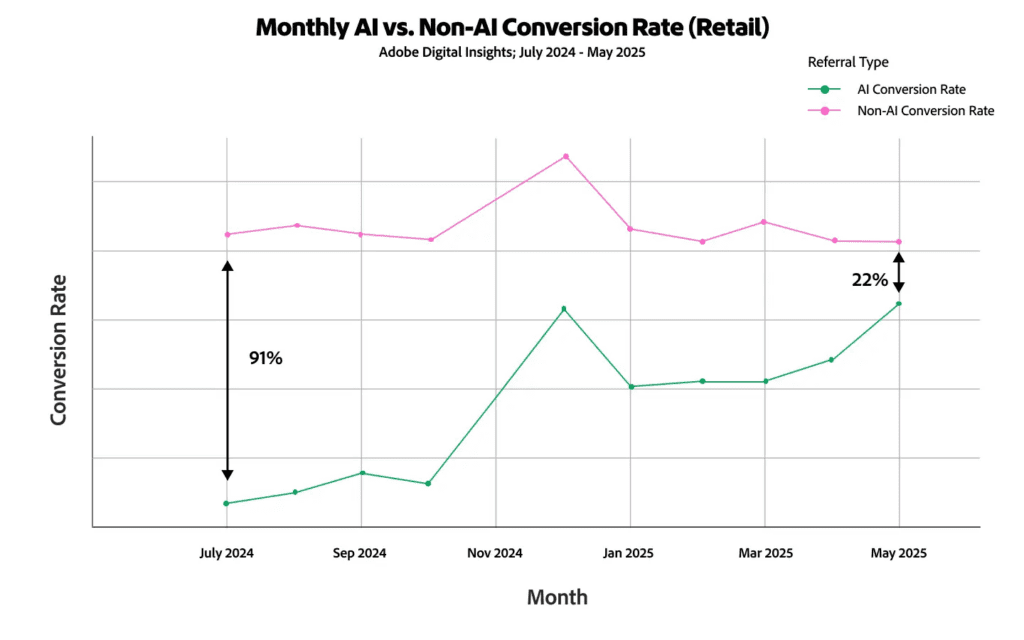
- Adobe research shows AI-driven retail traffic converted at 22% lower rates than non-AI traffic by May 2025, a big improvement from 91% lower in July 2024. Despite still trailing, the conversion gap is rapidly closing, highlighting growing effectiveness of AI referrals.
Secondary Indicators
- Track structured content crawls vs branded search/conversion spikes.
- Monitor web mentions (Google Alerts/Brandwatch) for AI authority signals.
- Check 7-30 day post-publish conversions for AI ghost traffic patterns.
AI Impression Tracking and Indirect Influence Mapping Framework
Ghost traffic refers to the indirect impact of your content through AI consumption. This is where LLMs (like ChatGPT, Perplexity, or Google AI Overviews) ingest, summarize, and recommend your work without generating trackable clicks or referrals.
Traditional analytics (e.g., Google Analytics) may miss this, capturing only direct traffic. This framework estimates ghost traffic to reveal your true influence.
Map Content to AI Consumption Patterns
AI systems consume structured content (frameworks, tables, lists) more heavily for summaries. Prioritize E-E-A-T signals as Google confirms these boost AI visibility.
Action steps:
- Audit your content library in Google Search Console. Filter for pages with high crawl frequency (e.g., 10+ crawls/week) but low direct traffic (<1% of total sessions). Tag these as “ghost traffic generators.”
- Prioritize creating/revising content with AI signals. Use schema markup (JSON-LD for HowTo, FAQ, or Article), numbered frameworks, and quantifiable data (e.g., “5 proven steps backed by 2025 SEMrush data”).
- Test them. Publish 3-5 optimized pieces and monitor crawl spikes within 7-14 days.
Build Indirect Influence Maps
Reconstruct customer journeys to uncover AI touchpoints missed by pixels or UTM tags.
Action steps:
- Interview 10-20 recent conversions quarterly via post-purchase surveys (use Typeform or Google Forms with open-ended questions: “What led you to discover us?“).
- Log responses in a Google Sheet template: Columns for “Customer Source,” “AI Mentioned?” (e.g., “Perplexity suggested this”), “Journey Length” (e.g., research phases).
- Spot patterns: If >20% cite AI, map as “indirect influence score” (e.g., AI discovery rate = AI mentions / total interviews).
With 30% of all buyers view genAI tools as a meaningful interaction, creating a “dark matter” gap in traditional metrics. Supplement with AI share-of-voice (dashboard trends), crawl intensity (Search Console), indirect scores (interviews), and multipliers.
Your content fuels invisible decisions at scale. Build these systems to measure it. Or you may risk underestimating your impact. And to know your brand visibility in ChatGPT, Perplexity, and Google AIO, book a call with ReSO.
Found this blog useful? Read about AI crawlers taking over the internet here.