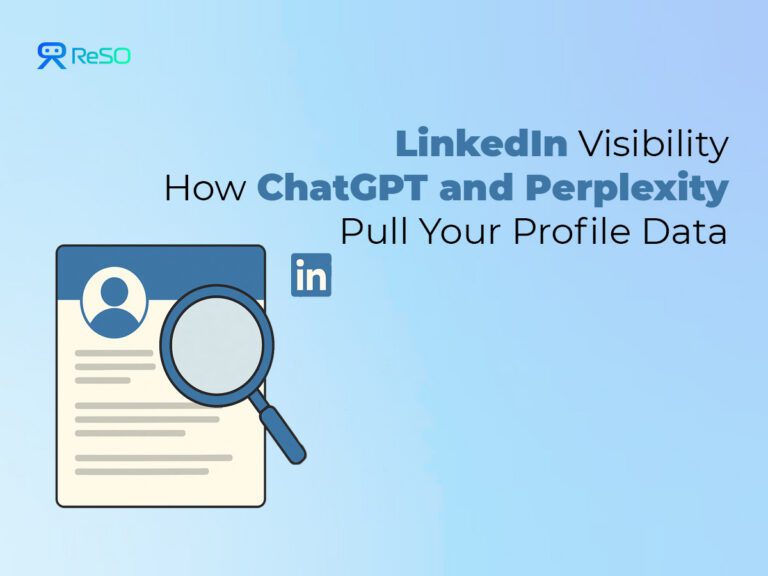

The way buyers discover B2B professionals has fundamentally changed. While you’ve been optimizing your LinkedIn profile for LinkedIn’s search algorithm, AI platforms like ChatGPT and Perplexity have quietly become primary discovery channels.
When someone asks, “Who are the best B2B SaaS consultants specializing in enterprise sales?” they’re no longer scrolling through LinkedIn. They’re asking for an AI that synthesizes information from across the web, including your LinkedIn profile.
This means your LinkedIn profile is competing with other profiles on LinkedIn and to be mentioned, cited, and recommended by AI systems that aggregate information from multiple sources to answer user queries. If your profile isn’t optimized for how large language models (LLMs) crawl, interpret, and synthesize LinkedIn data, you’re increasingly invisible to potential buyers.
Understanding how LLMs access your LinkedIn profile data, why personal brand visibility matters in AI discovery, and how to optimize for this new paradigm is essential for remaining discoverable in an AI-first world.
Key Takeaways:
- AI platforms like ChatGPT and Perplexity are now primary discovery channels for B2B experts, meaning LinkedIn profiles must be optimized for AI visibility, not just LinkedIn search.
- LLMs crawl publicly accessible LinkedIn data and extract structured professional signals that AI uses to rank and recommend experts within their knowledge bases.
- Cross-platform validation beyond LinkedIn through consistent brand mentions, personal websites, and credible citations is critical for AI systems to confidently identify expertise.
- Active and recent LinkedIn activity, including thought leadership posts and content updates, sends freshness signals that boost AI visibility and perceived authority.
- Professionals who optimize their profiles with clear expertise signals and create strategic content achieve early-mover advantages in AI-driven discovery and inbound opportunities.
How LLMs Crawl and Summarize LinkedIn Data
Understanding the mechanics of how AI platforms access and interpret LinkedIn data is crucial for optimizing your visibility in AI-driven discovery.
The Crawling Infrastructure
AI platforms use sophisticated web crawlers: automated bots that systematically browse websites to collect data. According to Cloudflare’s analysis of AI bot traffic in Q3 2025, OpenAI’s GPTBot accounts for 11.7% of observed AI crawling activity globally. Perplexity’s crawlers maintain a crawl-to-refer ratio that has evolved from 54 crawls per referral in January 2025 to 195 by July, indicating increasingly aggressive data collection.
These crawlers don’t access LinkedIn profiles through the platform’s API or official channels. Instead, they scrape publicly accessible profile data: your headline, summary, work experience, skills, posts, articles, and any content visible without login requirements.
What LLMs Extract from LinkedIn Profiles
When AI crawlers access your LinkedIn profile, they’re no longer storing raw HTML. They’re extracting structured information like professional identity markers, expertise signals, content and thought leadership, relationship context, and credibility indicators.
How AI Systems Synthesize This Data
Once collected, LinkedIn profile data becomes part of massive training datasets or retrieval-augmented generation (RAG) databases. When someone asks ChatGPT, “Who are experts in AI content marketing?” the system doesn’t search LinkedIn in real-time. Instead, it queries its knowledge base for entities matching the criteria, ranks candidates based on how comprehensively their data matches, and generates recommendations that synthesize profile information into natural language descriptions.
Reddit acknowledged this phenomenon in its October 2025 lawsuit against Perplexity, noting that “Reddit has emerged as the most cited domain across AI models globally” based on analysis of ChatGPT, Google AI Overviews, and Perplexity citations. The same pattern applies to LinkedIn for professional queries: it’s become one of the most-cited sources when users ask AI for expert recommendations or professional service providers.
The Discoverability Challenge
Here’s the critical insight: if your LinkedIn profile exists but lacks the structured, keyword-rich, authority-signaling content that LLMs recognize and prioritize, you won’t appear in AI-generated recommendations. Even if you’re highly qualified. The AI doesn’t “know” you exist in any meaningful way because the signals it uses to identify expertise aren’t present in your profile data.
This creates a fundamental asymmetry. Two professionals with identical qualifications but different LinkedIn optimization strategies will have dramatically different AI visibility.
The one who has structured their profile with clear expertise signals, consistent terminology, and rich content will be recommended by AI. The other will remain invisible, regardless of actual capability.
Why Brand Mentions & Personal Profiles Matter for AI Visibility
The relationship between your LinkedIn profile, broader brand mentions, and AI visibility is more interconnected than most professionals realize.
AI Relies on Cross-Platform Validation
LLMs look for consistency and validation across multiple data points. When evaluating whether you’re an expert in a specific domain, AI systems check:
- Is your LinkedIn profile consistent with your personal website in terms of expertise claims and specialization?
- Are you mentioned in articles, podcasts, or publications related to your field?
- Do other credible sources reference or cite your work when discussing topics in your domain?
- Is there a coherent “entity” representation of you across knowledge graphs like Wikidata, Crunchbase, or industry databases?
This cross-platform validation is why personal brand development beyond LinkedIn matters for AI visibility. A LinkedIn profile alone isn’t enough. You need a web of references that help AI systems confidently identify you as a legitimate expert worth recommending.
LinkedIn Profile as Entity Anchor
Your LinkedIn profile serves as the primary entity anchor that helps AI systems understand who you are professionally. Think of it as your digital professional identity card that AI uses to disambiguate you from others with similar names, connect your various online presences through links mentioned in your profile, understand your evolution over time, and classify you within professional taxonomies.
When someone asks an AI, “Who should I hire for content marketing strategy?” and your LinkedIn profile is incomplete, outdated, or poorly structured, the AI can’t confidently classify you as relevant even if you’re mentioned elsewhere online. The entity anchor is too weak to connect the dots.
Personal Brand Velocity Matters
AI systems favor recency and activity. A static LinkedIn profile from 2022 with no recent posts or updates signals lower relevance than an actively maintained profile with regular thought leadership content. This “freshness signal” matters enormously for AI visibility.
Professionals who consistently publish content on LinkedIn, like articles, posts, and comments on industry topics, create multiple touchpoints for AI crawlers to encounter and update their knowledge about your current expertise and perspectives.
This activity also generates engagement data that signals credibility and influence to AI systems evaluating authority.
How B2B Founders Appear in ChatGPT’s Recommendations
Theory matters, but real-world examples demonstrate how AI visibility translates to business outcomes. Let’s examine actual cases of B2B founders and professionals appearing in AI-generated recommendations.
SaaS Marketing Consultants
When querying ChatGPT with “Who are the top B2B SaaS marketing consultants for enterprise companies?” it generates recommendations that synthesize information from multiple sources. The professionals who appear consistently share common characteristics:
- Comprehensive LinkedIn profiles with detailed work experience highlighting specific achievements (e.g., “Grew ARR from $5M to $50M” or “Led marketing for Series C to IPO journey”).
- Active thought leadership presence with recent posts, articles, or comments on LinkedIn discussing current trends in B2B SaaS marketing.
- External validation through mentions in industry publications, podcast appearances, or speaking engagements at recognized conferences.
- Clear specialization language using consistent terminology matching how potential clients search (e.g., “enterprise B2B SaaS,” “product-led growth,” “demand generation”).
The Visibility Gap
What’s striking in this example is how many highly qualified professionals don’t appear in AI recommendations despite having the expertise. The gap is visibility optimization.
Professionals who haven’t structured their LinkedIn profiles for AI discoverability, don’t maintain an active thought leadership presence, and lack cross-platform entity validation simply don’t register as options when AI systems generate recommendations.
This creates a first-mover advantage. The professionals who recognized this shift early and optimized accordingly are now capturing disproportionate inbound interest, while equally qualified peers remain invisible to AI-driven discovery.
Optimization Checklist for LinkedIn → LLM Discoverability
Understanding the problem is valuable only if you know how to solve it. Here’s a comprehensive checklist for optimizing your LinkedIn profile and broader brand presence for AI discoverability.
LinkedIn Profile Optimization
- Headline clarity: Use your LinkedIn headline to explicitly state your specialization with keywords that match how people search. Instead of vague titles like “Marketing Professional,” use specific language: “B2B SaaS Growth Marketing | Helping Enterprise Companies Scale from $10M-$100M ARR.“
- Summary optimization: Write your LinkedIn summary, including clear statements of expertise, specific domains you serve, notable achievements with quantifiable results, methodologies or frameworks you’ve developed, and current focus areas. Use paragraph breaks for readability and natural keyword integration.
- Work experience detail: For each role, include specific accomplishments with metrics, technologies or methodologies you used, problems you solved and how, and results you delivered.
- Skills strategic selection: Choose skills that match how people search for expertise in your domain. Prioritize quality over quantity. Like 10 highly relevant, endorsed skills outperform 50 generic ones. Get endorsements from credible connections to add validation signals.
- Content consistency: Publish regularly on LinkedIn. Weekly posts or articles about your domain keep your profile fresh. And create multiple opportunities for AI crawlers to encounter updated information about your current expertise.
Cross-Platform Entity Building
- Use the same professional name across LinkedIn, your website, bylines, speaking engagements, and other platforms.
- Include your website, portfolio, X, and other relevant platforms in your LinkedIn profile.
- If you’re mentioned in Wikipedia, ensure the information is accurate. Claim and complete your profiles on Crunchbase, AngelList, or industry-specific directories.
- Get quoted in industry publications, appear on podcasts, speak at conferences, and publish on platforms beyond LinkedIn.
Strategic Content Development
- Answer common questions directly answer questions using the same language users use.
- Use structured formats like frameworks, checklists, step-by-step guides, and other structured content formats.
- Include specific, detailed examples of your work, providing rich context that helps AI understand what you’ve actually accomplished.
- Update your LinkedIn profile at least quarterly.
- Add new accomplishments, refine your summary based on current focus, and remove outdated information.
Your LinkedIn profile is the foundational anchor for AI to understand your professional identity, but it must be supplemented with a strong cross-platform presence, external validation, consistent terminology, active thought leadership, and strategic content addressing real buyer questions.
Your next potential client is already asking AI who to hire. The key question is whether your brand appears in those recommendations. And if you want your brand to appear in those answers, book a call with ReSo now.