Wait, what?
Your biggest competitor just landed three major clients this month. But here’s the plot twist, they didn’t spend a dime on Google ads or send a single LinkedIn message.
These prospects found them by casually asking ChatGPT: “What are the best B2B SaaS companies for [specific need]?”
Your company’s name? Not even close to making the list.
And this isn’t some “what if” scenario we’re talking about here. This exact conversation is happening right now. Probably while you’re reading this sentence.
Your ideal customers are already chatting with AI like it’s their personal business consultant. They’re asking ChatGPT for vendor recommendations, getting buying advice from Perplexity, and trusting Google’s AI Overviews more than traditional search results.
The numbers don’t lie, Google AI Overviews are now showing up in 16% of all U.S. searches (that’s up a staggering 102% since January). And get this: 88% of those are informational queries.
So, what’s really happening?
While you’ve been doubling down on SEO, a new search ecosystem has already taken over. And your competitors are winning inside it.
The good news: You’re not too late. Yet.
Why Your Current SEO Strategy Fails in AI Search (And What Actually Works)
The rules of the game have fundamentally changed, and most businesses are still playing by the old playbook.
Traditional SEO focused on optimizing for Google’s algorithm to rank in search results. AI search optimization requires understanding how Large Language Models (LLMs) process, evaluate, and recommend content to users asking specific questions.
The strategies that built your current rankings? They’re not just ineffective, they’re counterproductive.
What No Longer Delivers Results
- Keyword-focused content optimization doesn’t work when AI reads for meaning and context, not keyword density. AI engines analyze whether your content genuinely answers the user’s question, regardless of how many times you mention your target keywords.
- Link building as a primary strategy has diminished returns. While authority signals still matter, AI engines prioritize content quality and structure over traditional ranking factors. You could have thousands of backlinks, but if your content lacks substance, AI won’t cite you.
- Domain authority dependence is a trap. AI doesn’t evaluate your domain’s age or authority score before deciding to recommend you. It evaluates whether your content demonstrates genuine expertise and provides valuable insights.
- Generic, surface-level content gets filtered out immediately. AI engines favor specific, expert-level information with clear recommendations over broad, generic advice that could apply to anyone.
What AI Engines Actually Prioritize
Think of AI as a highly intelligent research assistant that needs to provide accurate, relevant recommendations to users with specific needs.
- Direct, structured answers to specific questions. AI wants your content to immediately address the user’s query in the opening sentences. When someone searches for “best project management tool for remote teams under 50 people,” AI looks for content that directly addresses that exact scenario.
- Demonstrable expertise and authority signals. AI evaluates author credentials, company information, case studies, and evidence that supports your claims. It’s essentially asking: “Why should I trust and recommend this source?”
- Well-structured, easily extractable information. Numbered lists, clear headings, FAQ sections, and organized content make it easier for AI to understand and reference your information.
- Current, relevant insights. AI favors content that reflects recent market conditions, updated information, and fresh perspectives over outdated or recycled content.
- Clear recommendations and actionable guidance. Instead of vague advice, AI prefers content that takes a definitive stance and provides specific recommendations based on different scenarios.
The Core Requirements: AI’s Content Evaluation Framework
AI engines evaluate your content based on three fundamental criteria:
- Problem-solution fit: Does this content solve a specific problem or answer a particular question? AI looks for relevant, targeted information rather than broad, generic advice.
- Source credibility: Can this source be trusted? AI examines expertise indicators, factual accuracy, and authority signals to determine whether your content should be recommended.
- Actionable guidance: What should users do with this information? AI favors content that provides clear next steps and practical recommendations over theoretical discussions.
- The strategic shift: Instead of optimizing for search engine rankings, you need to optimize for being the most helpful, credible answer to specific user questions.
Companies that understand this distinction are becoming the go-to recommendations while others remain invisible in AI search results.
The 6-Step AI Search Optimization Framework That Actually Works
Alright, enough theory. Let’s get into the nitty-gritty of how to actually show up when your customers are chatting with AI about their problems.
Step 1: Become a Detective of Your Own Customers (Week 1)
Your mission: Figure out exactly how your ideal customers talk to AI when they’re looking for solutions like yours.
Here’s what most companies get wrong: They assume customers search for their products the same way in ChatGPT as they do in Google.
What you need to do:
- Start conversations with ChatGPT, Perplexity, and Claude using different variations of how your customers might describe their problems
- Try prompts like: “I need a [category] for [specific situation] with [budget constraint]”
- Document every competitor that gets mentioned and pay attention to how they’re described
- Notice the language AI uses, it’s probably different from your marketing copy
Your customers aren’t searching for “enterprise software solutions.” They’re asking things like “What’s the easiest way to manage projects when half my team works remotely and the other half keeps forgetting to update anything?”
Step 2: Fix the Stuff That’s Broken Under the Hood (Week 1)
Translation: Make sure AI can actually read and understand your website.
If AI can’t figure out what you do from your homepage in 10 seconds, you’re already out of the running.
Your technical to-do list:
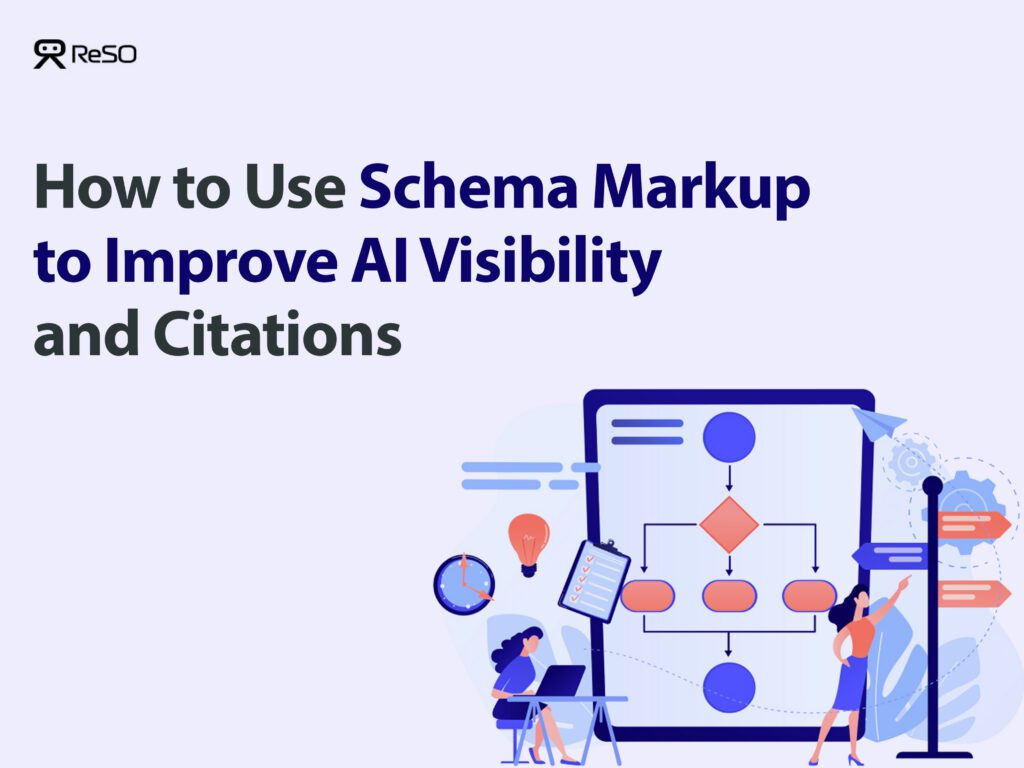
- Add schema markup that tells AI exactly what services you offer (think of it as labels for robots)
- Rewrite your meta descriptions to be factual, not fluffy, “We help SaaS companies reduce churn by 30%” beats “Innovative solutions for modern businesses”
- Make sure every important page answers one specific question right at the top
- Create FAQ sections that address the actual questions your prospects ask (not the ones you wish they asked)
Step 3: Create Content That AI Actually Wants to Quote (Weeks 2-3)
Become the source AI engines trust enough to cite when someone asks about your industry.
Content types that make AI sit up and take notice:
- Original research: Even a simple survey of 50 customers beats regurgitating industry stats everyone else uses
- Head-to-head comparisons: “Slack vs Teams for Remote Manufacturing Teams”, be specific and pick a winner
- Implementation guides: “How We Reduced Customer Support Tickets by 40% in 90 Days” with actual steps
- Expert insights: Get quotes from industry leaders about specific trends or challenges
The secret sauce for getting cited:
- Answer the question in your first paragraph, don’t make AI hunt for it
- Include actual numbers: “increased by 25%” not “significantly improved”
- Put author credentials right there where AI can see them
Step 4: Build Your AI Street Cred (Weeks 2-4)
Convince AI that you’re worth recommending by showing up in places that matter.
Authority signals AI actually notices:
- Getting quoted in industry publications (even small ones count)
- Speaking at events and making sure there’s a digital trail of it
- Publishing case studies with real numbers and real client names
- Keeping your content fresh, AI notices when you last updated stuff
The multiplier effect: Every mention in an authoritative publication is like getting a referral from someone AI trusts. The more of these you collect, the more likely AI is to mention you.
Step 5: Track Whether Any of This Is Actually Working (Weekly)
Because if you can’t measure it, you can’t improve it.
What you need to monitor:
- Search your company name across different AI platforms, how often do you show up?
- Ask AI the same questions your customers ask and see if you get mentioned
- Check whether competitors are stealing your thunder in AI recommendations
- Monitor if AI-aware visitors are actually converting better (they usually do)
The weekly reality check: Spend 30 minutes every Friday asking AI engines questions your customers would ask. Are you in the conversation or watching from the sidelines?
Step 6: Get Better Based on What’s Actually Happening (Monthly)
The continuous improvement loop that separates winners from wishful thinkers.
Your monthly analysis:
- Which pieces of content are getting cited and why?
- Where are competitors showing up that you’re not?
- How is AI describing your company when it does mention you? (Sometimes the description isn’t what you expect)
- What new customer questions are emerging that you should address?
Each step builds on the others. Follow the system, and you’ll start seeing your name pop up in AI recommendations where it matters most.
How ReSO Prepares Businesses for AI Search Domination
Look, we just walked through a comprehensive 6-step framework that absolutely works. But let’s be real for a second, implementing all of that manually is like trying to track every conversation happening about your industry across four different AI platforms while also running your actual business.
It’s doable, but it’s also exhausting. That’s where ReSO comes in.
ReSO’s Three-Pillar System: The Shortcut to AI Dominance
Pillar 1: Prompt Intelligence (AKA “Mind Reading for Marketers”)
Instead of you sitting there for hours asking ChatGPT different variations of customer questions, ReSO has already done the heavy lifting.
We’ve reverse-engineered how your specific buyers search across ChatGPT, Perplexity, Claude, and Google AI Overviews. And not just any buyers, your buyers, using your industry language, looking for solutions like yours.
While you’re guessing what prompts matter, ReSO users know exactly which questions are driving purchase decisions in their space.
Pillar 2: Competitive Intelligence
Here’s what typically happens: You think you’re invisible in AI search, so you don’t worry about it. Then ReSO shows you the report, and you realize your biggest competitor is getting recommended 3x more often than you across AI platforms.
We monitor whether you’re showing up in AI recommendations, how you’re being described when you do appear, and most importantly, why your competitors are beating you in specific prompt categories.
The wake-up call: Sometimes you discover you’re actually being mentioned, but AI is describing your company completely wrong. Or worse, mentioning you alongside a negative qualifier. ReSO catches this stuff before it becomes a bigger problem.
They’ll show you exactly which content gaps are costing you recommendations and which competitors own which types of buyer questions.
Pillar 3: Technical AISO Implementation (The Robot Whisperer)
You spend weeks learning schema markup, auditing metadata, and trying to figure out why AI engines can’t seem to understand what your company actually does.
Our system scans your site, identifies exactly what’s preventing AI citation, and gives you a prioritized list of fixes that actually matter for LLM visibility.
Instead of generic SEO recommendations that may or may not help with AI search, you get specific technical improvements designed to make AI engines love your content. Stop guessing whether your competitors are beating you in AI recommendations. Book a call with ReSO and get a real-time audit of your AI search presence. See exactly which customer prompts are driving recommendations in your industry and where you’re missing out.
Frequently Asked Questions
1. How do AI search engines decide which sources to cite and quote?
AI search engines decide which sources to cite and quote based on how clearly and credibly a source answers a specific question. They evaluate relevance to the prompt, structure, and extractability of the content, evidence of expertise, freshness, and consistency across sources. Content that delivers direct, well-supported answers with clear authority signals is more likely to be selected and quoted.
2. Why does traditional SEO fail to produce visibility in AI-generated answers?
Traditional SEO fails in AI-generated answers because AI systems do not rank pages the same way search engines do. Instead of rewarding keywords, backlinks, or domain authority alone, AI evaluates whether content directly answers a user’s question with clarity, structure, and evidence. Pages optimized only for rankings often lack the extractable answers AI needs to cite.
3. How important are structure and formatting for getting cited by AI?
Structure and formatting are critical for getting cited by AI because AI systems extract answers, not pages. Clear headings, concise paragraphs, bullet points, and FAQ-style sections make information easy to isolate and reuse. Well-structured content reduces ambiguity, helping AI confidently select, quote, and reference the most relevant parts of your content.
4. What authority signals do AI engines trust when recommending B2B brands?
AI engines trust authority signals that demonstrate real expertise and reliability. These include:
- Clear author credentials
- Original data or case studies
- Consistent brand mentions across trusted sources
- Up-to-date content
- Transparent company information.
5. How can companies track whether they are being mentioned by AI platforms?
Companies can track AI mentions by regularly querying AI platforms with the same questions their buyers ask and documenting whether their brand appears. They should also monitor: referral traffic from AI tools in analytics, review how AI describes their company when mentioned, and use AI-visibility or LLM mention tracking tools to measure citation frequency, positioning, and share of voice over time.