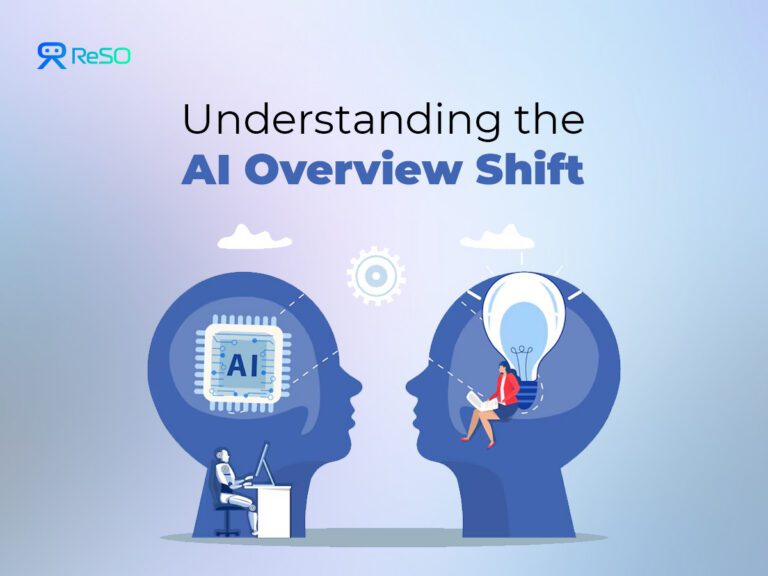

AI Overviews and AI Mode look similar, but they don’t behave the same. Both generate answers, both cite sources and both sit inside Google’s search experience. From the outside, they appear to be variations of the same system. However, they aren’t.
Large-scale analysis of hundreds of thousands of responses shows that AI Overviews and AI Mode rely on different source pools, surface different content, and reward different optimisation approaches. Visibility in one does not reliably translate to visibility in the other. This changes the optimisation problem.
Instead of one AI layer inside Google, there are now two distinct visibility interfaces: a static summary system designed for quick extraction, and a conversational system that expands queries and pulls from deeper, more contextual sources.
Key Takeaways
- AI Overviews and AI Mode operate as separate visibility environments. With only 13.7% citation overlap, appearing in one does not ensure presence in the other.
- Each system rewards a different content model. AI Overviews prioritise concise, structured, multimedia-ready content, while AI Mode favours comprehensive, multi-topic depth and contextual coverage.
- AI Mode expands queries through reasoning and sub-questions, which means visibility is more dynamic and often influenced by content freshness and topical completeness.
- AI visibility now drives traffic quality, not just volume. Brands cited in AI Overviews see stronger click performance, while absence from AI results is associated with significant CTR decline.
- Optimisation has shifted from keywords to semantic authority. Clear structure, schema, entity relationships, and comprehensive topic coverage determine inclusion across both systems.
- User behaviour reinforces a zero-click environment. Most users rely on AI summaries for evaluation, making citation presence more important than traditional ranking alone.
- AI Overviews and AI Mode should be tracked as independent channels. Winning in AI search requires dual optimisation while maintaining traditional SEO as the foundation for hybrid discovery.
Only 13.7% Citation Overlap
Perhaps the most striking discovery from Ahrefs’ comprehensive analysis: when AI Overviews and AI Mode answer identical queries, they share only 13.7% of their citations. This means in most cases, the systems rely on different source pools despite answering the same question.
According to Victorious’ December 2025 study analyzing 1,500 real-world queries, only 30-35% of URLs cited in AI Overviews also appear in AI Mode. More dramatically, 77% of all unique domains appear in only one experience, while just 23% show up in both.
What does this mean? Visibility in AI Overviews does NOT guarantee visibility in AI Mode, and vice versa. These are separate visibility channels requiring independent optimization strategies.
Google AI Overviews Trackers: Key Differences Revealed
| Feature | AI Overviews | AI Mode |
| Interaction | Static summary | Conversational with follow-ups |
| Data Source | Pre-indexed | Real-time and reasoning-based |
| Length | 2-3 paragraphs | 4× longer responses |
| Citations | 13.3 sources average | 12.6 sources average |
| Entity Mentions | Moderate | 3× more brands/entities |
| Omitted Citations | 11% of time | 3% of time |
| Monthly Users | 2 billion | 100 million (US/India) |
| Self-Consistency | Moderate volatility | 9.2% overlap across 3 tests |
How to Rank in AI Mode: Understanding Query Fan-Out
AI Overviews:
Demonstrates strong preference for multimedia content (videos, core pages). Optimized for quick, direct answers from selective, authoritative sources.
AI Mode:
Leans toward encyclopedic and detailed textual sources. AI Mode has high volatility.
This volatility creates both challenges and opportunities. Content that ranks in AI Mode today may not rank tomorrow, but fresh, comprehensive content can capture visibility quickly.
AI Mode Rank Tracking: What Actually Works
Certain content characteristics perform better:
For AI Overviews:
- Concise, well-structured answers with clear headings
- Multimedia elements (especially videos)
- Strong brand signals and mentions
- Authority sites with established trust
- Content optimized for featured snippets
For AI Mode:
- Comprehensive, detailed explanations
- Encyclopedic coverage with depth
- Multiple related subtopics addressed
- Reference-style content with citations
- Longer-form authoritative sources
AI Overviews Optimization Guide: The Growth Trajectory
According to Semrush’s analysis of 10+ million keywords from January to November 2025:
- January 2025: AI Overviews appeared in 6.49% of queries
- March 2025: Jumped to 13.14% (72% growth month-over-month)
- July 2025: Peaked at nearly 25% of queries
- November 2025: Pulled back to less than 16% of queries.
This surge-and-retreat pattern suggests Google tested aggressively, then refined based on user data.
Practical Implications: Multi-Channel AI Strategy Required
| Strategy | Key Benefit |
| Treat AI Overviews & AI Mode as separate channels | Success in one doesn’t guarantee success in the other |
| Create topically deep content | Supports longer AI Mode answers and entity expansions |
| Optimize for semantic authority | Both systems prioritize meaning over exact keywords |
| Build comprehensive coverage | AI Mode prefers encyclopedic sources that reward depth |
The Citation Impact: What Actually Drives Traffic
According to Dataslayer’s analysis of March 2025 core update data, being cited in AI Overviews creates measurable business impact:
- Cited brands: 35% higher organic CTR, 91% higher paid CTR: AI mentions boost click value across channels
- Non-cited brands: Suffer full 65% organic CTR decline: No AI visibility = traffic collapse
- Citation frequency: One AI citation can generate more qualified traffic than ranking #3 in traditional results
This citation advantage compounds over time.
User Behavior Shift: The Zero-Click Reality
Digital Third Coast’s December 2025 survey of 1,003 consumers reveals changing search patterns:
- 63% fact-check information from AI Overviews/AI Mode
- 26% didn’t use Google for their last product purchase
- 42% used AI to assist in last purchase decision
- 49% agree AI Overviews have improved since June 2025
- 21% scroll past AI Overviews for traditional results
These usage patterns confirm AI search is multi-layered, requiring optimization across static summaries, conversational experiences, and independent AI platforms.
AI Overviews and AI Mode are distinct channels with only 13.7% citation overlap requiring separate GEO strategies. Brands mastering both gain sustained visibility as 2B+ users shift toward AI-driven discovery.
If you are still not showing up in AI Overviews or AI Mode, or any LLM, book a call with us here to make sure your clients find you in AI answers.
FAQ: AI Overviews and AI Mode
Q: What’s the main difference between AI Overviews and AI Mode?
AI Overviews provide static summaries at the top of search results, while AI Mode offers conversational, interactive experiences with follow-up capability. They cite different sources 87% of the time despite answering the same questions.
Q: If I rank in AI Overviews, will I rank in AI Mode?
Not necessarily. Only 30-35% of URLs cited in AI Overviews also appear in AI Mode. 77% of domains appear in only one experience, requiring separate optimization strategies.
Q: How many sources do AI Overviews cite?
AI Overviews cite an average of 13.3 sources, while AI Mode cites 12.6 sources. However, only 13.7% of these citations overlap between the two systems.
Q: Which industries see the highest AI Overview presence?
Science leads at 25.96% saturation, followed by Computers & Electronics (17.92%), and People & Society (17.29%). Informational queries trigger AI Overviews 88.1% of the time.
Q: How do I track my AI Mode rankings?
As of June 2025, AI Mode clicks count toward Google Search Console under “Web” search type, but you can’t filter them separately. Use third-party AI tracking tools to monitor citations across both AI Overviews and AI Mode independently.
Q: Does AI citation improve traditional SEO performance?
Yes. Cited brands see 35% higher organic CTR and 91% higher paid CTR according to 2025 data. One AI citation can generate more qualified traffic than ranking #3 in traditional results.