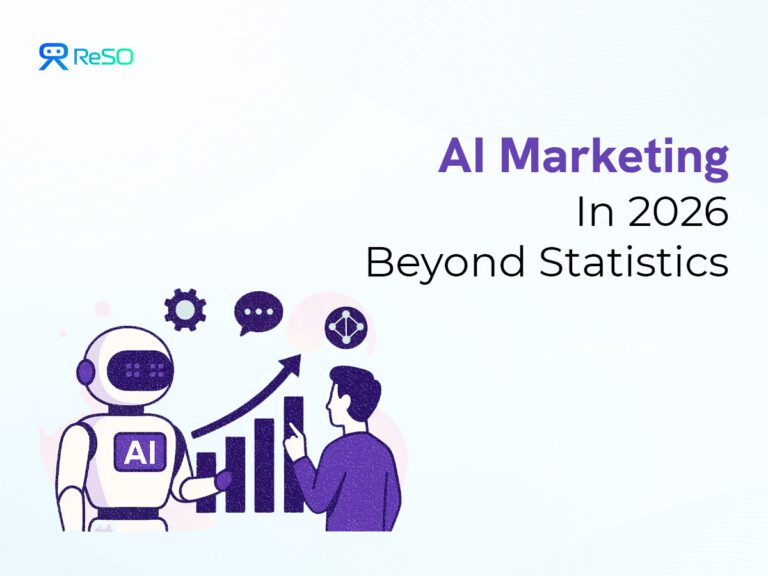
You’ve probably seen the headlines. Google’s AI Overviews hit 2.5 billion monthly users. ChatGPT has become part of everyday workflows. And suddenly, every marketer is talking about “AI transformation.” The gap now is not adoption; it’s in converting AI usage into measurable outcomes.
In 2026, the teams that treat AI as an operating system and keep it data-ready, trained, and embedded into workflows will win. What changed since 2025 is where AI now shows up in the buyer journey, shaping how people discover, compare and choose brands.
Key takeaways:
- AI adoption is no longer the differentiator. The advantage comes from turning AI usage into measurable business outcomes.
- Success depends more on clean data, team training, and workflow integration than on the AI tools themselves.
- AI search platforms are changing how buyers discover brands, making citations and visibility as important as rankings.
- The highest-performing teams use AI to augment human expertise, not replace it.
- Advanced AI strategies such as predictive CLV, behavioral adaptation, and predictive attribution help improve revenue, retention, and marketing efficiency.
- AI can accelerate content creation and distribution, but fact-checking, brand alignment, and human oversight remain essential.
- The most effective content workflows combine AI-driven efficiency with human creativity, judgment, and original insights.
- Small businesses should focus on practical AI applications that deliver immediate ROI, while enterprises should prioritize integrated, data-driven AI ecosystems.
- AI-generated content offers clear advantages in speed, scale, and cost efficiency, but success requires balancing those benefits against risks around accuracy, originality, and trust.
- The brands that win with AI are not necessarily the ones with the biggest budgets, but the ones that continuously adapt, optimize, and evolve their strategy as the technology changes.
The three AI ecosystems changing marketing
Google AI Overviews:
AI Overviews now appear in 25% of all Google searches by volume and are reducing clicks to top-ranking pages by 34.5-61%, depending on query type.
Translation: if you’re still banking on traditional SEO traffic, you need a backup plan. Seo is not dead, the goals have simply shiifted.
However, 90% of buyers still click through to sources featured in AI Overviews. Instead of optimizing for position #1 in search results, you’re optimizing to be the source that AI trusts and cites.
ChatGPT:
ChatGPT behaves less like a search engine and more like a research layer. Users click 1.4 external links per visit, compared to Google users who click only 0.6 times. They also spend 8 seconds longer on sites when they do visit.
What this means is that ChatGPT users are more engaged, but they are doing their homework first. They arrive with intent, not curiosity.
Perplexity:
Perplexity has quietly overtaken Gemini as a traffic referral source. It’s becoming the go-to for users who want sources with their answers, making it particularly valuable for B2B marketers.
The truth about AI content creation
- 74.2% of new webpages now contain AI-generated content, and 86.5% of top-ranking pages have some AI content.
- Before panicking about AI taking over, 97% of companies still edit and review their AI content, and only 2.5% publish “pure” AI-generated content.
- The winners aren’t replacing humans with AI, they are using AI to amplify human creativity and strategic thinking.
- Companies using AI are publishing 42% more content each month, but they are not cranking out robot copy.
- They use AI for the heavy lifting, like research, first drafts, and optimization while keeping humans in charge of strategy, brand voice, and final quality control.
Why AI marketing initiatives fail
A fact most teams miss is that there is no correlation between AI content percentage and search ranking position. Which means the companies obsessing over AI content detection tools are missing the point entirely.
The real challenge is implementation.
- 47% of AI projects are profitable
- 33% break even
- 14% actually lose money
The difference between success and failure comes down to three factors:
- Data Infrastructure: AI is only as good as the data you feed it. Companies that succeed invest heavily in clean, integrated data before they even think about AI tools.
- Team Training: Organizations that train employees on AI see a 43% higher success rate. It is about upskilling, not replacing.
- Strategic Integration: The most successful companies put 70% of their AI investment into people and processes, 20% into technology and data, and just 10% into algorithms.
The 6-step AI marketing implementation framework
| Step | What To Do | How To Nail It & Example Actions | Mistakes to Avoid |
|---|---|---|---|
| 1 | Data Infrastructure Audit & Setup | Audit all sources, map flows, fix data quality, and create governance | Ignoring sync/gaps; poor validation |
| 2 | AI Use Case Identification | Prioritise 2–3 high-impact, low-risk use cases first | Spreading effort too thin |
| 3 | Tool Selection & Integration | Build if AI is your core edge; else, buy or partner for a quick win | Chasing only new, shiny tools |
| 4 | Team Training & Change Management | Build phased training: start with literacy, then skills, then integrate | Not investing in people |
| 5 | Pilot Design & Execution | Run “Goldilocks” 90-day pilots. Optimise, measure, iterate fast | No clear metrics, no feedback loop |
| 6 | Scale, Optimise, and Iterate | Expand successful pilots in phases: perfect, expand, then transform | Scaling without adapting or learning |
The companies that successfully implement AI marketing are the ones that follow a systematic approach, focus on human and AI collaboration, and relentlessly optimise based on real results.
Real AI campaign breakthroughs
Two campaigns worth studying, each showing a different way AI breaks through at brand scale.
Pizza Hut’s “Pepperoni Hug Spot” campaign:
An AI-generated video introduced a fictional pizza chain called “Pepperoni Hug Spot” and went viral almost overnight as viewers noticed striking similarities to Pizza Hut’s actual branding. Rather than issuing cease-and-desist letters, the brand worked with Leo Burnett and the video’s creator and leaned into the hype and temporarily rebranded itself as “Pepperoni Hug Spot,” launching a pop-up with AI-inspired ads, branding, and recipes lifted straight from the viral video. The campaign generated massive earned media, social conversation, and brand engagement without the typical multi-million-dollar production budget of a traditional viral campaign. The lesson here was that AI-generated content can achieve organic virality when it resonates culturally, and brands willing to embrace unexpected AI-driven narratives can turn brand confusion into marketing gold.
Heinz’s DALL-E ketchup visualisation:
Heinz collaborated with DALL-E to invite the public to visualise its iconic ketchup bottle. Users entered text prompts describing how they saw Heinz bottles, and the AI generated high-quality images from the descriptions. This resulted in over 800 million views and coverage across prestigious international media outlets. The campaign turned customers into content creators and demonstrated how AI content can scale user-generated creativity while reinforcing brand identity.
These campaigns are early indicators of what AI content makes possible in marketing. The brands winning aren’t necessarily those with the biggest budgets; they are the ones that understand how to harness AI’s creative and viral potential.
Advanced AI marketing strategies that drive real ROI
Your AI tools are in place, pilot programmes are showing promise, and now the question is: what’s next?
The advanced strategies turn AI from a nice-to-have into a measurable growth engine. These tactics help companies predict customer behaviour, personalise campaigns in real time, improve retention, and allocate budget with more confidence. The goal is stronger revenue impact, lower acquisition costs, and marketing systems that get smarter with every customer interaction.
Predictive Customer Lifetime Value Optimization
The old-school way was to look at what customers bought before, bucket them into “spends a lot” or “spends a little,” and send everyone in each bucket the same emails. The AI way is to predict how much each customer will be worth in the future, then automatically treat them accordingly, before they even know what they want.
Instead of waiting to see if someone becomes your best customer, AI spots the signs early and rolls out the red carpet before they realise they deserve it. For example, Sarah starts as a “budget-conscious buyer.” AI notices she is opening more emails, browsing premium products, and engaging with content more often. She automatically moves into the “high-potential” group and starts receiving different messaging with no manual work required.
Personalised Intervention Timing
This is where AI gets almost creepy-smart. It does not just predict who might leave, it also predicts exactly when they are thinking about it. For example, AI detects that high-value customer Mike is showing early warning signs of disengagement. Instead of waiting until he’s already got one foot out the door, it triggers a personalised “we miss you” campaign 30 days before he would typically churn.
Real-Time Behavioural Adaptation
Forget personalisation based on last week. AI now personalises based on what someone is doing this second, combined with smart predictions about what they’ll do next. For example, a visitor lands on your pricing page and spends two minutes comparing plans. They are about to leave (AI can tell from mouse movement and scroll behaviour). Instantly, AI shows them a case study from their exact industry plus a limited-time discount. All in real time, tailored to them. It’s like a psychic salesperson who knows what each visitor needs to hear.
AI connects all your touchpoints, including email, social ads, website, and chatbot, so they are singing the same song based on what customers actually do.
Predictive Attribution
AI doesn’t just tell you what worked before; it also predicts what will work next. Want to shift 20% of your budget from Facebook to LinkedIn? AI can model the likely results before you spend a dime. AI can boost marketing productivity and cut costs. It isn’t about replacing your strategy brain; it is about letting AI handle the tedious optimization so you can focus on the big-picture creative work.
Content marketing AI: Creation, distribution, and optimization
Strategic Content Planning
AI analyzes your best-performing content and identifies patterns you would never spot manually:
- Optimal content length for different funnel stages
- Topic combinations that drive the most engagement
- Content format preferences by audience segment
- Distribution timing for maximum reach
Performance Prediction
Before publishing, AI can estimate how a piece of content is likely to perform. It uses historical performance, audience behavior, and industry patterns to suggest improvements before the content goes live.
Distribution Intelligence
Instead of posting the same content everywhere, AI optimizes distribution per platform:
- LinkedIn: Professional insights with data points
- Twitter: Key takeaways with engaging questions
- Email: Detailed analysis with clear next steps
- Blog: Comprehensive guide with internal linking
Content marketing execution: AI drafting, fact-checking, and human-AI partnership
The tactics above are only useful if supported by strong execution. Three principles separate teams that get real value from AI content from those that just publish faster.
1. Use AI for drafting and ideation, not final output
Treat AI as a starting point, not a finish line. The marketers whose AI content outperforms human content aren’t pressing “generate” and publishing raw outputs. They use AI to accelerate the most time-consuming parts of content creation while applying human expertise where it matters most. In practice, use AI to generate multiple outlines per topic, let AI draft first versions that you substantially rewrite, have it produce 10-15 headline variants, and synthesize reseach that a human analyzes and contextualizes. AI handles scale and speed; humans handle strategy and authenticity.
2. Maintain rigorous fact-checking and brand alignment
AI can produce confident, polished content that still contains incorrect information, outdated data, or misattributed sources. That makes verification non-negotiable. Establish a pre-publish protocol: every factual claim traced to a credible source, every statistic verified against original data, every attributed quote confirmed authentic. Layer brand-voice guidelines with approved terminology, prohibited phrases, tone examples, and brand values that should permeate outputs. Add a human review stage focused on accuracy and strategic alignment. Does this serve business objectives, provide genuine audience value, and maintain brand integrity? The content that performs is AI-assisted and human-perfected.
3. Blend AI efficiency with human creativity and authenticity
The hybrid model works best. AI handles pattern-based tasks like meta descriptions, social post variants, email subject-line testing, FAQ responses, and product description templates. While humans own content that requires lived experience, such as case studies with real customer outcomes, thought-leadership with unique perspectives, brand storytelling that conveys values, and nuanced topics requiring judgement. A strong AI-human workflow uses AI to draft outlines and first versions, then humans add proprietary data, original insights, strategic framing, emotional resonance, and forward-looking views that AI cannot replicate. As the content ecosystem becomes more AI-saturated, purely AI-generated output commoditizes and competitive advantage comes from the combination.
AI-generated content: benefits and limitations
Before scaling any AI-content workflow, weigh what you actually gain against what you actually lose. This is the trade-off map teams should keep in front of them:
| Pros of AI-Generated Content | Cons of AI-Generated Content |
|---|---|
| Faster content delivery and shorter cycle times | AI produces generic, bland output without human oversight |
| Higher monthly publishing volume for greater market presence | AI draws from existing data, risking derivative rather than original ideas |
| AI-assisted content can outperform fully-human output on engagement metrics | An authentic brand voice requires careful prompting and editing to maintain |
| Lower production costs while maintaining or improving quality | AI can produce plausible-sounding but incorrect information; fact-checking is non-negotiable |
| Continuous operation enables rapid response to trends and breaking news | Personalisation with customer data raises privacy and compliance concerns |
| Consistent tone, style, and messaging across high content volumes | AI lacks nuanced emotional intelligence for a deep human connection |
| SEO optimisation without sacrificing readability | Some audiences distrust AI content; overuse damages credibility |
The pros substantially outweigh the cons for organisations implementing AI thoughtfully. Success requires treating AI as an augmentation tool by amplifying human creativity rather than replacing it.
Small business vs enterprise: Scalable AI strategies
AI strategy should match company size, budget, data maturity, and implementation capacity. Small businesses and enterprises can both see ROI from AI, but the right approach looks different.
Small business AI strategy: Start small, think big
The Bootstrap Approach:
- Email Intelligence: Use AI for subject-line optimisation and send-time prediction
- Social Media Automation: AI-powered content scheduling and engagement
- Customer Service: AI chatbots for FAQs and lead qualification
- Basic Personalisation: Dynamic website content based on traffic source
The best starting point is usually AI features inside tools you already pay for, such as ReSO, HubSpot, Mailchimp, Shopify, or similar platforms.
Enterprise AI strategy: Integration at scale
The Systems Approach:
- Data Integration: Connect all customer touchpoints into a unified AI platform
- Advanced Attribution: Multi-touch attribution across all channels and campaigns
- Predictive Analytics: CLV modelling, churn prediction, demand forecasting
- Automated Optimisation: Real-time budget allocation and campaign optimisation
Small businesses should focus on AI tools that deliver immediate ROI with minimal setup. Enterprises should invest in AI platforms that integrate with existing systems and scale across multiple business units.
Both approaches work; the mistake is trying to implement enterprise AI strategies with small-business budgets or limiting yourself to basic AI tools when you have the resources for advanced implementation.
The AI marketing landscape is moving fast. What works today may not be enough tomorrow. ReSO helps you understand where your brand currently stands across AI-driven discovery, what gaps are holding you back, and how to optimize your presence accordingly. Book a call with us now.
Frequently Asked Questions
Why do most AI marketing initiatives fail despite high adoption?
Because companies focus on tools instead of foundations, weak data infrastructure, limited team training, and poor workflow integration reduce AI’s impact. Successful teams treat AI as an operational capability, not a standalone tool.
How has AI changed the role of SEO and website traffic in marketing?
AI has shifted SEO from ranking pages to becoming a trusted cited source. Platforms like Google AI Overviews may reduce direct clicks, but buyers still engage with sources AI references. Visibility now depends on credibility, structured content, and relevance.
Is AI-generated content hurting search rankings or brand trust?
No, there is no proven correlation between AI-generated content and lower rankings. What matters is quality control. Nearly all high-performing teams edit and review AI outputs. AI works best when used for research and optimisation, while humans remain responsible for strategy, accuracy, and brand voice.
How should companies measure real ROI from AI marketing efforts?
Real ROI from AI marketing is measured through outcomes, not activity. Key signals include improved conversion rates, reduced customer acquisition costs, higher customer lifetime value, and faster decision cycles. Teams that run focused pilots with clear success metrics and scale only proven use cases see the strongest returns.