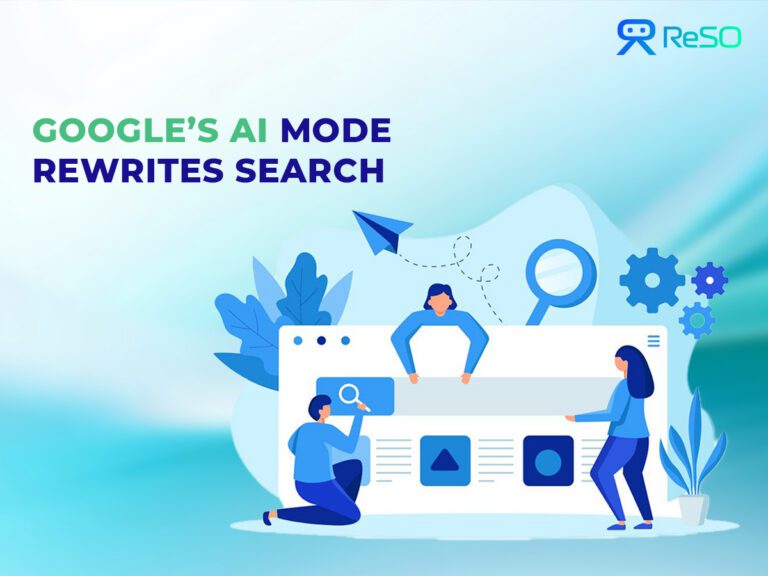
Search behavior is entering a new phase, and if you haven’t tried Google AI Mode yet, the short version is that people are beginning to interact with search differently. Instead of typing a few keywords and reviewing a list of links, users can now ask detailed questions, refine them through follow-ups, and receive synthesized answers that pull information from multiple sources. For B2B marketers, understanding this transition is becoming increasingly important.
AI Mode is a new search experience that combines Google’s search capabilities with conversational AI. Rather than presenting only a list of results, it can generate comprehensive answers supported by citations, real-time information, and follow-up prompts. Search turns into a dialogue with follow-ups, clarifications, and layered answers, all without hopping across pages.
Google launched AI Mode first for US users in Search Labs, then rolled it out to Google One AI Premium members. It runs on Gemini 2.0, Google’s latest model, which reasons through complicated queries by breaking them into sub-questions and running parallel searches to assemble comprehensive answers. For example, instead of manually comparing specs, reviews, and prices across tabs, AI Mode runs hundreds of searches at once to deliver a packaged conversational summary, sometimes even with integrated shopping and checkout.
Users are already asking queries that are two to three times longer than before. People want detailed insight, not a quick hit. AI Mode also extends beyond text, incorporating visuals, charts, and interactive experiences that support more complex research journeys.
Key takeaways
- Google AI Mode shifts search from keyword retrieval to conversational answer generation.
- Visibility increasingly depends on retrieval, extraction, and citation, not just rankings.
- Longer, multi-intent queries require content built around buyer questions rather than keyword variations.
- Content with clear structure, conversational headings, FAQ schema, and inline citations is easier for AI systems to surface.
- AI-generated content is not penalized; low-quality, generic content is.
- Content freshness, topical authority, and primary-source citations play a larger role in AI-powered search experiences.
- B2B teams should measure AI visibility through citations, branded search lift, and assisted conversions alongside traditional SEO metrics.
Google AI mode is expanding faster than most teams realize
AI Mode first launched in the United States before expanding to India and many additional markets. Today, Google has made AI Mode available across more than 200 countries and territories, although some advanced capabilities are still rolling out gradually based on language, region, feature readiness, and subscription tier.
For B2B marketing teams, the more practical question is no longer whether AI Mode will reach their market. It is whether their content is ready for how AI-powered search changes discovery.
The reason to prepare now is simple. The content characteristics that support visibility in AI Mode already overlap with what Google rewards across AI-powered search experiences: clear answers, structured sections, credible sources, strong topical coverage, and content that directly addresses user questions.
Search behavior is also changing. Users are becoming more comfortable asking longer, more specific, conversational queries instead of relying on keyword shorthand. That means B2B content needs to answer complete questions, compare options clearly, and make expertise easy for AI systems to extract and cite.
Google’s continued investment in AI-powered search makes the direction clear. Individual features may arrive at different speeds across markets, but the broader shift is already underway. Preparing now is less about chasing a new feature and more about making your content easier to understand, retrieve, and trust in the next phase of search.
What does all this mean for B2B marketers?
Search Visibility Is Moving Beyond Rankings
Google’s Head of Search has called AI Mode “the future of Google Search.” Which means that traditional SEO focused on keyword rankings will matter, but it is not the full game anymore. AI Mode adds a retrieval layer where Google can synthesize information from multiple sources into a single answer, often before the buyer clicks. Content now needs to be optimized for ranking, extraction, attribution, and citation, with clear answers, strong topical authority, structured sections, and credible sources. Bing is reshaping the same signals from its own side, with a distinct impact on SEO.
AI content is not penalized. Low-information content is.
The misconception that “AI content will tank rankings” has been decisively disproven. Semrush’s AI Overviews Study, which analyzed top-ranking pages across thousands of keywords, shows ranking factors remain what they always were: backlinks matter, helpful original content wins, and topical authority remains critical.
Google does not penalize content just because AI helped create it. It penalizes thin, generic, low-value content. What matters is that AI is a strategic tool for scaling content without sacrificing SEO. The bar is higher, but speed and volume no longer conflict with quality.
The new content game is velocity plus information gain
AI lets marketers increase content velocity, but only when the output adds real information gain. It can accelerate research, briefs, first drafts, email personalization, content refreshes, and sales enablement updates, but it cannot fix stale positioning or generic POVs. For B2B buyers, usefulness still comes from depth: original insights, product context, customer language, comparison angles, and clear answers to high-intent questions.
AI Mode changes search behavior
AI Mode pushes users from short keyword searches to longer, multi-intent prompts. B2B buyers can combine vendor comparisons, integration requirements, pricing concerns, compliance needs, and TCO analysis in a single query. The content that wins is built around query clusters and conversational topics, not isolated keywords. That means structuring pages with modular answer blocks, clear definitions, complete comparisons, and authoritative citations that AI systems can retrieve, interpret, and reference.
Buyer behaviors before and after the launch of Google AI Mode
| Before Google AI Mode | After Google AI Mode |
|---|---|
| Users typed short, simple queries, often making multiple searches for complex topics. | Users ask longer, multi-layered questions in a single query, 2-3× longer than before. |
| Users browsed multiple pages to gather details and compare products. | AI Mode delivers comprehensive summaries with essential details and citations, reducing the need for multiple searches. |
| Mostly text-based search with occasional voice or manual search. | Multimodal inputs, including text, voice, and images via Google Lens, enable more natural information discovery. |
Real-time, multi-source answers change how buyers research
AI Mode taps Google’s Knowledge Graph, real-time news, shopping data, and trusted databases to pull fresh information and inline citations. What appears is dynamic and current, which is an advantage for marketers who maintain up-to-date, factual content.
Because AI Mode provides inline citations rather than just URLs, well-structured content has a real shot at being surfaced even when it is not ranking in Google’s top 10. That changes the SEO game for B2B. Authoritative, prompt-optimized content gets found and trusted even when classical rankings say otherwise.
AI Mode Shortens Research And Buying Journeys
For B2B companies selling SaaS, hardware, or industrial products, AI Mode is experimenting with integrated shopping, enabling real-time pricing, availability checks, and in-interface checkout. For categories where the buying flow can be compressed, it reduces friction and promises faster sales cycles. For enterprise sales with RFP processes, the impact is upstream; research speeds up even if the close doesn’t.
What should your B2B marketing team do this quarter
Restructure a priority page for AI Mode extraction:
Before: The classic SEO pattern
The page opens with a lengthy introduction that explains the category, targets keyword variations, and delays answering the buyer’s question until several paragraphs later. H2s are broad and topic-based, such as “Why This Matters” or “Key Considerations.” Citations, if present, sit at the bottom of the page.
After: Restructured for AI Mode
The page opens with a direct answer to the primary buyer question, followed by a concise summary of the complete response. H2s are written as the questions buyers actually ask, such as “How do global teams manage payroll accuracy across multiple countries?” instead of “Global Payroll Considerations.” Citations are linked to primary sources and placed near the claims they support. Each section is designed to stand on its own, making it easier for AI systems to retrieve, understand, and cite specific passages without relying on surrounding context.
This is not a complete content overhaul. It is a structural change that improves answer extraction, citation readiness, and content usability for both buyers and AI-powered search systems.
Three structural patterns that win in Google AI Mode
Clear FAQ schema:
Mark up genuine question-and-answer sections with the FAQPage schema, and make sure the schema matches the visible on-page content. AI extraction works better when machine-readable markup reinforces the page structure rather than describing something the user cannot see.
Inline citations with primary sources:
Support substantive claims with links to sources such as studies, regulators, product documentation, or named research firms. Inline citations help with verification because the claim and source sit close together and are not separated in a generic references list.
Conversational H2s:
Write headings as the questions buyers would actually ask in AI Mode, not as broad category labels. “Which compliance frameworks apply to SaaS vendors selling into EU financial services?” is stronger than “Compliance” because it carries intent, context, and retrieval value.
Beyond the page: Your AI Mode readiness checklist.
- Review how your content performs in a conversational, multi-turn search journey.
- Map pages to buyer questions and decision paths, not just keyword clusters.
- Build chunkable content sections that can be extracted, cited, and understood independently.
- Maintain topical authority with original insights, credible sources, and consistent updates.
- Use AI to scale only when quality, accuracy, and expert review stay intact.
- Track visibility beyond rankings, including AI citations, inline snippets, and source mentions.
- Test AI Mode with real buyer queries to see whether your content is retrieved, ignored, or misrepresented.
Buyer journey in AI Mode: From query to conversion
How a B2B buyer moves through a purchase when AI Mode handles the research:
- Awareness query: A buyer starts with a long, context-heavy question such as, “We’re a 200-person Series B SaaS company in healthcare. What compliance frameworks apply when we sell into large hospital systems?” AI Mode may assemble an answer across HIPAA, HITRUST, SOC 2 Type II, and BAA requirements, with inline citations.
- Your citation: Your brand appears as one of the cited sources because your content directly answers a specific sub-question, such as how BAAs work in healthcare SaaS. Even without a click, the citation creates brand visibility.
- Branded follow-up: The buyer later searches your brand directly or revisits the topic with a more specific query. This is where branded search lift becomes an important downstream signal.
- Landing page visit: The buyer reaches your site through branded search, direct navigation, or a cited source link, often landing on a comparison page, compliance resource, or pricing page. The visit is more qualified because the buyer already has context.
- Conversion: A demo request, content download, or sales conversation follows. In analytics, the source may look like direct traffic, branded search, or organic search, but the earlier AI Mode exposure may have influenced the journey.
The impact will not always show up in last-click attribution. Teams should track branded search lift, cited-source visibility, assisted conversions, and high-intent landing page behavior to understand how AI-powered search contributes to pipeline.
AI is an opportunity, not a Threat
AI won’t tank your rankings, but mediocre, low-value content will. As AI Mode becomes a larger part of the search experience, B2B marketers need to focus on what makes content retrievable, trustworthy, and useful: original insights, clear structure, factual accuracy, topical authority, and source-backed claims.
The opportunity for B2B marketers is to produce content faster while building assets that can appear inside conversational answers, influence buyer research earlier, and create demand before a click ever happens. Teams that adapt now will have a stronger foundation for discovery. Teams that wait may have to restructure large content libraries after buyer behavior has already moved.
Ready to turn AI Mode into a growth channel? ReSO helps B2B brands build authority, visibility, and revenue through discovery. Book your call.
Frequently Asked Questions
What is Google AI Mode, and how is it different from Google AI Overviews?
AI Overviews add an AI-generated summary above traditional search results. AI Mode is a conversational search experience powered by Gemini, allowing users to ask follow-up questions, refine searches, and explore topics across multiple turns.
What content structures perform best in Google AI Mode?
Content designed for extraction: direct answers near the top, conversational headings, self-contained sections, FAQ schema where appropriate, and citations linked to primary sources. The easier a section is to understand and verify, the easier it is to cite.
How does AI Mode affect website traffic?
AI Mode may increase zero-click searches for informational queries, but it can also influence buyers earlier in the research process. Marketers should monitor branded search growth, citations, and assisted conversions alongside organic traffic.
How should B2B marketers prepare for AI Mode?
Focus on answer-first content, strong topical authority, structured information architecture, and source-backed claims. Optimize pages for retrieval and citation, not just rankings.