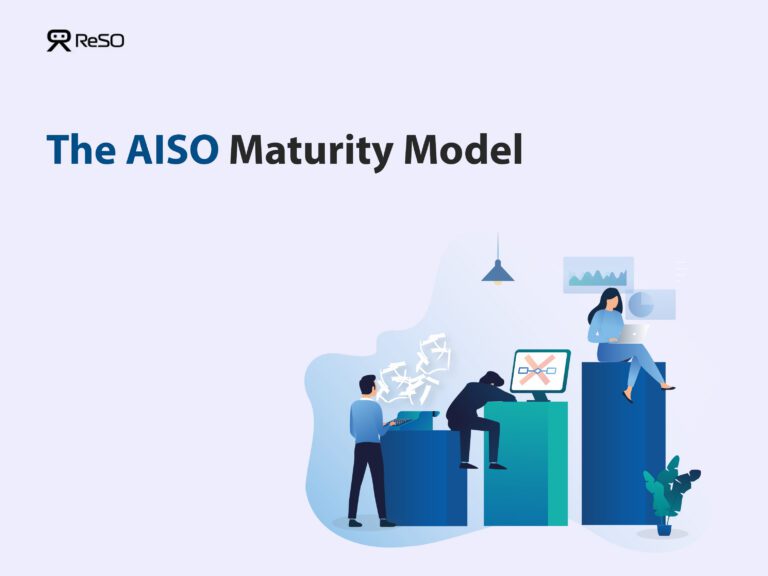
Most organizations still cannot clearly say how ready they are for AI search, making it difficult to identify gaps, prioritize investment, or measure progress. The AI Search Optimization (AISO) Maturity Model provides a practical way to assess that readiness across five stages, from AI-Blind to AI-Native.
Each stage reflects how mature an organization is across technical eligibility, structured data, content engineering, entity authority, and citation measurement. The model also pairs each stage with diagnostic signals, KPIs, and a clear next step, helping teams understand where they stand and what needs to improve next.
Use it as a diagnostic framework rather than a fixed progression. Organizations rarely advance evenly across every dimension, and a team may be highly mature in content while still lagging in measurement or entity authority.
Why a maturity model fits this problem
The five-level pattern running from Initial to Optimizing was established by the Capability Maturity Model in the late 1980s and has since been adapted to content operations, marketing operations, and generative AI readiness by most of the major analyst firms. Several structural elements transfer cleanly.
| Established element | AISO equivalent |
|---|---|
| Process documentation | Content engineering standards and prompt coverage protocols |
| Measurement discipline | Citation tracking and share-of-voice reporting |
| Cross-functional governance | Coordination across SEO, content, brand, and technical teams |
| Continuous improvement loops | Structured testing of techniques across engines |
| Final-state definition | Compounding citation authority across all major platforms |
Existing AISO maturity models differ on one key question: should maturity be defined by citation rate alone, or across multiple dimensions?
This model takes the multi-dimensional approach. Citation rate by itself can group organizations with no AI search activity together with teams already investing in technical, content, and measurement improvements that have not yet translated into citations. Those organizations are at very different stages and need different next steps.
The five dimensions that define stage position
Technical eligibility
Whether crawlers can access, render, and interpret the content at all. Signals include AI crawler permissions in robots.txt, server-side rendering or raw HTML delivery, and page performance. With AI crawler volume now among the heaviest traffic classes on the web, server logs settle the question faster than any audit tool does. The gate is binary; without it, content quality is irrelevant.
Structured data coverage
Schema markup helps give search engines and AI systems clearer, machine-readable information about a page and its entities. It can support broader search visibility, especially when implemented consistently across relevant pages.
Google adds an important caveat. Its generative AI optimization guide, published in May 2026, states that structured data is not required for its generative AI features and that no special AI-specific markup exists.
The practical takeaway is to treat schema as supporting infrastructure rather than a standalone citation lever. It can help machines interpret content and relationships more clearly, but it should not be positioned as something that directly improves performance in Google’s AI features
Content engineering
Content engineering means structuring pages so AI systems can easily identify, extract, and cite useful information. The Princeton GEO study tested nine optimization strategies across 10,000 queries and found that citations, statistics, quotations, and credible external sources could improve visibility.
In practice, this supports content structures built around clear definitions, concise summaries, answer-first sections, and well-supported claims.
Entity and topical authority
Consistent cross-platform entity presence and strong topical depth help AI systems build a clearer picture of your brand’s authority.
Keep identity information aligned across your site and third-party sources, support content with clear author attribution, and reinforce key topics through analyst coverage, relevant listings, and focused content clusters.
Citation measurement
Whether the organization tracks citation frequency, share of voice, and competitive position across AI engines. Dedicated tools now cover everything from basic monitoring to enterprise-level reporting, giving teams a clearer view of where their brand appears and how that visibility changes over time.
Stage 1: AI-Blind
No awareness of citation dynamics and no deliberate practice. Infrastructure and content built exclusively for traditional search or direct human consumption.
Diagnostic tells:
- Crawlers blocked or unspecified in robots.txt
- Rendering dependent on JavaScript with no server-side fallback
- No schema on primary pages
- Content organized around keyword density rather than answer blocks
- No author or entity disambiguation signals
- No citation tracking
- Prompted about its own category, the brand is absent or actively misrepresented
KPIs. Citation rate near zero, schema coverage at zero, AI referral traffic negligible.
Next step:
- Run an audit across branded and non-branded category prompts.
- Fix robots.txt and add Organization, WebSite, and Author schema to the homepage and primary pages.
- Install baseline tracking
Typical time to Stage 2: Two to four months.
Stage 2: AI-Aware
AI search is recognized as a distinct channel, and the technical foundations are starting to improve. Content and measurement still follow a traditional SEO approach, while citations remain limited and largely incidental.
Diagnostic tells:
- AI crawlers are permitted
- Basic schema is present on fewer than one-third of relevant pages
- Content strategy remains keyword-first
- AI search awareness sits mainly within SEO or content teams
- Tracking is limited to branded queries
- Branded citations appear occasionally, with little or no visibility on category queries
KPIs: Citation rate in the low single digits to mid-teens on tracked queries, schema coverage below 30%, and tracking focused mainly on branded queries.
Next steps:
- Expand schema coverage beyond 60% of relevant pages
- Audit the top 20 non-branded category queries across AI engines and document which competitors appear
- Restructure the 10 highest-traffic pages into answer-first formats with supporting external citations
- Brief leadership on AI search as a distinct channel alongside organic search
Stage 3: AI-Active
AI search is now a deliberate, resourced program. Technical eligibility is in place, schema coverage is substantial, and content engineering is applied systematically. The brand begins earning citations on non-branded queries, while measurement expands to share of voice.
Diagnostic tells:
- Schema covers 60-80% of relevant pages
- Pillar-cluster architecture spans two to four core topics
- Author entity profiles are documented and cross-referenced
- Tracking includes non-branded queries and share-of-voice reporting
- The brand earns citations across at least one non-branded category set
- Visibility is beginning to appear in Google’s AI surfaces
KPIs: Citation rate of roughly 15-40% across the tracked set, schema coverage of 60-80%, and monthly share-of-voice reporting across at least three platforms.
Next steps:
- Build pillar clusters across the next four to six priority domains identified through competitive gap analysis
- Begin producing original research and proprietary data
- Integrate citation data into existing dashboards and connect it with pipeline performance
- Strengthen author entities through external bylines and analyst briefings
Typical time from Stage 2: Six to twelve months.
Stage 4: AI-Optimized
AI search is integrated across SEO, content, brand, and product marketing, with measurement connected to revenue attribution. The brand is recognized across multiple non-branded topic areas, and authority is building across engines.
Diagnostic tells:
- Schema covers more than 80% of the content estate
- The entity knowledge graph is maintained and internally linked
- A prompt library of roughly 100-500 prompts spans multiple intent categories and runs on a defined cycle
- AI-sourced sessions are connected to CRM
- The brand appears across multiple engines, including competitive comparison queries
- Dedicated ownership and cross-functional governance are in place
KPIs: Citation rate above 40% across the core query set, AI-sourced pipeline visible in CRM, and time-to-citation for new content under 60 days.
Next steps:
- Expand into vertical and sub-vertical query coverage
- Build third-party validation through analyst inclusion
- Improve agentic readiness by making documentation, API references, and integration guides easier to parse
- Test structured content formats to identify which patterns earn citations by query type
Typical time from Stage 3: Twelve to twenty-four months in competitive categories.
Stage 5: AI-Native
Content strategy, brand architecture, and product discoverability are designed for retrieval from the start. Citation sits alongside organic and paid as a core business metric, and the organization is recognized as a category-defining source.
Diagnostic tells:
- Schema is built into the publishing workflow, so new content ships with structured data by default
- The brand appears as a primary cited source for category-defining queries across multiple engines
- Citation data informs product roadmap decisions
- Analyst relations support citation and authority goals
- New content in established topic areas earns citations faster than greenfield content
- Citation gains on one engine begin to correlate with stronger visibility on others
KPIs: Sustained citation rate above 40% across a broad engine set, with measurable compounding returns from new content in established topic areas.
Next steps:
- Build agentic commerce readiness so product data, pricing, and availability are accessible to agents handling multi-step comparison tasks
- Monitor emerging areas such as agent experience design
- Contribute to category definition through standards documentation and academic engagement
- Extend the same capabilities across sub-brands and regional teams
Why progression compounds
The progression follows a clear sequence: technical eligibility, citation visibility, measurement, content investment, entity authority, and then stronger citation performance.
- Technical eligibility comes first. If crawlers cannot access the content, the rest of the process cannot work.
- Measurement follows visibility. Once citations begin to appear, teams can track share of voice, identify gaps, and direct investment more precisely.
- Content investment strengthens authority. Consistent coverage from credible, attributed authors helps build entity authority.
- Authority can compound. Stronger authority can support further citation growth because citation begets citation in a feedback loop similar to backlink-driven authority.
The pattern also varies by vertical:
- B2B SaaS: Comparison-page architecture and third-party validation
- Ecommerce: Schema completeness across large catalogs
- Regulated sectors: Author credentials and evidence depth
- Professional services: Attributable practitioner expertise
Enterprise software tends to score highly on average visibility benchmarks, although widely cited figures from late 2025 are better treated as a baseline than a current reading. ReSO’s Visibility Audit provides comparable scoring across verticals.
Why the model expires and what replaces it
Four limitations are worth keeping in mind when using any AISO maturity model.
- False linearity: Organizations rarely progress evenly. A team may have Stage 3 content engineering but Stage 1 measurement. Score each dimension separately, use the average as the headline stage, and call out the lowest score because that is usually the main constraint on progress.
- Over-simplification: Maturity models are useful for diagnosis and communication, but they are not fixed prescriptions. AI engine behavior changes quickly, so the definition of “mature” will continue to evolve.
- Vendor framing: Any maturity model created by a vendor carries some built-in perspective. Treat it as a directional framework and validate the recommendations against your own data, goals, and operating model.
- Obsolescence: AI search is changing fast. Google’s guidance continues to reshape what site owners can directly influence, while agentic retrieval introduces new requirements that a citation-focused model does not fully capture. Stage 5 may therefore expand over time, or give way to an additional stage as agentic search becomes more common. The most durable work is the work that survives those changes: technical eligibility, structured information, strong content, entity authority, and a broader eligibility surface.
ReSO helps teams assess where they sit today, identify the gap, and build a clearer path forward. Book a call to see how your current maturity compares and where the next opportunity sits.
FAQ
How do I know which AISO stage my company is in?
Score your organization across the five dimensions: technical eligibility, structured data, content engineering, entity authority, and citation measurement. Use the average as the headline stage, then look closely at the lowest score because that is usually where progress is being held back.
What should we prioritize if we are stuck between two stages?
Focus first on the weakest dimension rather than trying to improve everything at once. A company may have strong content engineering but weak measurement or entity authority, and that lower-performing area can limit progress even when the overall maturity score looks higher.
Is Stage 5 achievable for mid-market brands?
Yes, within a defined sub-category. Companies that sustain citation engineering, original research, and analyst relations can become a reference source in narrower verticals. For most mid-market brands, Stage 4 is the more realistic near-term target.
How often should we reassess our AISO maturity?
Reassess whenever there is a meaningful change in your content program, technical setup, measurement coverage, or AI search performance. Regular reviews also help because engine behavior changes quickly, which means the definition of maturity can shift over time.
Does this replace our SEO maturity assessment?
No, the two share foundations such as crawlability and content quality, but AISO adds different requirements around citation measurement and third-party authority. Run them alongside each other rather than combining them into one assessment.