For years, B2B marketing worked on a simple assumption: run more campaigns, publish more content, drive more traffic, and some of it will convert. That belief shaped how modern marketing teams operated.
Editorial calendars grew around every keyword opportunity. Campaigns extended across paid channels, newsletters, webinars, and social media. The goal was to increase reach, keep the funnel full, and trust that a fraction of the audience would eventually turn into pipeline. For a long time, this model worked well enough to become the default for B2B marketing.
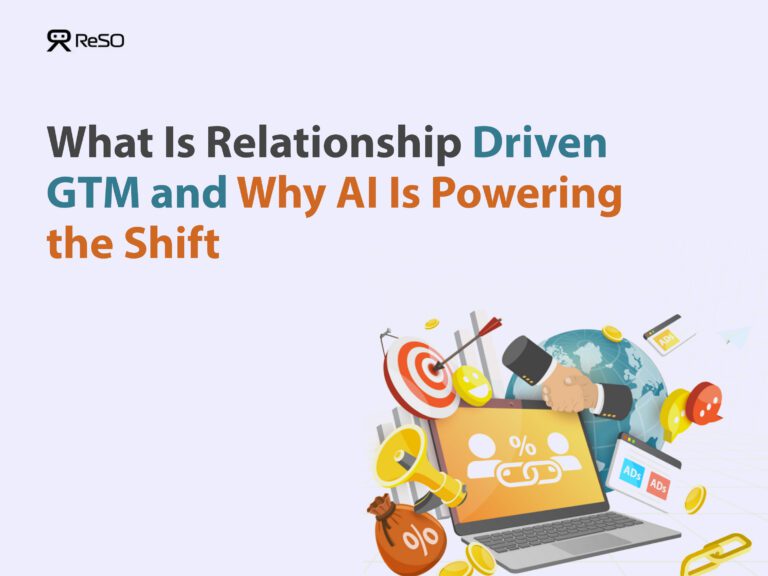
Relationship-driven GTM takes a different approach. It focuses on building real trust with buyers, partners, communities, customers, and industry voices before a sales conversation begins. The goal is not just to capture attention, but to create credibility through authentic relationships that influence how people talk about, recommend, and remember your brand.
With AI, buyers are now discovering, comparing, and shortlisting companies through AI-generated answers, community discussions, peer recommendations, and third-party sources. Visibility is no longer only about showing up in search results or campaign touchpoints. It is also about whether your brand is trusted, referenced, and recommended across the conversations and sources AI systems rely on.
How did buyer research work earlier?
Earlier, when someone wanted to learn about a product, a category, or a solution to a problem, the process followed a predictable path.
A buyer would start with a search query or an ad that introduced them to a topic. From there, they would visit a website, read blog posts or landing pages, explore guides or resources, and gradually build an understanding of the space
Once they had enough information, they would compare vendors, shortlist a few potential options, and eventually speak with a sales team to clarify the details before making a decision.
Companies that produced more content, answered more questions, and captured more search traffic had a stronger influence on how their category was understood.
Trust developed gradually during this journey. The more a buyer reads your explanations, explores your resources, and interacts with your brand, the more credibility you build.
Where does buyer research start now?
Increasingly, buyers begin their research differently. Instead of opening multiple search results and comparing articles manually, many people now start by asking a direct question to an AI system such as ChatGPT, Perplexity, or Claude.
When someone asks a question on these systems, they get a structured answer that explains the topic, compares options, and mentions the companies, tools, or approaches associated with that space. That first can shape how a buyer understands the category, which problems they consider important, and which brands feel credible enough to explore further.
This is where relationship-driven GTM becomes influential. AI systems look further than what a company says about itself and pick up signals from third-party sources, community discussions, customer stories, expert mentions, partner content, and public conversations.
So if your brand is already being talked about, recommended, cited, or associated with trusted people in your category, you have a stronger chance of showing up in the buyer’s first layer of research.
The buyer’s first impression is now also built by relationships, references, and reputation your brand has earned.
From campaign-driven GTM to relationship-driven GTM
As early buyer research moves outside brand-controlled environments, traditional campaign-driven GTM starts to lose some of its impact. Visibility is not enough when buyers now form their opinions across AI answers, peer conversations, community threads, customer stories, and expert-led discussions.
This is where relationship-driven GTM comes in. Buyers notice how a company shows up in conversations, how its ideas circulate in the market, and how other practitioners reference its thinking. It focuses less on how often a company pushes its message and more on how consistently its ideas show up through trusted people and credible spaces.
In other words, buyers do not solely depend on what a company says about itself. They observe how consistently that company’s ideas appear in the places where real industry conversations and voices keep appearing.
What does a relationship-driven GTM actually look like?
Relationship-driven GTM is often misinterpreted as simply producing more thought leadership or posting more frequently on social platforms. In reality, the model is built on a specific set of signals that shape how a company is perceived within its category.
- Public expertise: Founders, operators, and practitioners openly share how they think about problems, make decisions, and learn from real situations. These explanations show how the company approaches its domain instead of just promoting its products.
- Recognisable voices: Ideas become more memorable when they are attached to identifiable people. When practitioners consistently explain the same concepts across articles, discussions, interviews, and events, those ideas begin to develop clear authorship.
- Peer validation: When customers, partners, or industry professionals reference your approach in their own conversations, the message carries far more weight than self-promotion. That’s because independent voices reinforce credibility and show that your ideas travel beyond the channels that you own.
- Consistent positioning: The same category framing, problem explanation, and core language need to appear across different channels over time. This repetition creates clarity around what the company represents.
Credibility forms through pattern recognition, and buyers gradually notice the same perspective appearing across multiple trusted people, spaces, and conversations.
Why AI rewards relationship-driven GTM
AI systems do not evaluate brands the same way traditional search engines do. Instead of ranking individual pages by backlinks or keywords, modern AI models synthesise information from many different sources to assemble explanations.
In doing so, they implicitly recognise patterns of presence across the ecosystem. When a company appears repeatedly across leader discussions, industry publications, expert commentary, customer stories, partner content, and independent references, it becomes easier for the model to treat that perspective as a reliable context. The company begins to appear consistently across different answers because the supporting signals exist in multiple places.
This means AI systems often surface companies that show up across trusted platforms rather than those that publish content only on their own websites. Presence across the ecosystem becomes a stronger signal than isolated content production.
Why scale-only GTM is breaking
The breaking of scale-driven strategies can be traced to three structural changes:
- Content saturation, where most major categories already have thousands of articles explaining the same foundational topics.
- AI summarisation, where buyers increasingly consume condensed explanations generated by AI systems instead of reading multiple articles
- Signal compression, where AI models surface a smaller set of trusted explanations repeatedly because those signals appear most consistently across the data they encounter.
Together, these structural changes reduce the advantage that content volume once had. Publishing more pages no longer automatically increases influence. What matters now is whether your ideas become part of the explanations others reuse.
What to measure beyond website traffic
As buyer research changes, website traffic is not the only way to measure influence. A company may get fewer direct visits, but still shape how buyers understand the category if its ideas appear across AI answers, expert commentary, partner content, customer stories, and community discussions.
This is where share of voice comes in. It shows how often your brand appears in relevant category conversations compared to competitors. For relationship-driven GTM, this means tracking where your company is mentioned, who is mentioning it, and whether those mentions appear in places buyers already trust.
That can include AI answers, community threads, LinkedIn discussions, podcasts, newsletters, analyst commentary, partner content, customer advocacy, and third-party reviews. Community platforms sit close to the center of B2B discovery now, and Reddit is the clearest example. The goal is to increase the number of trusted places where your brand and ideas show up when buyers research your category.
Where most teams get relationship-driven GTM wrong?
Despite the growing importance of relationship-driven signals, many teams struggle to implement the approach effectively because the signals they create stay scattered.
In some organisations, founder content exists independently of the product narrative, creating a disconnect between the ideas shared publicly and the solutions the company actually offers. In other cases, customer stories remain generic and fail to demonstrate the thinking behind the approach.
Another common issue arises when companies participate in communities without presenting a clear perspective. Conversations occur, but the organisation’s underlying point of view remains vague or inconsistent.
A similar issue occurs when positioning and messaging changes frequently, and the signals surrounding the company become scattered, making it difficult for both buyers and AI systems to recognise a coherent narrative.
In those situations, AI systems tend to surface competitors whose explanations appear more stable and easier to interpret.
Relationship-driven GTM works only when these signals connect. The founder’s point of view, customer proof, community presence, partner content, and product narrative should all reinforce the same core idea.
Expert perspective: Melissa Moody on relationship-driven GTM
To understand how relationship-driven GTM works in practice, we spoke with Melissa Moody, Founder and CMO of Gated, co-founder of Wednesday Women, and former marketing leader at Google.
Through her work with founders and startups, Melissa has helped shape how modern teams think about relationship-led growth and trust-based GTM.
In the conversation, she explains:
- Why traditional demand-generation playbooks are starting to break
- How relationship-led ICPs help identify champions for your organization
- Why teams need to move beyond campaign-driven demand generation
- How trusted conversations, communities, partnerships, and practitioner networks build credibility
- How these channels create pipeline momentum
If you’re a founder, GTM leader, marketer, or partnerships professional building GTM around trust, communities, and partnerships, this session is worth watching. Watch it here.
Relationship-driven GTM works because buyers are influenced by the conversations that surround a category. The companies that show up consistently in those conversations start shaping how the market understands the problem, the solution, and the credible players in the space.