You registered a domain last week. The site is live, the homepage looks sharp, and your product pages are ready. But when you search your brand on Google or ask tools like ChatGPT about your category, your website does not appear.
Search engines need to crawl and index your pages before they can rank them. AI systems need clear, structured signals to understand your site and decide whether to cite it in answers. Without these foundations, your website exists, but it is not yet discoverable.
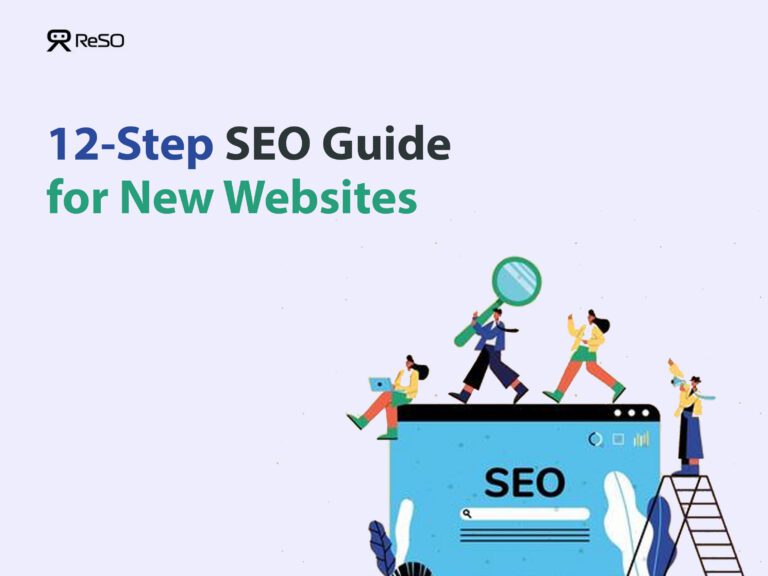
This guide outlines 12 steps to move from launch to visibility. It covers the technical setup, site structure, content, authority building, and AI readiness required to get your website indexed, ranked, and cited.
1. Choose a CMS that does not limit your SEO ceiling
- Select a content management system that gives you control over URL structure, meta tags, heading hierarchy, robots.txt, and sitemap generation.
- WordPress with a lightweight theme remains the default recommendation because its plugin ecosystem covers every technical SEO requirement.
- Webflow and Shopify work well for specific use cases (design-heavy portfolios and ecommerce, respectively), but both impose constraints on URL depth and server-side rendering that can become obstacles as the site scales.
Whichever platform you pick, confirm that it supports custom title tags per page, canonical URL management, and schema markup injection without requiring a developer for every change.
2. Lock in your technical foundation
Before publishing any content, handle the infrastructure that search engine crawlers evaluate on first visit.
SSL certificate:
Verify HTTPS is active across every page. Mixed-content warnings (HTTP resources loaded on an HTTPS page) still cause indexing issues.
Mobile responsiveness:
Over half of global web traffic comes from mobile devices, according to Statista. Load your site on a phone and check that navigation, text size, and tap targets work without zooming. (Source: Statista)
Page speed baseline:
Run your homepage through Google PageSpeed Insights:
- Target a Largest Contentful Paint (LCP) under 2.5 seconds
- Interaction to Next Paint (INP) under 200 milliseconds
- Cumulative Layout Shift (CLS) below 0.1
- Compress images before uploading, use modern formats like WebP, and defer non-critical JavaScript
Robots.txt:
Confirm the file exists at yourdomain.com/robots.txt and is not blocking critical pages. A misconfigured robots.txt on a new site can prevent Google from crawling anything.
3. Plan your site architecture and URL structure
- Map out every page your site needs before you start writing. Think of site architecture as a blueprint: homepage at the top, category or pillar pages one level below, and individual posts or product pages branching from each category.
- A clean hierarchy like /blog/keyword-research-basics/ tells both users and crawlers what the page covers.
- Keep URLs short, descriptive, and lowercase.
- Use hyphens between words.
- Avoid date-based URLs for evergreen content, parameter-heavy strings, or deeply nested paths beyond three levels.
- Internal linking: Make sure every page on your site can be reached within three clicks from the homepage. Design your navigation menu and internal links so users and search engines can easily find any page without digging too deep.
4. Research keywords with a new-site strategy
New domains lack authority, which means competing for high-volume, high-difficulty keywords out of the gate is unlikely to produce results. Instead, focus on:
- Long-tail keywords with lower difficulty scores. A query like “best CRM for freelance consultants” is far more winnable than “best CRM” for a brand-new site.
- Question-based queries that signal informational intent. Tools like AnswerThePublic and Google’s “People Also Ask” feature surface the exact questions your audience types.
- Competitor gap analysis: Enter two or three competitor domains into your keyword tool and filter for keywords where they rank but you have no presence. Prioritise those with difficulty scores under 30 and monthly search volumes above 200.
Build a spreadsheet with columns for keyword, search volume, difficulty, intent type, and the target page on your site. Group keywords into clusters that map to your site architecture from Step 3.
5. Build a content strategy around pillar and cluster pages
A pillar page covers a broad topic at an overview depth. Cluster pages address specific subtopics in detail and link back to the pillar, creating topical authority signals that search engines use to determine which site should rank for a given subject.
For example:
A SaaS company launching an SEO tool, the pillar might be “Keyword Research for Beginners,” with clusters covering “How to Find Long-Tail Keywords,” “Keyword Difficulty Explained,” and “Search Intent Types.” Each cluster page links to the pillar, and the pillar links to every cluster.
Plan an editorial calendar that publishes cluster content consistently, 2-3 posts per week for the first 90 days, to build indexing momentum. AI retrieval systems also reward topical depth. Domains that build out a focused cluster of content around a single topic are more likely to be retrieved and cited than those covering the same topic with only a handful of pages.
6. Create optimized content that matches search intent
Every page you publish should satisfy the intent behind its target keyword.
- Informational queries need guides or explainers.
- Commercial queries need comparison content or product roundups.
- Transactional queries need landing pages with clear calls to action.
- Navigational queries need clear, authoritative pages (like your homepage or key product pages) that help users quickly find a specific brand or resource.
Structure each piece with a clear heading hierarchy:
- One H1 (the page title)
- H2s for major sections
- H3s for subsections
Front-load the answer in the first 100 words so that both featured snippets and AI summary systems can extract a direct response.
Demonstrate E-E-A-T (Experience, Expertise, Authoritativeness, Trustworthiness) by citing credible sources, including author bios with relevant credentials, and grounding claims in data rather than opinion.
Google’s quality rater guidelines evaluate these signals explicitly, and AI systems use similar criteria when selecting sources to cite.
7. Execute on-page SEO for every published page
On-page optimisation turns good content into content that search engines can parse and rank accurately.
Title tags:
Keep them under 60 characters. Include the primary keyword near the front. Make them specific enough that a searcher knows what the page delivers before clicking.
Meta descriptions:
Summarise the page in 155 characters or fewer. While meta descriptions do not directly affect rankings, they influence click-through rates, and higher CTR sends positive engagement signals.
Internal links:
Link to related pages using descriptive anchor text. The anchor text you choose shapes how search engines understand the relationship between pages on your site, so avoid generic phrases like “click here” or “read more.”
Image optimisation:
Use descriptive file names, add alt text with relevant keywords, and compress files to keep page speed fast.
Header tag usage:
Use H2 and H3 tags to break content into scannable sections. Never skip heading levels (H2 straight to H4), and include secondary keywords naturally in subheadings.
8. Complete your technical SEO launch checklist
With content live, verify the technical elements that determine whether search engines can find, crawl, and index your pages.
Generate and submit an XML sitemap:
Most CMS platforms auto-generate sitemaps. Submit yours through Google Search Console under the Sitemaps section.
Verify robots.txt:
Ensure no critical pages are disallowed. New sites sometimes ship with a leftover Disallow: / from staging environments.
Add structured data:
Implement Organization schema on your homepage, Article schema on blog posts, and FAQ schema on pages with question-and-answer content. Structured data helps search engines parse content accurately and increases eligibility for rich results.
Check Core Web Vitals:
Use GSC’s Core Web Vitals report to identify pages that fail LCP, INP, or CLS thresholds.
Validate canonical tags:
Every page should have a self-referencing canonical tag unless it intentionally points to another URL.
Test mobile usability:
GSC’s Mobile Usability report flags tap target issues, text readability problems, and viewport configuration errors.
9. Build authority from zero
New websites face a cold-start problem: no backlinks, no domain authority, no reason for search engines to trust the content. Breaking through requires deliberate outreach.
Digital PR and original research:
Publish data, surveys, or industry benchmarks that journalists and bloggers want to reference. A single cited study can generate dozens of backlinks from high-authority domains.
Guest contributions:
Write for publications in your niche. One or two contextual links back to your site per guest post build domain authority gradually.
Community participation:
Engage genuinely on Reddit, industry forums, and niche communities. Provide useful answers that reference your content where relevant. AI answer engines frequently pull from Reddit threads and community discussions when generating recommendations.
Local and industry directories:
List your business on relevant directories (G2, Capterra, industry-specific platforms). These citations establish legitimacy.
Brand mentions on third-party platforms:
Even unlinked mentions of your brand on trusted sites contribute to authority signals. Nofollow links and brand references on review platforms carry weight for both traditional search and AI citation systems, where backlinks serve as trust credentials that determine which sources AI models quote, recommend, or name.
10. Set up Google Business Profile (if applicable)
For businesses with a physical location or service area, a Google Business Profile (GBP) directly influences local search rankings and map pack visibility.
- Claim or create your profile at business.google.com. Complete every field: business name, address, phone number, hours, website URL, service categories, and photos.
- Choose a primary category that matches the specific service you want to rank for. A law firm specialising in employment law should select “Employment attorney” rather than the generic “Lawyer.”
- Encourage customers to leave reviews and respond to every review within 48 hours.
- Consistent NAP (Name, Address, Phone) data across your website, GBP, and directory listings reinforces local trust signals.
11. Optimise for AI and LLM search from day one
Traditional SEO gets your pages into Google’s index. AI SEO determines whether your brand appears in AI answers. For a new website, building both tracks simultaneously is more efficient than retrofitting AI optimisation later.
Why AI visibility matters at launch:
AI answer engines now influence purchasing decisions before a user ever reaches a search engine results page. When someone asks ChatGPT, “What is the best project management tool for small teams,” the brands cited in that answer capture mindshare at the highest-intent moment. A new website that ignores AI visibility cedes that territory entirely to established competitors.
Establish entity recognition early:
- AI systems identify brands through entity signals: consistent naming across your website, structured data (Organisation and Person schema), author pages with credentials, and references on third-party platforms.
- A brand mentioned on Wikipedia, G2 reviews, and industry publications registers as a known entity in AI knowledge graphs.
Structure content for AI extraction:
AI retrieval systems favour content that is modular, clearly headed, and front-loads answers.
- Write self-contained sections where each H2 or H3 block can stand alone as a quotable unit.
- Use tables for comparisons, numbered lists for processes, and FAQ sections with direct answers.
Pages structured this way are more likely to be selected during retrieval-augmented generation (RAG), the process where AI models pull external sources to ground their answers.
Monitor AI mentions from the beginning:
- Run 20-30 queries relevant to your brand and product category across ChatGPT, Perplexity, and Google AI Overviews each month.
- Record whether your brand appears, in what context (featured recommendation, comparison mention, or passing reference), and which competitors are cited instead.
- Platforms like ReSO automate this tracking with scheduled query monitoring and citation frequency reporting.
Build citation eligibility through third-party validation:
AI systems weigh third-party references heavily when deciding which sources to cite.
- Reviews on G2
- Mentions in Reddit recommendation threads
- Coverage in industry publications
- Inclusion in buyer’s guides
All of this increases the probability that an AI model will name your brand.
The first citation carries significant weight. Once an AI system cites a domain, it tends to revisit it more often, pulling in additional content and reinforcing its presence. Over time, this creates a compounding advantage where cited brands continue to gain visibility faster than those that are not referenced.
12. Monitor, measure, and iterate
SEO is not a launch-day task; it is an ongoing feedback loop.
Week 1-4 after launch:
Focus on indexing: Check GSC’s Index Coverage report to confirm pages are being discovered. If key pages show “Discovered but not indexed,” improve internal linking to those pages and request indexing manually through GSC.
Month 2-3:
Track impressions in GSC: Rising impressions mean Google is showing your pages for relevant queries, even if clicks are still low. If impressions are flat, revisit keyword targeting and content quality for underperforming pages.
Month 3-6:
Analyse click-through rates: Pages with high impressions but low clicks need better title tags and meta descriptions. Pages ranking on page two (positions 11-20) are candidates for content updates, additional internal links, and backlink outreach to push them onto page one.
Ongoing:
Update published content quarterly: Refresh statistics, add new sections that reflect industry changes, and replace outdated examples. Consistency matters: search engines and AI systems both favour domains that publish and update on a regular cadence rather than those that publish in a burst and go quiet.
Review your backlink profile monthly to identify new linking opportunities and disavow toxic links. Track AI citations alongside traditional rankings to capture the full picture of your brand’s search visibility.
Common mistakes to avoid
1. Targeting high-difficulty keywords on a zero-authority domain
New sites that chase head terms like “CRM software” or “project management tools” waste months producing content that will not rank. Filter your keyword list by difficulty score and prioritise queries where your content has a realistic chance of reaching page one within 90 days.
2. Publishing content without a linking structure
Orphan pages that receive no internal links get crawled less frequently and accumulate authority more slowly. Every new page should link to at least two existing pages on your site, and at least two existing pages should link back to it.
3. Ignoring AI visibility until the site is “established”
Teams that treat AI SEO as a later-stage project lose the first-mover advantage on citation compounding. AI crawlers index new content quickly when a site earns its first citation. Delaying entity setup, structured data, and third-party seeding by six months gives competitors six months of compounding citation momentum.
4. Setting up analytics after launch instead of before
Traffic data from launch day onward tells you which pages are being discovered first, which queries are driving impressions, and where drop-offs occur. Installing GSC and GA4 after the first month means losing irreplaceable baseline data.
Start today by submitting your XML sitemap to Google Search Console, publishing your first pillar page, and if you want a clear view of where your site stands across both search and AI visibility, book a call with ReSO. We’ll audit your SEO and AISO setup, identify gaps in indexing, content structure, and citations, and show you exactly what to fix to get discovered where your buyers are actually searching.
Frequently Asked Questions
How long does it take for a new website to start ranking on Google?
Most new websites start seeing impressions within 2-4 weeks of submitting a sitemap, but meaningful traffic usually takes 3-6 months. The timeline depends on keyword difficulty, content quality, and how quickly the site builds authority through consistent publishing and backlinks.
Should I block AI crawlers to protect my content?
Blocking AI crawlers (such as GPTBot or ClaudeBot) prevents your content from being used in AI-generated answers, which eliminates the possibility of earning AI citations. For new websites trying to build visibility, blocking these crawlers removes a growing discovery channel. The trade-off only makes sense for publishers whose primary revenue depends on direct page views and who have already established strong organic rankings.
What should you focus on first after launching a new website?
Focus on getting your site indexed and understood. Set up Google Search Console, submit your sitemap, and publish a few clear, high-intent pages. Strong structure and focused content help search engines and AI systems recognise and surface your site faster.
Can a new website appear in AI-generated answers like ChatGPT or Google AI Overviews?
New websites can earn AI citations, but they need to cross a visibility threshold first. AI systems select sources based on content structure, entity recognition, third-party validation, and topical depth rather than domain age alone. A new site with 20 well-structured articles on a focused topic, positive reviews on G2 or Capterra, and a handful of authoritative backlinks can appear in AI answers within the first six months if it builds citation eligibility from day one.