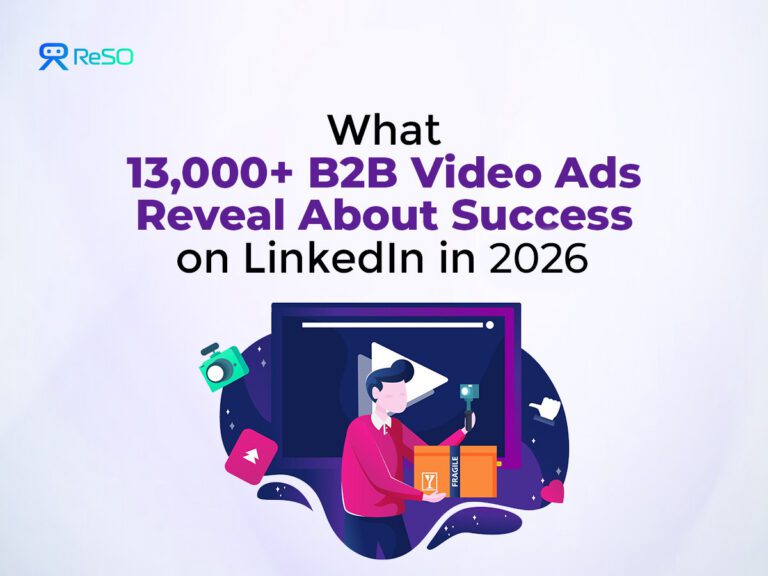
An analysis of more than 13,000 B2B video ads found a consistent pattern across industries, company sizes, and production budgets. Videos with real people, visible faces, and clear emotional cues outperformed highly produced brand films on engagement and conversation quality.
That matters because many B2B teams still treat production value as the main performance lever. They invest in polished scripts, motion graphics, voice-overs, and studio-quality edits, expecting higher creative quality to drive stronger pipeline signals. The data points to a different performance variable: human presence.
A polished product video may explain the platform with clean visuals and scripted messaging. A founder-led clip may simply talk through a customer pain point, share a field insight, or explain a common buying misconception. On LinkedIn, the second format often feels more native to the feed. It gives buyers a person to evaluate, a POV to engage with, and a problem they recognize from their own GTM environment.
The takeaway is clear. Human signal is no longer a creative layer added after the strategy. It is becoming a core variable in video performance, especially for LinkedIn-first B2B buyers.
Key Takeaways
- Real people and authentic emotion drive stronger engagement than logo-led or heavily produced videos.
- Longer videos can work when they attract high-intent viewers, build trust, and include a relevant in-video CTA.
- Unscripted content performs well because it creates stronger credibility signals than heavily scripted brand messaging.
- Short-form video helps B2B teams earn attention quickly in the LinkedIn feed, especially when the hook, pacing, and point of view are clear.
- Cultural fluency, expert commentary, strong attention capture, and aspirational outcomes make video feel more relevant to specific buyer groups.
- The strongest LinkedIn B2B video ads combine human presence, emotional credibility, buyer-specific context, and a repurposing system that extends each recording across search, social, and sales enablement.
- For teams building a larger LinkedIn content strategy, this connects closely with how search-optimized thought leadership on LinkedIn shapes visibility across buyer research journeys.
The human factor: Why it still dominates
B2B buying may look rational within a procurement workflow, but the people still shape the decision-making process. Buyers evaluate risk, credibility, expertise, and confidence long before a purchase order is approved. Video becomes one of the fastest ways to assess those signals.
That pattern continues to show up across industry research. In Wistia’s 2026 State of Video findings, webinars ranked among the most impactful video formats for marketers, and long-form educational content continued to hold engagement better than many shorter formats. Viewers spend more time with content that helps them understand a problem, evaluate expertise, or hear directly from practitioners.
The common thread is not production quality but trust transfer. Buyers respond to founders explaining market shifts, operators sharing execution lessons, customer-facing teams discussing recurring pain points, and subject-matter experts breaking down complex decisions. These formats create stronger credibility signals than highly scripted brand messaging because they feel closer to real buying conversations.
As LinkedIn continues to grow as a primary B2B video distribution channel, that dynamic becomes even more visible. While evaluating products, buyers are also looking at the people, expertise, and perspective behind them.
Why unscripted content performs
Research from LinkedIn Marketing Collective found that authentic emotional display lifted engagement by 78% in brand-awareness campaigns. That helps explain why videos led by real people often outperform content that feels overly staged or corporate.
The performance gap comes from credibility signals. Buyers engage more readily with founders explaining a market shift, operators sharing execution lessons, or practitioners discussing customer challenges. These formats feel closer to actual buying conversations and create stronger trust than heavily scripted brand messaging.
On LinkedIn, expertise is often the creative asset. Videos featuring subject-matter experts drove a 40% lift in engagement, reinforcing the role of founder-led, practitioner-led, and expert-led content in B2B video strategy.
Short-form video is winning the feed
LinkedIn’s data shows that cinematic storytelling can build brand belief at the awareness stage, with narrative-led ads driving 129% higher engagement than generic ads. The stronger takeaway sits in creative fit, because high-performing video aligns the format, message, and buyer context.
For feed-native formats, shorter videos often have an advantage because they are easier to consume on mobile, fit naturally into a buyer’s workday, and create faster attention signals. LinkedIn also found that videos using memes drove 111% higher engagement, pointing to a broader pattern where the feed rewards personality, relevance, and pattern interruption.
B2B brands do not need to become meme pages to apply this insight. Short-form video works best when it has a sharp creative hook, a clear point of view, and enough contextual tension to stop the scroll.
What else works: More than just humans
Human presence provides a strong credibility signal, and LinkedIn’s research highlights four additional factors that improve B2B video performance:
- Cultural fluency:
Videos that reflect the audience’s environment, language, and buying context feel more relevant and relatable.
- Expert commentary:
Insights from founders, practitioners, subject-matter experts, or customers establish authority and trust quickly.
- Strong attention capture:
Motion, on-screen text, pacing, and a clear problem statement help earn attention early in the feed.
- Aspirational outcomes:
Videos that help buyers visualize a better workflow, stronger team, or improved business outcome create stronger engagement than feature-focused messaging alone.
Combined with a genuinely human-centred approach, these principles make video feel more relevant, credible, and aligned with how modern B2B buyers consume content on LinkedIn.
Cultural fluency makes video feel specific
Cultural fluency is the quiet work of making a video feel built for a specific audience, category, and buying context. In B2B, that comes down to four creative inputs.
- Industry norms:
Enterprise tech buyers may read composure and authority as credibility. Fintech buyers often look for precision and restraint. SaaS buyers may respond better to founder-led energy, speed, and direct market perspective.
- Generational signals:
Different buyer cohorts read production choices differently. A polished brand film may signal trust to one buyer and unnecessary marketing spend to another.
- Team archetypes:
Engineering-led buyers usually want product depth, workflow clarity, and honest trade-offs. Sales-led buyers look for outcomes, momentum, and peer proof. Finance-led buyers need numbers, risk control, and a clear implementation path.
- Implementation:
These signals show up in language, visual references, editing pace, speaker choice, screen recordings, customer proof, and even the presence or absence of music.
Cultural fluency makes the video feel relevant before the buyer has consciously decided why. A few industry examples make this easier to see. In enterprise tech, a calm executive-led video with slow pacing and one clear data point can signal category maturity. In fintech, restrained graphics, precise statistics, and a product-led visual style can signal compliance-grade rigor. In healthcare SaaS, a practitioner speaking from a real workflow can create more trust than polished B-roll.
Cultural fluency is different from brand voice. Brand voice is the company identity layer. Cultural fluency is the audience-values layer. A brand can keep the same voice across videos while adjusting the signals that make each vertical feel understood.
How to create better B2B video ads
Use the data as a creative brief, not just a reporting input. The strongest LinkedIn video ads usually combine human presence, clear expertise, and fast creative signaling. Here is a playbook grounded in the data.
- Lead with a real person:
Feature a founder, operator, customer, or subject-matter expert on camera. Visible humans create faster credibility signals than abstract product visuals.
- Build around one buyer problem:
Keep the message focused on a specific pain point, misconception, workflow gap, or decision trigger.
- Script the structure, not every line:
Plan the hook, proof point, and takeaway, while leaving enough room for natural delivery.
- Design for the feed:
Use captions, motion, pacing, and a clear opening frame to earn attention quickly, especially on mobile.
- Add authority signals:
Use expert commentary, customer proof, product screens, benchmarks, or specific field insights to support the claim.
- Match the cultural code:
Adjust language, visuals, pacing, and proof points for the buyer segment, vertical, and team archetype.
- Measure quality of engagement:
Track watch time, completion rate, click-through rate, comments, saves, and qualified conversations instead of judging performance on views alone.
ROI framework: engagement per dollar, not raw engagement
Raw engagement can make expensive video programs look successful. Engagement per dollar gives B2B teams a clearer read on creative efficiency, because it connects performance to production cost.
A simple 2026 cost map looks like this:
- Founder, customer, or SME clip: Low production cost, fast turnaround, and strong fit for weekly feed video, thought leadership, product education, and customer stories.
- Polished studio production: Higher production cost, stronger fit for brand films, product launches, investor-facing assets, and high-stakes announcements where perceived quality is part of the message.
- Live webinar repurposing: Moderate upfront effort, high content yield, and strong efficiency when one session becomes clips, summaries, transcripts, social posts, and sales enablement assets.
The goal is not to remove polished production from the mix. It is to use it where production value supports the business context. For recurring LinkedIn videos, unscripted and repurposed formats often create better creative throughput, faster testing cycles, and stronger engagement efficiency.
Video-to-blog repurposing strategy for search optimization
A strong LinkedIn video should not live only in the feed. One LinkedIn Live, webinar, customer interview, or founder-led clip can become a structured website asset when it is repurposed intentionally.
Webinars are especially valuable because the Q&A captures the way buyers naturally phrase questions, objections, comparison criteria, and implementation concerns. That language often mirrors the terms people use when researching solutions, making it highly reusable across content formats.
The workflow is straightforward:
Step 1: Transcribe
Use Otter, Rev, or the native transcript from your video host. Clean up the transcript so names, product terms, and statistics are spelt correctly.
Step 2: Extract three to five standalone quotes
Pull the lines that can stand on their own as LinkedIn posts, FAQ answers, pull quotes, newsletter snippets, or supporting points inside other blog posts.
Step 3: Publish transcript plus embedded video as a blog post
Add headings every 200–300 words, timestamps, and a short intro. For webinars, audience questions often make effective H2 or H3 headings because they reflect real buyer concerns. Add VideoObject schema for the embedded video and Article schema for the post so search engines can understand both the watchable and readable versions of the content.
Step 4: Internal-link to existing related content
Connect the new post into your thought-leadership hub, related guides, case studies, event recap pages, and product content so it strengthens topical relevance across the site.
One webinar can support multiple outputs, including a LinkedIn post, a transcript-based article, a YouTube upload, a newsletter, and several short-form clips. The recording effort happens once, while the content continues creating value across search, social, and sales enablement channels.
How to measure emotion resonance in LinkedIn analytics
Views alone do not show whether a video created trust, attention, or emotional recall. For LinkedIn video, stronger signals come from how people watch, save, comment, and share.
- Completion rate:
The share of viewers who finish the video. High completion is the clearest signal that the emotional beat held attention.
- Save rate:
Saves indicate the viewer wanted the content available later. Authentic emotion drives saves because viewers found the content to be useful and worth a re-watch or to share later.
- Comment quality:
Specific comments matter more than generic praise. A comment that references a line, idea, example, or speaker moment shows stronger resonance than a simple “great post.”
- Share-to-view ratio.
Shares are a stronger signal than likes because the viewer is putting their own reputation next to the content.
A polished video that misses the mark often shows the same pattern: strong initial CTR, low completion rate, thin comments, and low saves. The opening frame earned attention, but the content did not create enough trust or relevance to hold it.
Baseline targets to aim for: industry-quoted targets sit around 40%+ completion for sub-30-second video, 25%+ completion for 30-to-60-second video, save rate above 1% (strong), and positive comment sentiment above 60% for videos where the emotional beat is landing. Treat these as directional until you have 30 days of your own data against which to calibrate.
Tool set worth knowing:
- LinkedIn Campaign Manager:
Best for first-party campaign data, including video views, completion behavior, clicks, engagement, audience demographics, and paid distribution performance.
- Sprout Social:
Useful for cross-channel comparison and stronger comment-sentiment analysis. Useful when you need to see how a video travelled beyond LinkedIn into Twitter/X, Facebook, or Instagram discussions.
- Hootsuite:
Useful for scheduled publishing, consolidated reporting across brands, and employee-advocacy accounts. Useful when multiple team members amplify the same video, and you want the composite reach and engagement in one view.
Each tool surfaces something the others do not. LinkedIn native owns the paid-audience truth, Sprout owns sentiment depth, Hootsuite owns advocacy composition. Teams that rely on only one of the three tend to optimise for a partial picture of what the video actually did.
Why emotion is the biggest miss in B2B videos
This is one of the more surprising findings in LinkedIn’s research and one of the clearest signals that many B2B video programs still underuse emotion and play too safe.
Emotion helps buyers build trust, assess credibility, and connect with the people behind a product. Even in complex B2B purchases, decisions are influenced by human factors long before procurement, legal reviews, or budget approvals enter the picture.
Yet only 7% of B2B videos contained authentic emotional display. At the same time, LinkedIn found that authentic emotion increased engagement by 78% in brand-awareness campaigns. The gap between what performs and what most brands produce remains significant.
The takeaway is not that every video needs to be emotional. It is that videos featuring real people, genuine conviction, customer challenges, and human experiences often create stronger engagement than content built entirely around features, messaging, or production quality.
Industry examples: Real B2B brands using videos well
A few B2B brands show how video can support clearer positioning, stronger engagement, and better campaign efficiency.
SAS Viya’s LinkedIn campaign combined sharper messaging, targeting, and branding to drive a 31% increase in engagement, reach nine million new buyers in six months, and reduce cost per lead by 28%.
Maersk used a more cinematic approach to shift brand perception beyond shipping. After the campaign, fewer than 20% of exposed customers still saw Maersk only as a shipping company, with the majority of buyers recognizing it as an integrated logistics provider.
Both demonstrate what happens when business goals and human storytelling align naturally.
The opportunity is huge, and growing
LinkedIn saw 154 billion video views, and 55% of B2B marketers in LinkedIn’s benchmark survey said short-form social video produced the highest ROI.
The teams gaining the most from this transition are building repeatable video systems around human presence, emotional credibility, cultural fluency, and smart repurposing. The advantage comes from turning each recording into a source asset for LinkedIn, website content, newsletters, sales enablement, and search visibility.
The next challenge is understanding whether your content is actually being discovered. Publishing better video is one part of the equation. Knowing how often your brand appears across search engines, AI assistants, and buyer research journeys is the other.
If you’re curious how visible your brand is today, ReSO can help benchmark your presence across modern search surfaces and identify where the biggest opportunities exist.
Frequently Asked Questions
How quickly do I need to grab attention in a LinkedIn video ad?
Within the first three seconds. Decision-makers scroll fast, and AI-driven feeds prioritise early engagement signals. Strong hooks, visible humans, motion, or on-screen text in those first moments determine whether a viewer stops, watches, or moves on.
Does showing a real person on camera affect trust and brand recall in B2B ads?
Yes, human faces signal authenticity and credibility, reduce skepticism, and create an emotional hook that aids recall. Viewers are measurably more likely to remember a message and associate it with a trustworthy brand than they are with logo-only or heavily polished content.
What is the most effective way to repurpose a LinkedIn video for search visibility?
Turn the video into multiple search-friendly assets, including transcript-based articles, FAQ content, expert quotes, newsletter content, and supporting resource pages. This allows one recording to contribute across search, social, and sales channels.
Which engagement metrics matter most for LinkedIn video performance?
Completion rate, save rate, share-to-view ratio, comment quality, and qualified conversations provide stronger performance signals than views or likes alone because they indicate genuine audience interest and relevance.