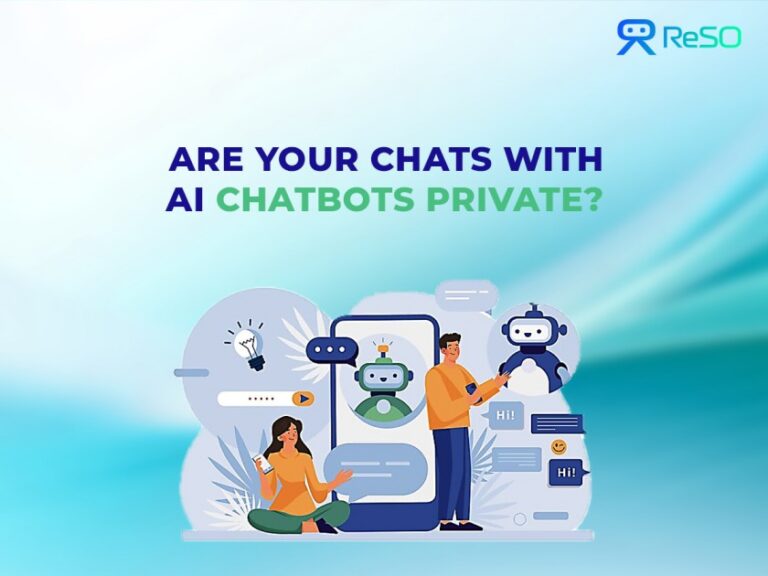
Your conversations with AI chatbots, whether you’re asking about college essays, customer support, or confidential work projects, aren’t as private as you might think. A lot of what you share is stored, analysed, and repurposed in ways most users do not realise. Even deleted chats may not be gone for good.
You’re chatting with a machine, yes. But that machine is fed and trained on your conversations, your uploads, your location, your device. Some providers collect voice recordings from AI assistants powered by speech-to-text. That’s a lot of context for these systems to learn from, and a serious privacy challenge for anyone expecting confidentiality.
The scale of the risk is no longer theoretical. Courts have already ordered AI providers to preserve chat logs for ongoing investigations, overriding standard retention policies and capturing even “deleted” sessions in legal holds. In a 2026 survey of security leaders, 68% of organisations reported data leaks linked to AI tools, while fewer than a quarter had dedicated AI data‑security policies in place. In other words, most companies are already seeing AI‑related exposure long before they have proper governance. Together, these statistics make one point clear: you need AI data governance in place before the first incident, not after.
Key learnings:
- AI chats are not just conversations. Prompts, uploads, metadata, feedback, and voice inputs can all become part of the data trail.
- Deleted chats may disappear from your view, but that does not always mean immediate deletion from backend systems.
- Consumer-tier and enterprise-tier AI tools do not offer the same privacy protections.
- Sensitive inputs create the biggest risk, especially customer data, source code, legal details, financial information, and internal strategy.
- Most AI leaks come from everyday behaviour, not sophisticated attacks.
- Businesses need clear rules on approved tools, data classification, vendor contracts, employee training, and AI-specific incident response.
- The safest approach is to treat every AI input as a potential data disclosure.
What conversations are being collected?
The providers behind major AI products can collect a wider range of data than most users realise.
Text conversations:
Prompts, responses, edits, follow-up questions, and feedback may be stored to improve product performance, monitor misuse, or train future systems, depending on the provider and your settings.
Files, documents, and images:
PDFs, spreadsheets, screenshots, presentations, images, and other uploads may be processed and retained. On consumer plans, this can create risk when people upload contracts, customer data, financial information, or internal work documents.
Location and device data:
Metadata such as approximate location, browser, device type, operating system, IP address, and usage patterns can help providers understand how the product is being used.
Voice recordings:
Voice-enabled AI tools may capture audio recordings, transcripts, and related interaction data to improve speech recognition and assistant performance.
Each data point may look harmless on its own. Together, they create a detailed picture of what you ask, what you upload, how you work, and which context you give the system, and is layered together to make AI “smarter.” It also means private inputs become part of a massive data pool whose boundaries you do not control.
Why are they collecting all this data?
Official logic is that AI models need continuous learning and retraining on fresh user data to improve accuracy, relevance, and brand safety. More real-world conversations produce better natural language understanding and better answers.
Operational reality is that your conversations become training material. They are anonymised on paper, but anonymisation of conversational text is notoriously leaky and hard to fully clean. Which means that names, account numbers, code snippets, and client details tend to survive the stripping.
This is where the risk begins. The more sensitive or proprietary the input, the more important it becomes to know how the provider handles, retains, and reuses that data.
Are deleted chats really deleted?
This is the murkiest layer. In many cases, “delete” only removes the chat from your visible history. The underlying data may still exist on backend systems for a period of time, especially if it is needed for compliance, safety reviews, abuse monitoring, legal processes, or system backups.
That is why deleted does not always mean immediately erased. A legal hold, investigation, or retention requirement can override standard deletion timelines. That’s the real privacy gap: you can delete from your screen, but you can’t guarantee deletion from every server layer. The only certainty is that once data leaves your device, you lose control over when and whether it’s truly gone.
How Big Is the Risk? AI-Related Breaches Are Exploding
In a 2026 survey of security leaders, 68% of organisations reported data leaks linked to AI tools but only 23% have proper AI data security policies in place. AI-adjacent breaches expose confidential chats, intellectual property, customer data, and internal communications. As AI moves deeper into HR, sales, and software development workflows, the attack surface widens.
Real-world incidents worth studying
Some cases that shaped the current governance conversation:
Samsung (April 2023):
Engineers at Samsung Semiconductor pasted proprietary source code and internal meeting notes into ChatGPT to debug and summarise. Those inputs were processed on OpenAI’s consumer tier, so the data entered OpenAI’s servers and at that time could flow into training data. Samsung banned generative AI on internal devices within weeks and began building an internal equivalent. The lesson: the cost of one careless paste is measured in years of IP leakage, not in the five minutes the engineer saved.
Air Canada chatbot ruling (February 2024):
A Civil Resolution Tribunal found Air Canada liable for refund policies that its chatbot fabricated during a grieving passenger’s query. The airline argued the chatbot was a “separate legal entity.” The tribunal disagreed and Air Canada paid out. The governance takeaway: your chatbot’s answers are your statements, and “the AI said it” is not a legal defence. Hallucinated policy becomes binding policy when a customer acts on it.
OpenAI data retention order (May 2025):
A federal court ordered OpenAI to preserve all ChatGPT output logs, including deleted chats during the New York Times vs. OpenAI lawsuit. That obligation ended on September 26, 2025, and OpenAI returned to normal retention practices. Some historical data from that period remains securely stored for legal purposes. Enterprises with ChatGPT Team/Enterprise subscriptions have contractual data-retention controls, but those can be overridden by court orders. The takeaway: vendor privacy commitments exist inside a legal system that can preempt them, and procurement teams should price that legal risk into their contracts.
Meta AI agent data leak (March 2026):
Meta’s internal AI agent instructed an engineer to perform tasks that exposed sensitive user and corporate data to multiple engineers for two hours. The AI provided a solution the employee executed, making confidential information accessible internally. Meta verified the leak but stated no user data was mishandled. The incident triggered a major internal security alert and highlighted a new risk: AI agents can make harmful recommendations that employees trust and execute. The governance lesson: AI agent instructions are as dangerous as direct human commands, and organizations need oversight on what AI tells employees to do.
Each incident shares a pattern where the technology behaved exactly as documented, and the organisation either misread the documentation or did not have governance that anticipated the edge case.
What does this mean for you and your business?
Whether you are a consumer or an enterprise customer, understanding the landscape is non-negotiable.
- Consumers: Rethink what you share in AI chats. Avoid personal identifiers, financial details, medical history, and genuinely sensitive discussions unless you are confident about the privacy terms.
- Businesses: Teams using AI chatbots need data governance policies that specify what can and cannot be pasted, how outputs are stored, and how usage maps to GDPR, CCPA, HIPAA, or sector-specific rules.It’s worth pairing this with tracking AI search traffic in GA4 to see how these platforms handle your brand on the other side.
- Employees: Sales, HR, engineering, and executives should be trained on AI privacy risk and disclosure norms. “I didn’t know” is the most common root cause of the most expensive leaks.
How Providers Are Responding (And Where They’re Falling Short)
Major providers have introduced privacy controls like opt-out switches for data usage, stricter permissions, and anonymisation tools. OpenAI’s usage policies let paid-plan customers disable training use. Google has increased provenance transparency to clarify where AI answers come from and how data is used.
Despite progress, enforcement and usability remain obstacles. Privacy policies are often complex or vague. Opting out can reduce feature quality. And the sheer volume of daily inputs makes total protection near-impossible even with good intent.
Provider comparison: how the big three handle your data
The differences matter, and they do not show up clearly in marketing pages. The controls you actually get depend on tier.
| Dimension | OpenAI (ChatGPT / API) | Anthropic (Claude) | Google (Gemini) |
|---|---|---|---|
| Default consumer-tier training use | Chats are used for training unless you opt out in settings | Claude.ai chats are not used for training by default (as of 2026) | Gemini chats can be reviewed by humans and used for improvement, unless you disable activity |
| Data retention on the consumer tier | 30 days for deleted chats; indefinite under current legal hold | 30 days; longer if flagged for Trust & Safety review | Up to 72 hours for short-term storage; up to 18 months if activity is on |
| Enterprise tier (Team/Enterprise/API on-demand) | Zero data retention option, no training on business data, SOC 2 Type II | Claude Enterprise: zero training, SOC 2 Type II, configurable retention | Gemini for Workspace: no training on business data, enterprise-grade controls |
| Regional controls | US/EU data residency on Enterprise, limited to consumer | US/EU data residency on Enterprise | GCP-standard regional controls; EU-specific Gemini for Workspace |
| Training data opt-out for consumer | Yes. Settings → Data Controls → “Improve the model for everyone” off | Default off | Activity setting in “My Activity” affects retention and review |
| Breach disclosure history | March 2023 chat history bug; disclosed within days | No major public incident as of 2026 | Multiple Google-wide disclosures governed by enterprise contracts |
The most common mistake enterprises make is they assume that consumer-tier protections match enterprise-tier protections and in reality, they do not. If you have SOC 2, HIPAA, or GDPR obligations, you need the enterprise contract with zero-retention and no-training terms, and you need to confirm it in writing, not in a settings screen.
A data governance framework for B2B AI use
A working AI governance programme covers five areas. This is the minimum and heavily regulated sectors may need more.
- Approved tools list:
Keep one canonical list of which AI tools that employees are allowed to use. Map each tool to the type of data it can handle: public content, internal data, or client-confidential data. Anything not on the list should be treated as prohibited by default. Shadow AI adoption, employees using unapproved tools, is the single largest source of leakage incidents.
- Data classification and input rules:
Give employees a short rule for what should never go into AI tools. For most teams, that means no PII, PHI, unreleased financial data, client-identifying details, unreleased product code, M&A information, or legal matter specifics.
- Contract and tier discipline:
Do not treat every AI plan the same. For approved business tools, procurement should confirm whether data is used for training, how long it is retained, who owns inputs and outputs, and how quickly the vendor reports breaches. SOC 2 Type II and ISO 27001 evidence should also be checked.
- Employee training with practical scenarios:
Abstract training, like saying “Be careful,” is not enough. Training should show real examples, such as whether an employee can paste a customer support ticket into an AI tool, what redaction means, and when human review is required.
- AI-specific incident response:
AI leakage is different from a typical breach. The data may sit with a model provider, enter review systems, or become difficult to fully remove. Your response plan should include vendor contacts, escalation steps, legal review, and clear internal ownership.
Risk matrix by company size and sector
AI privacy risk is not the same for every company. A freelancer, a 50-person SaaS team, and a regulated enterprise will not need the same level of governance.
Solo operators and micro-teams:
Lowest absolute risk but highest unit risk per incident. One pasted client file from a freelancer can end the client relationship. The baseline is to use approved business accounts, avoid sensitive inputs, and keep written rules.
SMBs (10-200 employees):
Shadow-AI risk is highest in this band because the security team is small and enforcement is patchy. The baseline is to have an approved tools list, sanctioned enterprise tier for AI that handles internal data, and quarterly training.
Enterprise (200+ employees):
Legal and compliance risk becomes the bigger issue. The baseline is to include full DPIA (Data Protection Impact Assessment) for each AI system, DLP rules that flag pasted PII, SSO-enforced tenant isolation, and formal vendor risk management.
Sector overlays also matters. Financial services, healthcare, and legal teams face stricter obligations around sensitive data, PHI, client communications, and privileged information. In these sectors, consumer-tier AI usage for client-facing or confidential work is not a productivity shortcut. It is a compliance risk.
The practical test is simple: would your AI usage still look defensible if a regulator, auditor, or client reviewed it tomorrow?
What you can do now
You cannot afford to wait for regulation or perfect policies. Take control with these practical safeguards.
- Read the terms of service carefully: Know what data is collected and how it is used, especially the training-use clause.
- Opt out where possible: Many platforms let you disable data collection or model training on inputs.
- Limit sensitive inputs: Don’t feed personal, financial, medical, or secret info into AI tools unless you are confident in the encryption and the tier.
- Use enterprise AI platforms with strong privacy features: Dedicated private environments, zero-retention contracts, and regional residency.
- Use on-prem or private cloud for highly sensitive data: Isolated deployments eliminate shared-infrastructure leak paths.
- Educate your teams continuously: Employees need to know the boundary between “AI is helpful” and “AI is a disclosure surface.”
The future of AI privacy
AI privacy is moving in two directions at once: stricter regulation and better privacy-preserving technology.
Regulators are catching up. The EU AI Act demands transparency, data minimisation, and human oversight. US state-level privacy laws re also expanding how companies must handle consumer data and automated decision-making.
Technically, federated learning is maturing; the model goes to the data rather than the data going to the model. Differential-privacy techniques add statistical noise that prevents re-identification. Provenance standards like C2PA attach verifiable trails to content, reducing misinformation and abuse.
These are important developments, but they are not a complete safety net yet. Many protections are still maturing, and most are not available in standard consumer AI tools. For now, the practical rule remains the same: be careful with what you share, understand the platform you are using, and treat AI inputs as data disclosures.
Why privacy matters beyond compliance
Protecting chat privacy is not just a legal checkbox. It is about trust: user trust, customer trust, employee trust. Leaks shatter brand reputation quickly and severely. And the broader AI ecosystem depends on users feeling safe enough to engage meaningfully. If privacy fears drive underuse, the transformative potential of AI dims.
Your AI chats are data. They help build smarter systems and expose risks you must understand. Don’t assume deletion means deletion. Don’t assume all providers respect privacy equally, or that policies will not change with a court order. Be informed, be deliberate, and treat your AI conversations like any other digital footprint you don’t fully control.
ReSO helps teams measure AI visibility, track brand mentions and citations, and uncover the sources influencing AI-generated answers. Book your call to learn how your brand is being surfaced across today’s AI discovery platforms.
Frequently Asked Questions
Are AI chat conversations permanently erased once deleted?
Not necessarily. Deletion usually removes the chat from the user’s visible history, but backend copies may persist for security, legal compliance, or service improvement. Retention depends on provider and tier, and legal requirements.
What types of data do AI chatbots collect during conversations?
AI chatbots can collect more than typed messages. They may process prompts, responses, uploaded files, images, device data, browser details, approximate location, usage patterns, and voice recordings in voice-enabled products. Usage varies by provider and by whether training-use is on or off for your tier.
What privacy risks should enterprises consider when using AI chatbots?
The biggest risks are sensitive data leaving company control, employees pasting confidential information into unapproved tools, unclear retention policies, and compliance exposure under laws such as GDPR, HIPAA, or CCPA. Approved tools, access controls, employee training, and contract-level privacy terms are the minimum safeguards.
How can businesses reduce AI privacy risk?
Start with a clear approved-tools list, simple input rules, and enterprise-tier platforms for business data. Teams should know what cannot be pasted into AI tools, when redaction is required, and who owns review and escalation if sensitive data is shared by mistake.