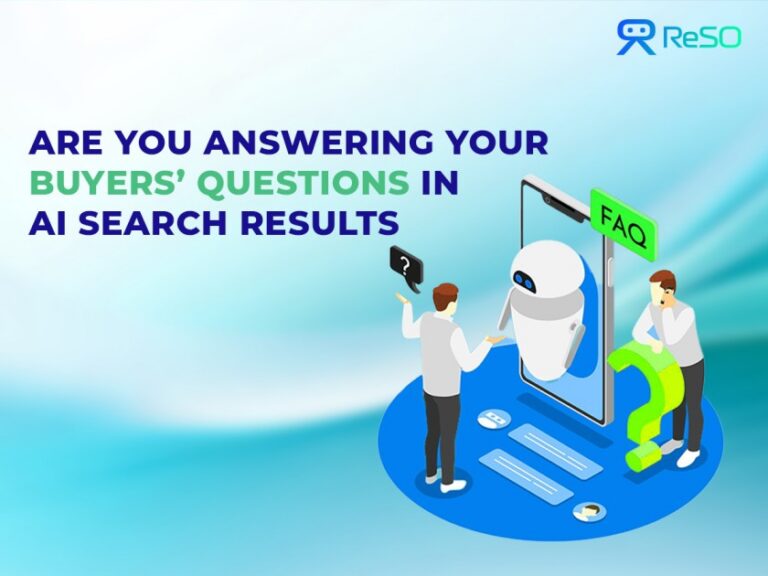
Curiosity is the new currency in search. AI engines like ChatGPT, Perplexity, Bing Copilot, and Google AI Mode answer questions directly rather than just pointing users to links. The brands cited in those answers are the ones delivering clear, strategic, question-driven content.
If your content isn’t built around the questions your audience actually asks, you are invisible to the new generation of search. And it is a multi-platform problem, not just Google visibility alone. Each AI platform assembles answers differently, drawing from different sources, trust signals, and content formats. Optimizing for one while ignoring the others leaves two-thirds of the AI visibility engines underserved.
As this becomes a primary research channel, it becomes important to understand what that restructure looks like in practice, who is already doing it well, where to source the buyer questions your content should answer, how to mark up those answers so machines can extract them, and how to evaluate your existing library against the standard of AI citation systems now.
Key takeaways
- AI search visibility starts with answering real buyer questions, not targeting isolated keywords.
- Brands that consistently appear in AI-generated answers structure content around a single question and answer it clearly.
- Sales calls, support tickets, Reddit, Quora, G2 reviews, site search, and AI conversations are valuable sources of buyer questions.
- Prioritize content opportunities using volume, strategic fit, and content gap rather than search volume alone.
- Clear page structure, direct answers, FAQ sections, and schema markup make content easier for AI systems to understand and surface.
- Regular content audits should focus on answer placement, source credibility, section structure, schema validation, internal linking, and freshness.
- Long form content performs best when it answers the primary question and the related follow-up questions buyers are likely to ask next.
- Original insights, case studies, first party data, and authentic participation in online communities strengthen visibility across AI-driven discovery channels.
Who is nailing this approach
A few brands consistently show what question-led content looks like in practice for their respective categories. Studying what they share can teach more than any generic framework.
NerdWallet
NerdWallet’s content is built around specific user decisions: how to choose a credit card, how to compare loan options, what fees to watch for, and which product fits a given use case. NerdWallet shows up in AI-powered responses across every major engine because AI tools gravitate toward structured, specific answers that address intent head-on. Their revenue grew 23% year-over-year despite, or because of, AI’s takeover of search.
HubSpot
FAQ sections, plus a direct-answer format, give HubSpot a dominant presence in featured snippets and AI summaries. Its pages often answer the core question early, then expand with examples, definitions, templates, and related questions. This content makes them approachable and builds authority in the category. Answers sit at the front of each page, not buried after 300 words of context-setting. For B2B marketers, HubSpot is the working textbook on FAQ discipline paired with schema.
Zapier
Zapier’s strongest content is practical and procedural. Step-by-step guides and Q&A content make it the go-to for AI assistants and traditional searchers. Their practical how-to emphasis matches conversational AI perfectly. AI engines want content like this that solves specific, complex problems precisely and in order.
The common pattern across all three is that they picked a specific user question and made the page’s entire structure revolve around answering it, cleanly enough that an AI model can extract the answer in one retrieval pass without needing to reason across paragraphs.
Why this matters for your B2B brand
AI search engines pull answers from across the web, synthesizing relevant pieces. If your content isn’t structured to answer questions clearly and progressively, you aren’t in the pool. You may still rank in traditional search but you won’t show up inside the AI-generated answer. Blogs and news content that rely on neutral, factual framing account for ~73% of citations in AI-generated answers.
What does this mean in practice is, that your chance of appearing in AI citations rises significantly when content is organised around the specific questions buyers ask, rather than only on the keywords SEO tools surface. Even when users don’t click through, exposure and authority build up because the citation itself plants the brand name. Trust and expert positioning then open doors to deeper engagement and eventual conversion, often weeks later via branded search rather than the original AI-sourced session.
How B2B brands should approach this
The operating model is these three things done consistently:
- Start with real questions:
Every content piece begins with a question your audience is actually asking. Sources can be customer conversations, sales-team intelligence, industry forums, community threads, and your own site’s search log. Never start with a keyword and reverse-engineer a question around it because the result reads like marketing to buyers and extracts badly for AI.
- Use clear headings, bullet points, and concise answers:
AI search favors chunked content. Each section answers one question and stands alone if extracted. Summaries that cut to the chase beat verbose explanations every time.
- Add FAQ sections and schema markup:
Structured data is how AI maps the answers on your page. FAQPage, HowTo, and Article schema are the important translation layer between your prose and the retrieval systems that decide whether to cite you.
Finding your high-impact buyer questions
A content strategy starts from the questions buyers actually want answers to, not the questions marketers wish they asked. Sourcing real questions is a cross-functional research method that draws from six concrete surfaces, each biased in its own direction.
- Sales call transcripts:
Every discovery call contains the questions a prospect is willing to ask a human but won’t submit in a form. Transcription tools like Gong, Chorus, and Fathom make this searchable. Sort by deal stage and persona for the sharpest signal.
- Support tickets:
Post-purchase questions reveal what buyers worry about when evaluating similar products. Retention content built from support themes often doubles as excellent acquisition content because it answers the questions competitors’ prospects are also asking.
- Reddit and Quora threads in your category:
Filter for threads with 50+ comments as those are the questions the market finds important. Note the phrasing as it is often more natural than the language your own marketing uses, and AI retrieval favors natural phrasing.
- G2 review Q&A sections:
Prospective buyers literally ask current customers questions in public. The most-upvoted questions are your prompt backlog.
- ChatGPT conversation logs (if available):
Teams with AI-assisted sales workflows sometimes have visibility into anonymized prompt patterns. These are the closest to real AI query behavior you can get.
- Your site search queries:
Internal search is an underused source, and it reveals the questions existing readers couldn’t find answers to on your own site, which acts as a direct inventory of content gaps.
Once you have the raw questions, score each from 1 to 5 across three dimensions:
- Volume: How often does this question appear across sources?
- Strategic fit: Does the answer naturally connect to your product’s value, or is it only adjacent?
- Content gap: How well does your existing content answer it today? A low score means it is already covered. A high score means there is a clear opportunity.
A score of 1 means it is already well covered, while a score of 5 indicates a significant opportunity. Multiply the three and then prioritize the top 20-30 for primary content investment and leave the rest as a quarterly backlog.
A realistic volume estimate: most B2B SaaS categories produce 200-500 distinct buyer questions across the research through evaluation journey. Of those, 40-60 matter enough to build primary content for. Thirty dedicated question-answer assets are a realistic quarterly programme for a four-person marketing team. Smaller teams should prioritise twelve and do them properly rather than thirty done thinly.
Schema Markup for AI Answerability
Schema helps search and AI systems understand what your page contains. It gives structure to the answers, steps, definitions, and sections already visible on the page.
Three schema types are especially useful: FAQPage for genuine Q&A sections, HowTo for step-by-step content, and Article with Speakable for long-form content that should be easier for voice AI systems to extract and read aloud. When paired with clear, question-driven content, schema helps AI systems interpret, categorize, and surface information more effectively.
FAQPage schema
Use for genuine Q&A sections: questions you actually answer on the page, written in natural language, with complete answers. Google explicitly rewards FAQPage schema on pages whose visible content matches the marked-up pairs. Misuse of this degrades the signal.
{
“@context”: “https://schema.org”,
“@type”: “FAQPage”,
“mainEntity”: [{
“@type”: “Question”,
“name”: “How much does your platform cost?”,
“acceptedAnswer”: {
“@type”: “Answer”,
“text”: “Pricing starts at $49/month per user for the Team plan, with Enterprise custom pricing available for 50+ users. A 14-day free trial is available on all plans.”
}
}]
}
HowTo schema
Use for procedural content: step-by-step instructions that genuinely need to be followed in order. Each step should be meaningful on its own. For “how to” queries, this structure makes the content easier for search and AI systems to understand, summarize, and surface.
{
“@context”: “https://schema.org”,
“@type”: “HowTo”,
“name”: “How to configure SAML SSO with Okta”,
“step”: [
{ “@type”: “HowToStep”, “position”: 1, “name”: “Create SAML app in Okta”, “text”: “In the Okta admin console…” },
{ “@type”: “HowToStep”, “position”: 2, “name”: “Configure ACS URL”, “text”: “Paste your ACS URL into…” }
]
}
Article with Speakable
Use Article with Speakable for long-form content and voice-friendly summaries. Speakable markup helps identify sections that can be clearly read aloud by voice assistants, making it easier for voice AI systems to understand and surface key information from the page.
{
“@context”: “https://schema.org”,
“@type”: “Article”,
“speakable”: {
“@type”: “SpeakableSpecification”,
“cssSelector”: [“.summary”, “.key-takeaways”]
}
}
The three schema types work together. FAQ marks the direct-answer blocks, HowTo marks the procedural blocks, and Article with Speakable marks the summary blocks. A single page can carry all three when the content genuinely supports them.
Validation is also essential. Google’s Rich Results Test and Schema.org validator catch 90% of the mistakes that kill schema effectiveness. Common failures include FAQ schema with answers that don’t match the visible text, HowTo schema missing required “step” fields, and Article schema without a valid author entity. Schema that fails validation signals to retrieval systems that your structured data is untrustworthy.
Platform-specific nuances matter too:
- ChatGPT’s retrieval leans heavily on clear natural-language headings and direct answers, with schema as a supporting signal.
- Perplexity weights citation clarity and primary-source linking.
- Google AI Mode reads the full schema graph and penalises misalignment between markup and visible content.
- Bing Copilot combines the schema signal with the traditional Bing ranking layer.
Optimising for all four means the same structural discipline of clear questions, direct answers, and validated schema and not four separate markup strategies.
Is your content AI citation ready? Six audit checks
Run this audit on your highest value pages every quarter. These six checks help identify which pages are ready for AI citation and which need work.
- First, check whether the page gives a direct answer in the first two paragraphs. AI systems need to identify the core answer quickly. If the answer is buried too deep, another page with a clearer opening may be easier to cite.
- Second, review the claims. Important claims should be backed by a credible source, original data, or clear evidence. Unsupported claims are harder for AI systems to trust and reuse.
- Third, check the section structure. Strong pages use clear H2s, direct answers beneath each section, and supporting detail below. Each section should make sense even when read on its own.
- Fourth, validate the schema. Use FAQPage for Q&A sections, HowTo for procedural content, and Article with author information for long form pages. The markup should match the visible content on the page.
- Fifth, review internal links. A page with no internal links can look disconnected from the rest of your site. Add links from two to four relevant pages where the connection is natural.
- Sixth, check freshness. Update old stats, confirm links, add newer examples, and remove outdated claims. A simple refresh can make a strong page more useful again.
Pages that clear all six checks are worth keeping and strengthening. Pages that fail two or more need a decision: update, merge, noindex, or retire. Prioritize pages with strong organic traffic, clear pipeline influence, or strategic value. Traffic pages with low business impact should not take the same effort as pages that help buyers evaluate, compare, or convert.
What This Really Means for Your B2B AISO
Traditional SEO focused heavily on keywords and backlinks. Today, visibility depends on answering a web of buyer questions with fresh, authoritative, user-focused content. AI-driven discovery is shifting attention from ranking positions to being cited as a trusted source, changing how teams approach content planning, writing, and site architecture.
Google’s AI Mode data shows average search sessions lasting over four minutes, double the traditional search baseline. Longer sessions indicate that users want deeper, more complete answers. Google AI Mode also breaks complex, conversational queries into multiple sub-queries.
Your content needs to answer the surface question and the deeper related questions underneath it, because the same buyer who asked the opening question will follow up inside the same AI session. Queries are running 2-3× longer, more specific, and more conversational than before. Brands that can anticipate depth of intent are more likely to earn visibility throughout the buyer’s research journey.
Applying this to your content strategy
Long-form, question-driven content that layers answers. Broad question first, then the specific sub-answers. Modular, chunkable sections, each answering one core question, improve the chance of being sourced. AI retrieval wants precise, bite-sized answers, not monolithic walls of text. Original, non-commodity content beats rehashed explainers every time. Google AI Mode favours trustworthy, unique information and downranks content it can detect as generic synthesis.
Engage on community platforms like Reddit, Quora, and Stack Overflow with authentic contributions. Community content dominates AI citations, sometimes more than top organic results, and a brand absent from these surfaces is systematically underweighted. Not every community source carries equal weight, and the way AI models balance Wikipedia and Reddit decides which one earns the citation. Back content with facts and clear outcomes like case studies, statistics, and actionable steps as they beat vague promises. Every claim should either trace to a primary source or declare itself as original data from your own team.
Why B2B marketers should care
B2B buyers are already using AI tools to research categories, compare vendors, and narrow their options before they ever speak to sales. Your content is competing to be cited in the answer buyers see first. If your content is not built for AI visibility, you may lose qualified demand before it reaches your analytics. The shift is not about creating more content. It is about making your best content clearer, more useful, and easier to cite.
AI systems reward direct answers, structured sections, credible sources, and fresh examples. Each sharper FAQ, stronger section, and better supported claim improves the chance that your brand appears in the buyer’s research journey. The playbook is simple: show up with clear, question-driven content; structure every resource with answerability in mind; update, monitor, and participate where the conversation lives.
ReSO helps B2B brands improve visibility across AI driven discovery channels.Book your 1:1 call with us.
Frequently Asked Questions
How do AI search engines decide which brands to cite?
They look for content that clearly matches the user’s question, explains the answer directly, and shows trust signals through structure, sources, and freshness. Ranking helps, but answer quality and extractability matter more.
What role do community platforms like Reddit and Quora play?
They help AI systems understand real buyer sentiment, peer opinions, and practical use cases. Community discussions often shape how AI answers comparison, evaluation, and “best fit” questions.
How should B2B brands find the right buyer questions?
Start with sales calls, support tickets, site search, G2 reviews, Reddit, Quora, and customer conversations. These sources reveal how buyers actually phrase problems, not just how marketers describe them.
What makes content easier for AI systems to cite?
Direct answers, clear headings, credible sources, validated schema, internal links, and fresh examples. Each section should answer one core question clearly enough to stand on its own.