For years, B2B marketing teams built their strategies around the assumption that if a company generated enough leads, revenue would eventually follow. The goal was to attract as many prospects as possible and move them through a funnel that converted a portion of them into customers.
So teams invested in inbound content engines, paid acquisition campaigns, gated assets such as whitepapers and webinars, and complex lead scoring models. Success was evaluated through MQLs, cost per lead, and overall pipeline volume.
However, many companies discovered a problem. Marketing could generate thousands of leads, but sales teams still struggled to convert them into revenue. The numbers looked good on dashboards, but they did not always reflect buying intent, sales readiness, or account quality.
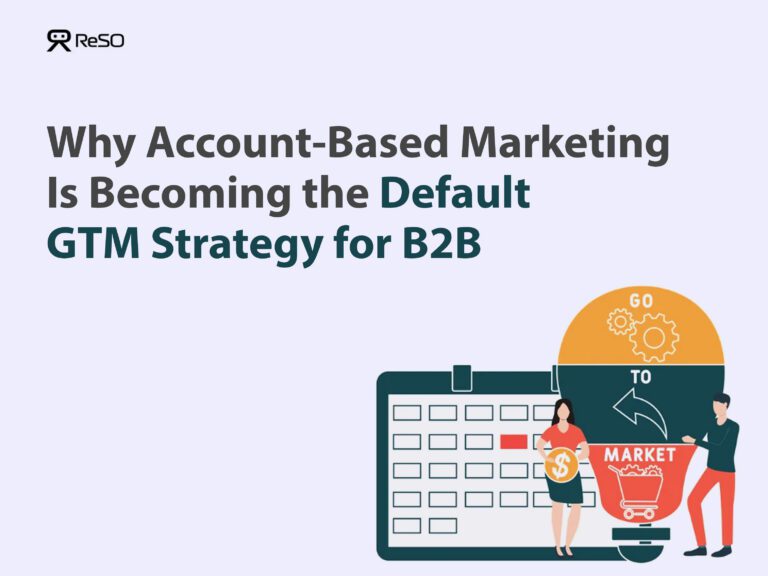
B2B buying decisions happen inside companies, across teams, committees, budgets, priorities, and internal timelines. That is why account-based marketing (ABM) is becoming a default go-to-market strategy for B2B companies. It helps marketing and sales focus on the accounts that matter most, understand the people involved, and build campaigns around revenue potential instead of lead volume.
Why did traditional GTM focus on lead volume?
Traditional B2B marketing relied on a funnel model that prioritised scale. If enough prospects entered the funnel, a predictable percentage would convert into customers. As a result, most marketing teams focused on expanding the top of the funnel by increasing reach, traffic, registrations, downloads, and contact collection.
Content marketing became a lead generation engine, paid campaigns were optimised for form fills, webinars and gated reports helped teams collect prospect information. Marketing technology platforms then scored these leads and passed them to sales.
For a period, this model seemed effective. Lead counts increased, pipelines expanded, and marketing teams could demonstrate activity and reach. Soon, many organisations began to notice that the leads entering the funnel did not match the ideal customer profile.
Some contacts had interest, but no authority to make decisions. Others engaged with content without any active buying need. This made lead volume a useful signal, but an incomplete GTM strategy for modern B2B teams.
How do B2B buying decisions actually work?
B2B buyer decisions are fundamentally different from consumer transactions. Instead of a single buyer making a quick decision, most B2B purchases involve multiple stakeholders of the same company. The decision moves through a buying committee, where different stakeholders evaluate the solution based on their own priorities, risks, and success metrics.
A typical B2B buying group can include finance, IT, operations, procurement, business users, and senior leadership. Each team looks at the purchase from a different perspective.
Finance teams evaluate ROI, budget fit, and payback period, while technical teams review integration, security, data flow, and implementation effort. Operational leaders look at usability, adoption, and workflow impact; and procurement teams assess vendor risk, compliance, pricing, and contract terms. Because these priorities differ, closing a deal requires alignment across several individuals.
This makes stakeholder alignment a central part of every B2B deal. The account needs shared confidence before the purchase moves forward. A lead may show interest, download a report, or attend a webinar, but the actual deal depends on how many people inside the account understand the value, trust the vendor, and agree on the business case.
This is where traditional lead-focused marketing starts to feel limited. It captures individual engagement, while B2B revenue depends on account-level intent, buying committee influence, and internal consensus.
Why do marketing and sales often misalign in B2B GTM?
The difference between leads and accounts creates one of the most common structural problems inside B2B go-to-market teams. Marketing teams are generally responsible for lead generation. Sales teams, on the other hand, are responsible for closing accounts. Because these units of measurement differ, these two teams often operate with different definitions of success.
A marketing team may hit its quarterly MQL target, while the sales team still spends hours qualifying contacts from accounts with low buying intent, unclear budget, limited urgency, or weak stakeholder alignment. Over time, this creates friction across the GTM motion.
Marketing sees campaign activity, engagement, and demand signals, while sales sees additional qualification work and limited account readiness. The pipeline may grow in size, while pipeline efficiency remains weak because a large number of individual contacts can enter the system without account-level readiness.
Account-based marketing helps solve this by providing a shared operating model where marketing and sales align around target accounts, buying committees, engagement quality, and revenue potential.
The change towards account-level thinking
Account-based marketing changes the unit of focus from individual leads to high-value accounts. Teams start prioritising companies with strong revenue potential, clear fit, and meaningful buying signals.
This changes the central question for marketing and sales. The focus moves from reaching more people to identifying the right organisations, understanding their buying committee, and building influence across the account.
Once target accounts are defined, marketing and sales work together on account research, segmentation, messaging, and engagement strategy. They study the company’s industry context, growth priorities, pain points, tech stack, trigger events, and decision-making structure.
This gives teams a sharper way to personalise campaigns. Outreach, content, ads, and sales conversations can reflect the account’s priorities instead of relying on generic lead nurture journeys.
Account-level thinking helps GTM teams use their time and budget with more intent. Resources go toward accounts with higher fit, stronger buying intent, and better revenue potential.
Why does ABM fit the economics of B2B revenue?
ABM is gaining momentum because revenue in many B2B markets comes from a smaller set of high-value accounts. In enterprise and mid-market segments, one strong customer can influence pipeline targets, quarterly revenue, and long-term growth.
A single enterprise deal can shape an entire quarter. Multi-year contracts, renewals, upsells, and cross-sells can also become a major source of revenue after the first deal closes.
This changes how marketing teams think about efficiency. The focus moves toward building relationships with accounts that have strong lifetime value, a clear fit, and expansion potential.
Account-based marketing fits this revenue model because it helps teams concentrate time, budget, and messaging on the organisations most likely to drive meaningful growth.
How have AI and technology made ABM more practical?
Historically, account-based marketing required extensive manual effort. Teams had to research companies individually, identify stakeholders through networking, and coordinate outreach through direct conversations between marketing and sales.
Modern go-to-market technology has made this process significantly easier to execute and scale. Today, companies can identify which organisations are visiting their websites, track engagement of different stakeholders, and analyse signals indicating buying intent.
CRM systems, marketing automation platforms, intent data tools, website visitor tracking, and account intelligence platforms help teams understand which accounts are engaging, what topics they care about, and where they may be in the buying journey.
AI adds another layer to this. Teams can now analyse account signals faster, summarise company research, identify buying committee patterns, personalise messaging, and prioritise accounts based on fit, intent, and engagement.
This has made ABM more practical for companies beyond large enterprises. Smaller GTM teams can now run account-based motions with clearer data, better coordination, and more relevant outreach.
How has buyer research changed ABM adoption?
Another factor driving ABM adoption is the way modern B2B buyers conduct thorough research before they speak with a vendor. They learn through practitioner content, industry communities, peer recommendations, product comparisons, analyst insights, review platforms, and conversations with people they trust.
By the time they enter a sales conversation, many buyers already understand the category, compare different vendors, and have early opinions about which solutions feel credible.
This means marketing influence must happen earlier in the buying journey. Companies need to build credibility and familiarity within target accounts before a demo request, pricing conversation, or formal buying process begins.
Account-based marketing helps teams show up in the right places for the right accounts. It allows marketing and sales to shape perception, build trust, and create account-level engagement before the deal enters the pipeline.
Expert perspective: Paola Piccinno on ABM for B2B Founders
To understand how B2B founders can apply ABM practically, we spoke with Paola Piccinno, Fractional CMO and Global ABM Strategist, during the session “Account-Based Marketing Essentials: A 30-Minute Starter for B2B Founders.”
With more than 20 years of international marketing leadership across APAC, EMEA, Europe, and North America, Paola has helped scale-ups and enterprises build focused, insight-driven ABM programs without relying on large budgets or complex tech stacks.
In the conversation, she explains:
- How founders can stop chasing lead volume and focus on accounts that matter
- Why account selection is the foundation of every strong ABM motion
- How clearer ICPs help teams build sharper target account lists
- Why insight-led conversations create more relevance than surface-level personalisation
- How marketing supports sales through account intelligence, messaging frameworks, and timing cues
- What is nearbound as a GTM strategy
- How can nearbound build trust, shorten sales cycles, and improve win rates across key accounts
If you’re a B2B founder or GTM leader looking to sharpen your go-to-market strategy, this session is worth watching. Watch it here.
ABM works because it matches how B2B deals are actually won. Strong revenue opportunities come from focused account selection, relevant conversations, alignment between the buying committee, and trust across the people involved in the decision.
As buying journeys become more complex, B2B teams are treating ABM as a core part of their GTM strategy. It gives founders and revenue teams a clearer way to prioritise the right accounts, support sales execution, and build a pipeline with stronger revenue potential.